


Procedure
1. Turn off the ignition.
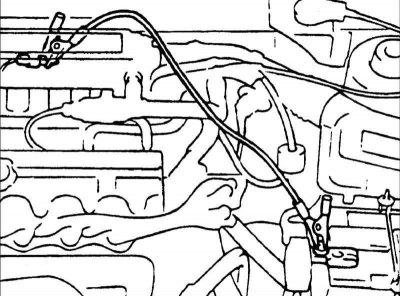
2. Using additional wires, apply voltage to the fuel pump connector and check whether the pump works or not.
Caution: To hear the fuel pump located in the fuel tank, remove the plug from the fuel filler neck.
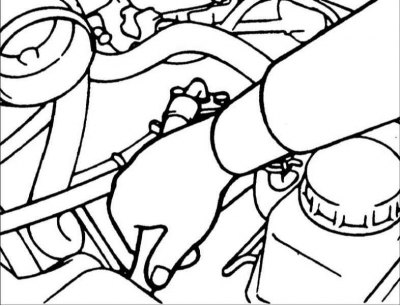
3. Clamp the fuel supply hose to determine if the fuel pump is creating pressure.
Checking the pressure generated by the fuel pump
1.. Remove the rear seat cushion and remove the fuel pump inspection panel.
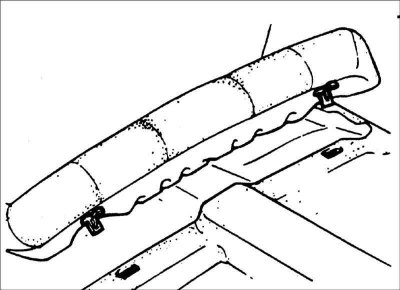
2. To relieve pressure in the fuel system, disconnect the fuel pump connector, start the engine and wait until it stops due to the fuel being used up from the fuel lines and fuel rail.
Caution! Before disconnecting the fuel lines, relieve the pressure in the fuel system, otherwise, fuel under pressure will leak out of the fuel system.
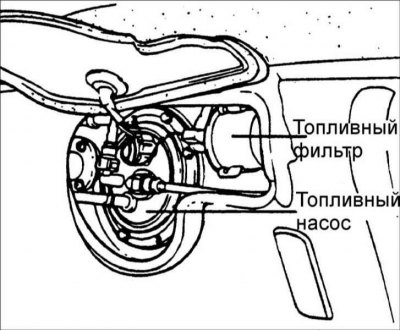
3. Disconnect the wire from the negative terminal of the battery and connect the fuel pump connector.
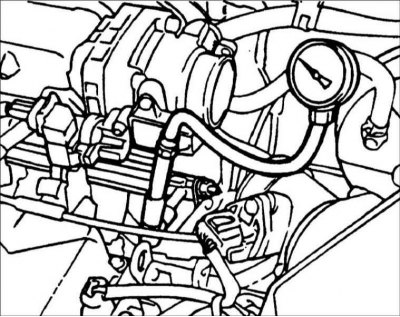
4. Connect the pressure gauge adapter (09353–24000, 09353–24100, 09353–38000) to the fuel filter and tighten the mounting bolt to the specified torque. Tightening torque: 25–35 Nm.
5. Connect the wire to the negative terminal of the battery.
6. Using additional wires, apply voltage to the fuel pump connector and check that there are no fuel leaks from the pressure gauge connections.
7. Start the engine and let it run at idle speed.
8. Measure the fuel pressure. Fuel pressure: 350 kPa.
9. If the measurements taken in steps 7 and 8 do not correspond to the required fuel pressure value, determine the cause and make the necessary repairs.
Condition | Probable cause | Method of elimination |
| Fuel pressure too low | a. The fuel filter is dirty. | a. Replace the fuel filter. |
| b. Leaks on the fuel return side caused by poor pressure regulator sealing. | b. Fix the leak or replace the fuel pump | |
| Fuel pressure too high | a. Fuel pressure regulator sticking. | a. Replace the pressure regulator. |
10. Stop the engine and after 5 minutes read the fuel pressure value on the pressure gauge, which should not change. If the fuel pressure has dropped significantly, determine the cause and make any necessary repairs.
Condition | Probable cause | Method of elimination |
| Fuel pressure decreases slowly after engine stop | Leaky fuel injector | Replace the fuel injector |
| Fuel pressure decreases very quickly after engine shutdown | Fuel pump check valve is open | Replace the fuel pump |
Relieve pressure in the fuel system.
Disconnect the hose and pressure gauge.
Cover the connection with a towel to prevent fuel splashing caused by residual pressure in the fuel line.
11. Relieve pressure in the fuel system.
12. Disconnect the hose and pressure gauge.
Warning: Cover the connection with a towel to prevent fuel splashing caused by residual pressure in the fuel line.
13. Replace the sealing ring on the end of the hose.
14. Connect the hose to the fuel line and tighten the union nut to the specified torque.
15. Check the fuel system for leaks.