
HyundaiBook.ru
Repair Chevrolet Repair Honda Repair Toyota Repair Land Rover Repair VAZ Repair Renault Repair Nissan
English Русский
Български
Беларускі
Український
Српски
Hrvatski
Română
Polski
Slovenský
Magyar
ArticlesSitemapContacts  


  Accent   Elantra   Getz   Grandeur   Sonata   Santa Fe   Tucson   Others
Elantra 1 (1990-1995, petrol) Elantra 2 (1995-2000, petrol) Elantra 3 (2000-2006)
  • Main
  • Elantra
  • J1 (1990-1995)
  • Power unit
  • Exhaust system
  • Forced crankcase ventilation system (PCV) — device and repair

Forced crankcase ventilation system (PCV) — device and repair (Hyundai Elantra J1)

0
Contents: Examination ⇓ Removal and installation ⇓
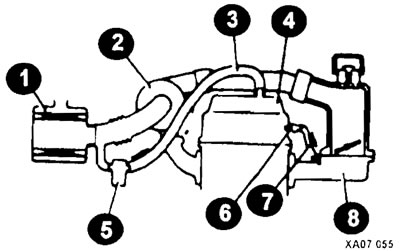
Main elements of the PVK system of…

Main elements of the PVK system of engines with fuel injection
1 - Air purifier;
2 - air duct;
3 - ventilation hose;
4 - cylinder head cover;
5 - oil separator;
6 - PVC valve;
7 - ventilation hose;
8 - intake manifold.


A closed crankcase forced ventilation system ensures the return of incompletely burned fuel (passing into the crankcase, bypassing the piston rings) back into the intake manifold to be re-burned with the air-fuel mixture.

Valve (known as the PVC valve) regulates the air flow into the manifold in accordance with the degree of vacuum in it. When the throttle valves are opened wide enough, the valve in question is fully open. However, at idle speed, with maximum vacuum in the manifold, the PVK valve reduces the air flow so as not to have an unnecessary effect on the small volume of mixture passing into the engine.

With the throttle valve fully open, with an increase in the volume of gas entering the crankcase and a decrease in the degree of vacuum in the manifold, the inflow through the PVK valve becomes insufficient. Under these conditions, excess vapors are sucked into the air purifier and enter the engine along with fresh air. A clogged valve or hose can cause uneven idle speeds, engine stops or low idle speeds, oil penetration into the engine and/or slagging and formation of oil deposits in the engine and air purifier. A leaky valve or hose can cause unstable idle speeds or engine shutdown.


Examination


The PVK is checked with the engine idling (after warming up).

Remove the PVC valve from its sleeve without disconnecting it from the hose. (Most valves are pressed into the sleeve, however some are threaded and screw into the sleeve.)

To check for vacuum, place your thumb on the end of the valve stem.
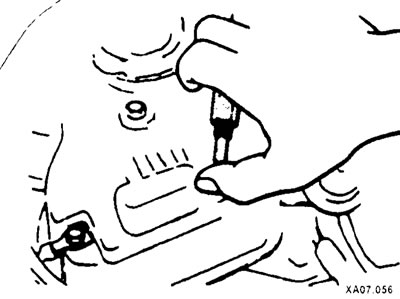
To check for vacuum, place your thumb…


If there is no vacuum, check to see if the hoses or pipes are clogged. If the pipes are clean, the valve is faulty.

With the engine off, remove the PVK valve, shake it, listening to the sound from the needle inside it. The absence of sound indicates that the needle is stuck and the valve needs to be replaced.

If the valve has a thread, it is recommended to use a thin wire, which is inserted into the valve (1) from the side with the thread, to check the movement of the plunger. If no movement is felt, the valve needs to be replaced.
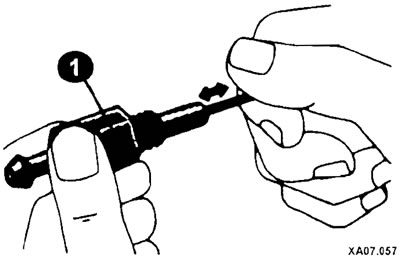
If the valve has a thread, it is…


Caution: An engine operated without crankcase ventilation may quickly fail. It is important to check and replace the PVC valve at regular intervals.


Removal and installation


Remove the PVC valve from the sleeve. Disconnect the hose from the valve. Note which side of the valve was inserted into the manifold.

Check the hose for cracks, kinks and blockages.

Check the pipe (to which the hose is attached) for blockage.

The normal functioning of the PVC system depends on the tightness of the engine. Check the PVC system in the following cases:
  • unstable engine idling, the causes of which cannot be attributed to a normal vacuum disturbance or a problem with the fuel supply;
  • air leakage through a leaky valve sleeve, oil pan gaskets, or even through the front and rear crankcase seals;
  • excessive contamination of the air cleaner with low mileage;
  • noticeable contamination of engine oil due to dilution with fuel long before the scheduled oil change.

Caution: Engines with severely worn valve rings and/or seals may experience blow-by so severe that the PVS system may not be able to cope with it.


The article is borrowed from an online resource [HyundaiBook]
This article is available at russian, bulgarian, belarusian, ukrainian, serbian, croatian, romanian, polish, slovak, hungarian
This article has been reviewed by: Konstantin Smirnov
Add to social network:

Previous
Elantra 1: Exhaust system
Next

General description of the fuel vapor prevention and exhaust gas toxicity reduction system
Fuel Evaporative Emissions Reduction System — Design and Testing
Exhaust Gas Recirculation (EGR) System — Design and Testing
General description of the exhaust system
Checking the suspension and condition of the exhaust tract
Replacing the exhaust system
We recommend other articles on the topic of Hyundai manuals:

Checking the crankcase ventilation system Hyundai Accent 3 (2005-2010)
Crankcase ventilation system Hyundai Getz (2002-2011)
Forced crankcase ventilation system Hyundai Sonata 4 (2001-2012, petrol)
Control of heating and ventilation system Hyundai Santa Fe 2 (2007-2012, petrol)
Fuel supply system — device Hyundai Tucson 1 (2005-2010)
Forced crankcase ventilation system Hyundai Matrix (2001-2010, petrol)

Link in different formats to this article

Visitor comments
No comments yet


How much will 18 + 36 ?


Elantra 3 (2000-2006) 
  • User manual
  • Control devices
  • Audio system
  • Starting the engine and driving
  • Faults en route
  • Maintenance and care
  • Technical information
  • Power unit
  • Gasoline engines
  • Diesel engines
  • Lubrication system
  • Cooling system
  • Fuel system (gasoline)
  • Fuel system (diesel)
  • Decreased toxicity
  • Ignition system
  • Transmission
  • Clutch
  • Mechanical gearbox
  • Automatic gearbox
  • Drive shafts and axles
  • Chassis
  • Car suspension
  • Steering
  • Brake system
  • Body
  • Exterior (external elements)
  • Interior (internal elements)
  • Air conditioning system
  • Electrical equipment
  • Equipment and devices
  • Headlights and lighting
  • Power devices
  • Electrical circuits
Elantra 2 (1995-2000, petrol) 
  • General information
  • Maintenance
  • Power unit
  • Engine repair
  • Cooling system
  • Intake and exhaust system
  • Fuel system
  • Transmission
  • Clutch
  • Manual gearbox
  • Automatic gearbox
  • Drive shafts and axles
  • Chassis
  • Front suspension
  • Rear suspension
  • Steering
  • Brake system
  • Body
  • Body elements
  • Electrical equipment
  • Equipment and devices
  • Electrical diagrams
Elantra 1 (1990-1995, petrol) 
  • General information
  • Introduction to the guide
  • Maintenance
  • Power unit
  • Minor engine repair
  • Engine overhaul
  • Lubrication system
  • Cooling system
  • Fuel injection system
  • Ignition system
  • Exhaust system
  • Transmission
  • Clutch
  • Manual gearbox
  • Automatic gearbox
  • Drive shafts
  • Chassis
  • Front suspension
  • Rear suspension
  • Steering
  • Wheels and tires
  • Troubleshooting
  • Brake system
  • Body
  • Body elements
  • Electrical equipment
  • Equipment and devices
  • Power devices
  • Heating and air conditioning
  • Electrical circuits
HyundaiBook.ru © 2018-2026 · Mobile version · Sitemap: EN BG BY UA RS HR RO PL SK HU · Administration · Site search · Hyundai owners Accent 1 · Accent 2 · Accent 3 · Elantra 1 · Elantra 2 · Elantra 3 · Getz · Sonata 3 · Sonata 4 · Santa Fe 2 · Tucson 1 · Tucson 2 · Matrix ·
This site uses cookies to optimize its functionality. By continuing, you agree to our terms.