
HyundaiBook.ru
Repair Chevrolet Repair Honda Repair Toyota Repair Land Rover Repair VAZ Repair Renault Repair Nissan
English Русский
Български
Беларускі
Український
Српски
Hrvatski
Română
Polski
Slovenský
Magyar
ArticlesSitemapContacts  


  Accent   Elantra   Getz   Grandeur   Sonata   Santa Fe   Tucson   Others
Elantra 1 (1990-1995, petrol) Elantra 2 (1995-2000, petrol) Elantra 3 (2000-2006)
  • Main
  • Elantra
  • J1 (1990-1995)
  • Power unit
  • Cooling system
  • Checking/topping up coolant

Checking/topping up coolant (Hyundai Elantra J1)

0
Contents: Examination ⇓ Topping up ⇓

Examination


Although there is a temperature and coolant level warning light, you should not rely entirely on it and should check the coolant level in the expansion tank in the engine compartment from time to time.

A proper check of the coolant level can only be performed with the engine not running. The fluid level is visible through the transparent tank even when the lid is closed. When the engine has cooled down, it should be slightly above the "LOW" mark on the expansion tank. When the engine is warm, the level should be even higher, but should not cross the "FULL" limit.

Topping up


A noticeable loss of coolant indicates a defect or damage. The coolant is not consumed or evaporated from the closed cooling system. Only when the engine overheats can a small amount of coolant escape through the radiator cap.

When opening the radiator cap (1) on a warm engine, there is a risk of being burned by hot steam, so you must proceed with caution.
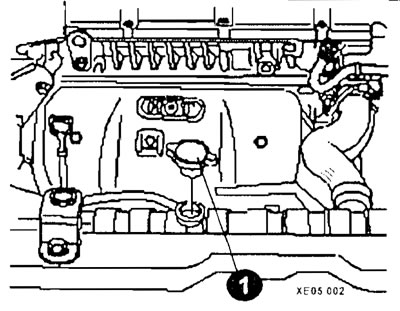
When opening the radiator cap (1) on a…


Turn the cap through a rag or glove first one turn and release excess pressure in the cooling system. Only then completely unscrew the cap


If you drink up the water, the coolant will gradually become diluted, so you need to top up the coolant.

Do not add fluid above the mark, as the fluid expands when heated and the excess flows out of the system.

[The text is provided by the web resource HyundaiBook]

Small amounts of liquid can be added to the tank both when the engine is warm and when it is cold.

If there is a significant loss of fluid and the engine is warm, do not add cold fluid to the expansion tank, as this may cause the cylinder head to warp or the cylinder block to crack.
This article is available at russian, bulgarian, belarusian, ukrainian, serbian, croatian, romanian, polish, slovak, hungarian
This article has been reviewed by: Konstantin Smirnov
Add to social network:

Previous
Elantra 1: Cooling system
Next

General description of the cooling system
Draining, flushing and filling the cooling system
Radiator — removal, cleaning and installation
Air conditioning condenser — removal and installation
Thermostat — Removal, Checking and Installation
Coolant pump — removal and installation
We recommend other articles on the topic of Hyundai manuals:

Checking the density of the coolant Hyundai Accent 1 (1994-1999)
Checking and replacing engine coolant Hyundai Getz (2002-2011)
Checking the cooling system for leaks, composition of the coolant Hyundai Sonata 3 (1993-1998)
Checking and replacing engine coolant Hyundai Santa Fe 2 (2007-2012, petrol)
Checking and adjusting valve clearances Hyundai Tucson 1 (2005-2010)
Checking the technical condition of the car Hyundai Matrix (2001-2010, petrol)

Link in different formats to this article

Visitor comments
No comments yet


How much will 29 + 28 ?


Elantra 3 (2000-2006) 
  • User manual
  • Control devices
  • Audio system
  • Starting the engine and driving
  • Faults en route
  • Maintenance and care
  • Technical information
  • Power unit
  • Gasoline engines
  • Diesel engines
  • Lubrication system
  • Cooling system
  • Fuel system (gasoline)
  • Fuel system (diesel)
  • Decreased toxicity
  • Ignition system
  • Transmission
  • Clutch
  • Mechanical gearbox
  • Automatic gearbox
  • Drive shafts and axles
  • Chassis
  • Car suspension
  • Steering
  • Brake system
  • Body
  • Exterior (external elements)
  • Interior (internal elements)
  • Air conditioning system
  • Electrical equipment
  • Equipment and devices
  • Headlights and lighting
  • Power devices
  • Electrical circuits
Elantra 2 (1995-2000, petrol) 
  • General information
  • Maintenance
  • Power unit
  • Engine repair
  • Cooling system
  • Intake and exhaust system
  • Fuel system
  • Transmission
  • Clutch
  • Manual gearbox
  • Automatic gearbox
  • Drive shafts and axles
  • Chassis
  • Front suspension
  • Rear suspension
  • Steering
  • Brake system
  • Body
  • Body elements
  • Electrical equipment
  • Equipment and devices
  • Electrical diagrams
Elantra 1 (1990-1995, petrol) 
  • General information
  • Introduction to the guide
  • Maintenance
  • Power unit
  • Minor engine repair
  • Engine overhaul
  • Lubrication system
  • Cooling system
  • Fuel injection system
  • Ignition system
  • Exhaust system
  • Transmission
  • Clutch
  • Manual gearbox
  • Automatic gearbox
  • Drive shafts
  • Chassis
  • Front suspension
  • Rear suspension
  • Steering
  • Wheels and tires
  • Troubleshooting
  • Brake system
  • Body
  • Body elements
  • Electrical equipment
  • Equipment and devices
  • Power devices
  • Heating and air conditioning
  • Electrical circuits
HyundaiBook.ru © 2018-2026 · Mobile version · Sitemap: EN BG BY UA RS HR RO PL SK HU · Administration · Site search · Hyundai owners Accent 1 · Accent 2 · Accent 3 · Elantra 1 · Elantra 2 · Elantra 3 · Getz · Sonata 3 · Sonata 4 · Santa Fe 2 · Tucson 1 · Tucson 2 · Matrix ·
This site uses cookies to optimize its functionality. By continuing, you agree to our terms.