


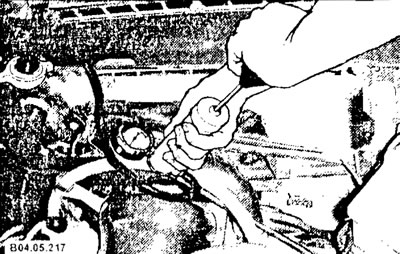
If the radiator cap is in good condition and the coolant is still being lost without any visible leaks from the outside, the problem is indeed serious. This could be caused by a defective cylinder head gasket. At this stage, you should consult a specialist.
If the radiator is leaking, replace it with a new or reconditioned one. If the radiator has been repaired by the owner or in a workshop, it should be tested under a pressure of at least 1.4 kg/cm². To do this, close the outlet channel with a suitable plug and supply compressed air to the radiator through another channel at a pressure of 1.4 kg/cm². Immerse the radiator in a bath of water at a temperature of 90°C. Leave it for 15 minutes and apply a pressure of 1.4 kg/cm² again. Watch for bubbles indicating leaks. If the radiator has not been pressure tested after repair, it should be monitored very carefully for several weeks after installation to detect any leaks in time.
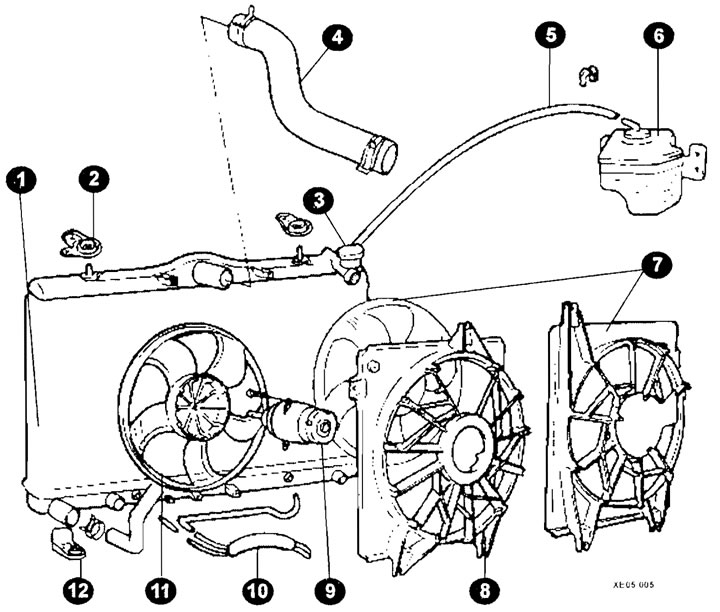
Radiator mounting elements (models 1998-2002.)
1 - radiator;
2 - Upper radiator mount;
3 - radiator cap;
4 - Upper radiator hose;
3 - expansion tank hose;
6 - expansion tank;
7 - elements of the air conditioning system condenser fan;
8 - casing;
9 - Fan motor;
10 - radiator pipe (models with automatic transmission only);
11 - fan;
12 - lower mount.
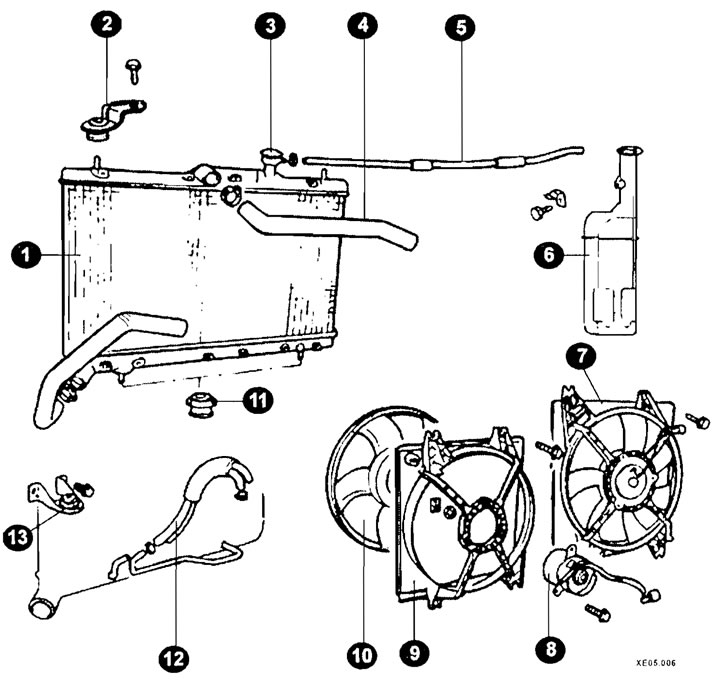
Radiator mounting elements (models 2002-2004.)
1 - radiator;
2 - Upper radiator mount;
3 - radiator cap;
4 - Upper radiator hose;
5 - expansion tank hose;
6 - expansion tank;
7 - air conditioning condenser fan;
8 - fan electric motor;
9 - casing;
10 - fan;
11 - lower radiator mount;
12 - radiator pipe (models with automatic transmission only);
13 - Upper radiator mount (models with automatic transmission only).
Removal
Drain the coolant as described above.
Loosen the upper radiator hose and lower radiator hose clamps and remove them.
Information is taken from a thematic website: HyundaiBook.ru
Disconnect the hose from the expansion tank.
Disconnect all electrical wires from the radiator fan and fan switch
Disconnect any cooling system lines that prevent the radiator from being removed from the vehicle.
After unscrewing the upper mounting bolts, remove the radiator together with the radiator fan (not all models).
Remove the radiator from the engine compartment, first removing it from the lower radiator mounting supports.
Flushing
Flush the radiator. If the radiator is removed from the vehicle, flush it in the opposite direction as well. Rinse the outside of the radiator with a strong stream of water from a hose. If you suspect that the radiator is partially clogged, flush it with a chemical solution before removing it from the vehicle. If nothing has changed, check if water flows through the radiator normally. 20-25 liters should pass in half a minute.
Leaks can be temporarily eliminated by using special additives to the coolant or by covering part of the radiator with a special mastic. However, it is better to replace the radiator.
Installation
The radiator is installed in the reverse order of removal.
Check the hoses for cracks and replace them if necessary.