


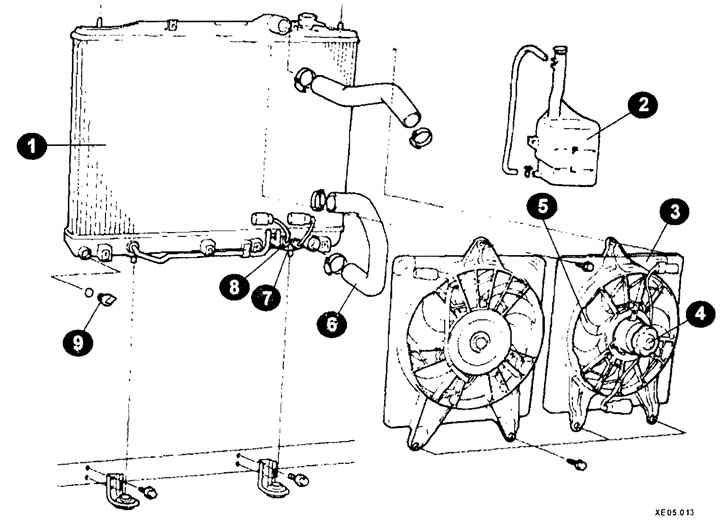
Fan and radiator components (models before 2000.)
1 - radiator;
2 - expansion tank;
3 - casing;
4 - electric motor;
5 - fan impeller;
6 - lower radiator hose;
7, 8 - thermal switch;
9 - drain plug.
The electric fan of the cooling system is mounted on the radiator casing. To remove it, disconnect the casing (3) from the radiator, disconnect the fan plug and remove the fan impeller (5). The fan motor can then be disconnected from the casing by unscrewing the mounting bolts.
Material was obtained from an official resource HyundaiBook
The fan cannot be repaired and must be replaced if necessary. First, make sure that the fault is not in the thermal switch or in the wire by applying 12 V voltage directly to the contacts of the electric motor (1).
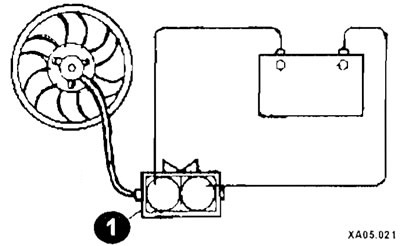
The fan motor either works or it doesn't. If the motor rotates, it's OK.
Caution: Do not run the motor for more than a few seconds with the fan removed.
Checking the fan motor/checking the radiator fan relay
The radiator fan relay is located in the relay box in the engine compartment.
Remove the relay from the relay box
Connect contacts 1 and 2 of the relay to the battery and simultaneously connect an ohmmeter to contacts 3 and 4. The resistance should be 0 ohms.
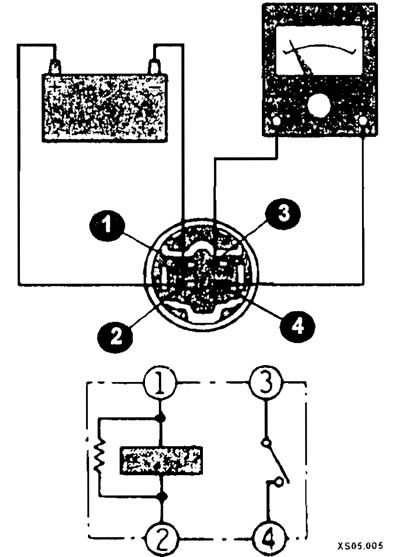
Turn off the voltage, the resistance between contacts 3 and 4 should be equal to infinity.
Check the resistance between contacts 1 and 2 with the battery voltage disconnected. Required value: 0 Ohm.
Checking the thermal switch
The thermal switch is installed next to the radiator drain fitting, at the bottom. When the coolant temperature rises, it turns on the electric fan. The switch is faulty if the electric fan does not turn on when the radiator is hot.
Checking the thermal switch is as follows:
Disconnect the thermal switch connector.
Short-circuit both connector contacts with a wire. If the fan turns on, replace the thermal switch.
If the fan does not turn on, check the contacts and correct connection of the fan motor connector, check the relay wiring and the fan motor according to the electrical diagram.
Secure the new thermal switch with a tightening torque of 30 Nm, applying sealant to the threads.
Fill with coolant.
Warm up the engine and let it idle until the fan comes on. Check the coolant level.
You can check the thermal switch even when it is removed. An ohmmeter should be connected to its contacts.
Place the thermal switch in hot water up to the thread and measure the resistance.
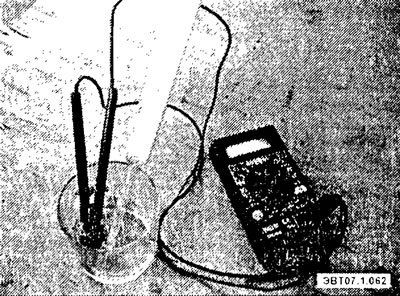
At 88° ±3°C the resistance should be 0, at temperatures below 78°C it should be infinity.