


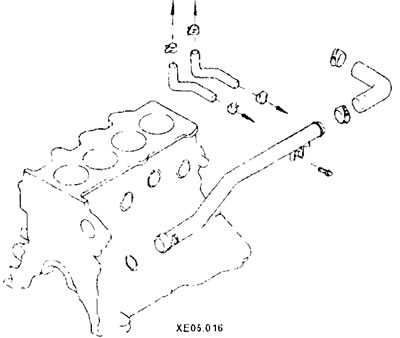
Cooling system hoses (models produced before 1995)
Cooling system hoses are the components that are subjected to the most careless treatment of all parts of the car. However, careless owners are often extremely surprised when a hose bursts or otherwise fails. Hoses age and over time become stiff and crack. They are exposed to high temperatures and pressures up to 1.5 kg/cm² (during normal operation). Their worst enemy is oil. If it gets on the hose, it should be wiped off immediately. If the hoses are not properly secured, they will rub against surrounding components, eventually causing pinholes.
When checking the oil and electrolyte levels, also inspect the cooling system hoses. Check the clamps for tightness every three months or after long, fast driving. If the clamps cut too deeply into the hoses, slide the clamp along the hose or replace the hose. If the hose becomes stiff or cracks begin to develop, replace it immediately.
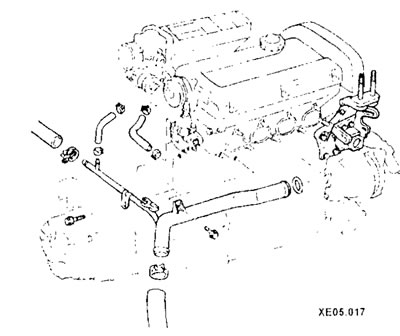
Cooling system hoses (models since 1996)
If a hose ruptures, stop the engine as soon as possible. Carefully open the hood (there may be a stream of hot coolant under the hood). As soon as possible, place a piece of thick fabric over the tear. Place another piece of cloth over the radiator/expansion tank cap and twist to release pressure. The stream will subside and it will be possible to determine the fault more accurately. If the problem is with one of the smaller hoses, it may be possible to "short circuit" the break. If one of the larger hoses ruptures, surgical tape or duct tape can be used as a temporary measure. A more radical temporary measure would be to cut the hose at the break and insert a piece of metal tubing, securing the hose with two clamps. This device will hold the fluid well until you can install a new hose.
Never pour cold water into a hot engine when it is not running: this is the surest way to cause cracks in the cylinder head. If there is enough coolant in the system, you can pour in cold liquid, adding it to the hot one.
Finally, if a hose bursts, you need to find out the cause before taking any action. The rupture may be caused by aging of the hose or careless handling. In this case, nothing more is required than replacing the hose. However, if it was a new hose, the cause should be found out immediately.