


Warning! Do not open the radiator cap while the engine is hot. The cooling system is under pressure and opening the cap may cause hot fluid to spray out, which can cause severe burns. Do not open the radiator cap until you can touch the radiator with your hand.
Caution: Engine coolant can damage your vehicle's paintwork.
Attention! The car engine is equipped with an aluminum radiator, so to avoid corrosion, it is necessary to use a coolant based on ethylene glycol. Do not dilute concentrated antifreeze with hard water, use only distilled water.
Recommended Engine Coolant
Use a 50 percent water solution of ethylene glycol based coolant. The engine coolant must be suitable for use with aluminum parts. Additional additives and anti-corrosion additives should not be used. The coolant must be of the correct concentration and type to prevent freezing and corrosion. Do not allow the antifreeze concentration to exceed 60% or fall below 35%, otherwise damage to the cooling system may occur.
Checking the coolant level
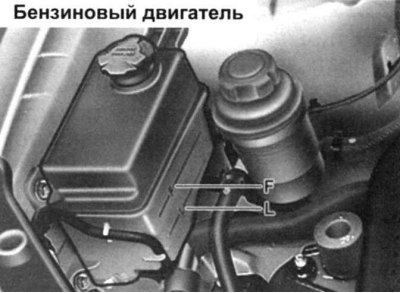
Fig. 1.211. Expansion tank with coolant
The coolant level can be seen on the side of the plastic expansion tank (Fig. 1.211). The coolant level should be between the LOW and FULL marks on the tank when the engine is cold. If the level is below the LOW mark, add fluid. If the level is low, check for leaks in the cooling system. Check the coolant level more often.