HyundaiBook.ru
Repair Chevrolet Repair Honda Repair Toyota Repair Land Rover Repair VAZ Repair Renault Repair Nissan
English Русский
Български
Беларускі
Український
Српски
Hrvatski
Română
Polski
Slovenský
Magyar
ArticlesSitemapContacts  


  Accent   Elantra   Getz   Grandeur   Sonata   Santa Fe   Tucson   Others
Elantra 1 (1990-1995, petrol) Elantra 2 (1995-2000, petrol) Elantra 3 (2000-2006)
  • Main
  • Elantra
  • XD (2000-2006)
  • User manual
  • Maintenance and care
  • Checking the level and replacing the engine coolant

Checking the level and replacing the engine coolant (Hyundai Elantra XD)

0
Contents: Coolant used ⇓ Checking the coolant level ⇓ Replacing the coolant ⇓
Warning: Do not open the radiator cap when the engine is hot. When the engine is hot, the coolant is under pressure and may be released when the radiator cap is opened. Failure to do so may result in serious burns. Open the cap only after the radiator tank has cooled down so much that you can touch it with your hand.


Coolant used


Use a quality fluid that is a 50% to…

Use a quality fluid that is a 50% to 50% mixture of ethylene glycol and water. The coolant should not be aggressive towards aluminum parts. Do not add additional corrosion inhibitors or additives to the fluid. To prevent engine corrosion and fluid freezing, use antifreeze of the required brand in the specified concentration. The antifreeze content in the liquid should be no higher than 60% and no lower than 35%, otherwise the cooling system will be damaged. The composition of the fluid for topping up or replacement is indicated in the table below.


Ambient temperature,°CCoolant composition,%
AntifreezeWater
-153565
-254060
-355050
-456040

Checking the coolant level


Gasoline engine
Gasoline engine
Diesel engine
Diesel engine

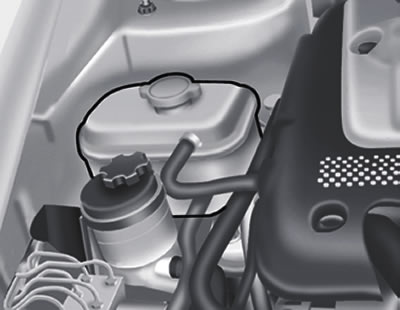
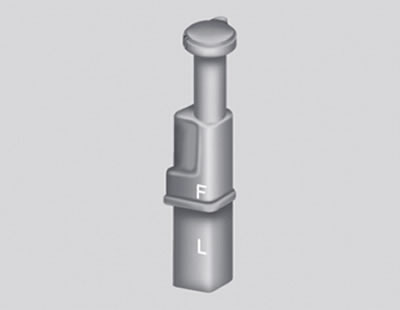
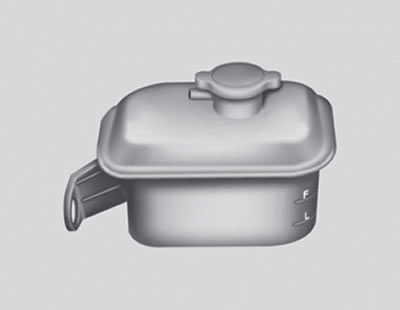
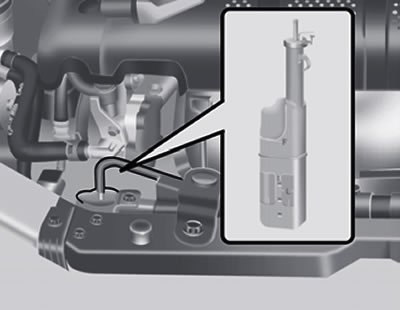
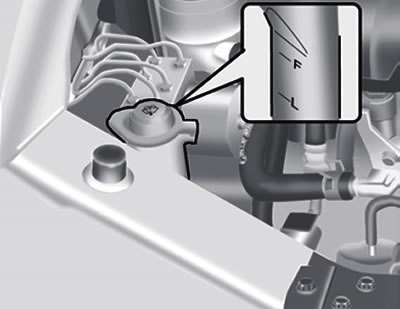
The liquid level is determined by the marks on the transparent wall of the expansion tank. When the engine is cold, the coolant level should be between the "L" (Min.) and "F" (Max.) marks on the reservoir. If the fluid level is below the "L" mark, add fluid until the level is between the "L" and "F" marks. If the fluid level drops, check the cooling system for leaks and check the level more often. If the level drops again, contact your Hyundai dealer to have it checked and determine the cause.

Replacing the coolant


The coolant must be replaced at the intervals specified in section 5.


Caution: Coolant can damage your vehicle's paintwork. If coolant gets on the paintwork, rinse it off thoroughly with clean water.


1. Place the car on a level horizontal surface, apply the parking brake and, after the engine has cooled down, remove the radiator cap.

2. Place a container to collect the drained liquid. Open the radiator drain cock, drain the fluid into a container, then close the drain cock securely.

3. The filling capacity of the cooling system is indicated in section 9. Pour the required amount of coolant into the radiator in accordance with the manufacturer's instructions on the container.
4. Turn the radiator cap fully…


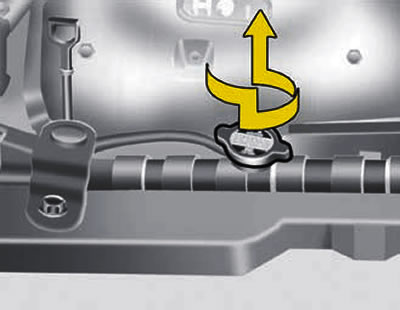
4. Turn the radiator cap fully counterclockwise without pressing on it to release residual pressure in the cooling system. Remove the radiator cap by pressing it down and turning it counterclockwise. After this, fill the radiator with clean demineralized or distilled water. Add water in small portions until the liquid level reaches the radiator neck.
5. Start the engine and add water to…


5. Start the engine and add water to the radiator up to the neck, then add liquid from the expansion tank so that its level is between the "L" and "F" marks.


6. Tighten the radiator and expansion tank caps and check that the system drain cocks are securely closed and that there is no leakage through them.

Warning: The cooling fan switches on and off depending on the coolant temperature and may therefore switch on when the engine is not running. When performing any work near the fan, be careful not to be injured by the fan when it starts. When the coolant temperature drops, the fan automatically turns off - this is normal.
This article is available at russian, bulgarian, belarusian, ukrainian, serbian, croatian, romanian, polish, slovak, hungarian
This article has been reviewed by: Konstantin Smirnov
Add to social network:

Previous
Elantra 3: Maintenance and care
Next

Changing engine oil and oil filter
Engine oil consumption
Checking the engine oil level
General check of the car
Engine bay
Spark plugs
Replacing the air filter
Windshield wiper blades
Filling the windshield washer reservoir
Checking the transmission oil level in a manual gearbox
We recommend other articles on the topic of Hyundai manuals:

Checking the coolant level Hyundai Accent 3 (2005-2010)
Checking and replacing engine coolant Hyundai Getz (2002-2011)
Checking the engine oil level Hyundai Sonata 3 (1993-1998)
Checking and replacing engine coolant Hyundai Santa Fe 2 (2007-2012, petrol)
Checking compression in a diesel engine Hyundai Tucson 1 (2005-2010)
Checking the engine oil level Hyundai Matrix (2001-2010, petrol)

Link in different formats to this article

Visitor comments
No comments yet


How much will 19 + 17 ?


Elantra 3 (2000-2006) 
  • User manual
  • Control devices
  • Audio system
  • Starting the engine and driving
  • Faults en route
  • Maintenance and care
  • Technical information
  • Power unit
  • Gasoline engines
  • Diesel engines
  • Lubrication system
  • Cooling system
  • Fuel system (gasoline)
  • Fuel system (diesel)
  • Decreased toxicity
  • Ignition system
  • Transmission
  • Clutch
  • Mechanical gearbox
  • Automatic gearbox
  • Drive shafts and axles
  • Chassis
  • Car suspension
  • Steering
  • Brake system
  • Body
  • Exterior (external elements)
  • Interior (internal elements)
  • Air conditioning system
  • Electrical equipment
  • Equipment and devices
  • Headlights and lighting
  • Power devices
  • Electrical circuits
Elantra 2 (1995-2000, petrol) 
  • General information
  • Maintenance
  • Power unit
  • Engine repair
  • Cooling system
  • Intake and exhaust system
  • Fuel system
  • Transmission
  • Clutch
  • Manual gearbox
  • Automatic gearbox
  • Drive shafts and axles
  • Chassis
  • Front suspension
  • Rear suspension
  • Steering
  • Brake system
  • Body
  • Body elements
  • Electrical equipment
  • Equipment and devices
  • Electrical diagrams
Elantra 1 (1990-1995, petrol) 
  • General information
  • Introduction to the guide
  • Maintenance
  • Power unit
  • Minor engine repair
  • Engine overhaul
  • Lubrication system
  • Cooling system
  • Fuel injection system
  • Ignition system
  • Exhaust system
  • Transmission
  • Clutch
  • Manual gearbox
  • Automatic gearbox
  • Drive shafts
  • Chassis
  • Front suspension
  • Rear suspension
  • Steering
  • Wheels and tires
  • Troubleshooting
  • Brake system
  • Body
  • Body elements
  • Electrical equipment
  • Equipment and devices
  • Power devices
  • Heating and air conditioning
  • Electrical circuits
HyundaiBook.ru © 2018-2026 · Mobile version · Sitemap: EN BG BY UA RS HR RO PL SK HU · Administration · Site search · Hyundai owners Accent 1 · Accent 2 · Accent 3 · Elantra 1 · Elantra 2 · Elantra 3 · Getz · Sonata 3 · Sonata 4 · Santa Fe 2 · Tucson 1 · Tucson 2 · Matrix ·
This site uses cookies to optimize its functionality. By continuing, you agree to our terms.