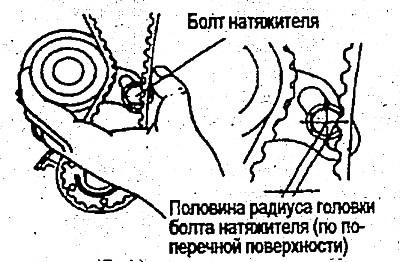
The adjustment is made as follows:
1. Turn the steering wheel exactly counterclockwise.
2. Place a wooden block under the engine oil pan and carefully lift it up.
3. Remove the left mounting bracket.
4. Remove the water pump assembly.
5. Remove the crankshaft pulley.
6. Remove the upper timing belt cover.
7. Check the belt for cracks, delamination or other damage. Carefully check the belt along its entire length.
8. Rotate the crankshaft until the piston reaches top dead center. In other words, align the ignition timing mark on the camshaft sprocket with the mark on the cylinder head.
The crankshaft must be turned clockwise, not counterclockwise. Turning the crankshaft counterclockwise can cause incorrect tension adjustment!
9. Remove the lower timing belt cover.
10. Loosen tensioner mounting bolts 1 and 2 in the order shown in the figure - this will ensure tension of the toothed belt spring.
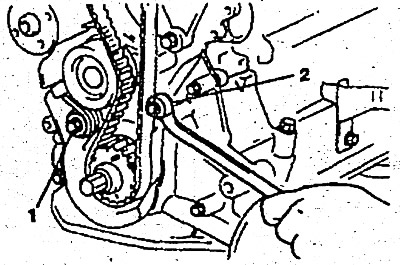
11. Check the belt application to ensure it is securely fastened.
12. Tighten tensioner mounting bolts 2 and 1, in that order. If bolt 1 is tightened first, the tensioner may move along with the bolt, which may cause the belt to become overtightened.
13. Turn the crankshaft clockwise once and set the mark on the crankshaft gear at top dead center.
14. Loosen tensioner mounting bolts 1 and 2 in the order shown.
15. Retighten tensioner mounting bolts 2 and 1 in the order shown to the following tightening torque:
Tightening torque 20-27 Nm.
16. Recheck the belt tension. Then press the tensioner and the belt from the tensioner side horizontally with medium force (approximately 49 N), approximately to the tips of the belt teeth.
The end of the belt tooth should be located half the radius of the tensioner bolt head from the center of the bolt head, as shown in the figure.