HyundaiBook.ru
Repair Chevrolet Repair Honda Repair Toyota Repair Land Rover Repair VAZ Repair Renault Repair Nissan
English Русский
Български
Беларускі
Український
Српски
Hrvatski
Română
Polski
Slovenský
Magyar
ArticlesSitemapContacts  


  Accent   Elantra   Getz   Grandeur   Sonata   Santa Fe   Tucson   Others
Accent 1 (1994-1999) Accent 2 (1999-2005) Accent 3 (2005-2010)
  • Main
  • Accent
  • MC (2005-2010)
  • Power unit
  • Engine management
  • Checking the mass air flow (MAFS) and temperature (IATS) sensors

Checking the mass air flow (MAFS) and temperature (IATS) sensors (Hyundai Accent MC)

0
Contents: Checking the MAFS signal shape ⇓ MAFS Characteristics ⇓ Checking the air temperature sensor ⇓ IATS Characteristics ⇓ Checking the wiring ⇓
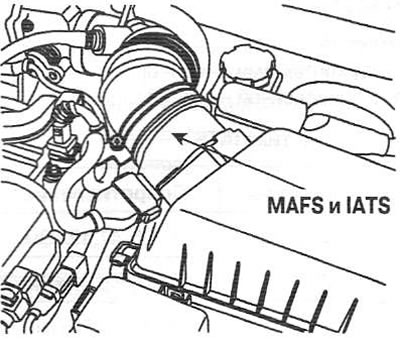
Checking the mass air flow (MAFS) and temperature (IATS) sensors


Checking the MAFS signal shape


The ECM constantly compares the signals from the air flow sensor and the throttle position sensor. During acceleration, the sensor output voltage increases, and during braking, it decreases
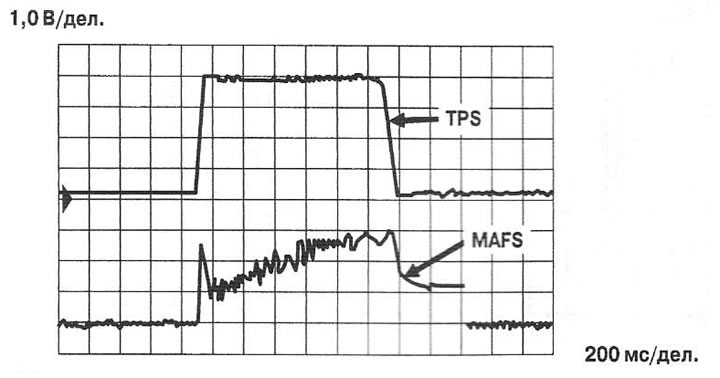
The ECM constantly compares the signals from the air flow sensor and the…


MAFS Characteristics


Air flow sensor

Air consumption, kg/h (at 20°C)Voltage, V
4,90,7
7,30,9
12,21,18
20,81,51
28,31,73
38,91,97
64,72,4
113,32,9
185,33,35
256,03,64
494,04,07
476,74,25
603,34,65

Note: If the output voltage is 0.0V or 5.0V, it means the sensor is damaged and needs to be replaced.


Checking the air temperature sensor


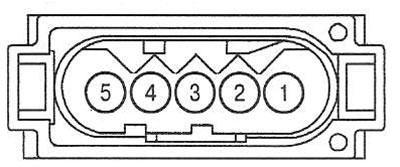
Measure the resistance of the sensor circuit between pins 1 and 5 and compare the result with the table below.


IATS Characteristics


TemperaturesResistance
-40°C41.26-47.49 kOhm
-20°C14.26-16.02 kOhm
0°C5500-8050 Ohm
20°C2350-2540 Ohm
40°C1110-1190 Ohm
80°C310-320 Ohm

Checking the wiring


With the ignition on, measure the voltage between the specified contacts of the wire portion of the connector.

Circuit under testNominal voltage
Contact 2 - "ground"B+
Contact 5 - "ground"5 V
Contact 2 - Contact 4Below B+ by about 200 mV
Contact 1 - Contact 2
Contact 1 - Contact 5

1. Sensor «mass»
1. Sensor "mass"
2. Nutrition (B+)
3. Air flow signal
4. "Mass"
5. Air temperature signal


Using an ohmmeter, measure the resistance between contacts 3 and 4. Nominal value: ∞ Ohm.

The original can be read on the resource HYUNDAIBOOK.ru
This article is available at russian, bulgarian, belarusian, ukrainian, serbian, croatian, romanian, polish, slovak, hungarian
This article has been reviewed by: Konstantin Smirnov
Add to social network:

Previous
Accent 3: Engine management
Next

Checking the oxygen sensor (HO2S)
Checking the crankshaft position sensor (CKPS) and camshaft position sensor (CMPS)
Checking the electromagnetic valve of the camshaft phase adjuster (OCV)
Peripherals of the engine management system
Checking the input and output signals of the engine control unit (models with manual transmission)
Checking the coolant temperature sensor (ECTS)
Checking the Throttle Position Sensor (TPS)
Checking the knock sensor (KS)
Checking the Idle Air Control Valve (ISCA)
Possible malfunctions and their causes
We recommend other articles on the topic of Hyundai manuals:

2.0L Engine Timing Belt — Checking Tension/Adjusting Hyundai Elantra 1 (1990-1995, petrol)
Coolant temperature gauge Hyundai Getz (2002-2011)
Checking the mass air flow sensor and intake air temperature… Hyundai Sonata 4 (2001-2012, petrol)
Table 2.34. Checked parameter of the mass air flow (MAF) sensor… Hyundai Santa Fe 2 (2007-2012, petrol)
Checking the technical condition of speed sensors Hyundai Tucson 1 (2005-2010)
Removal and checking wheel speed sensors (ABS) Hyundai Matrix (2001-2010, petrol)

Link in different formats to this article

Visitor comments
No comments yet


How much will 38 + 34 ?


Accent 3 (2005-2010) 
  • General information
  • User manual
  • Maintenance
  • Power unit
  • Engine repair
  • Cooling and lubrication system
  • Power and exhaust system
  • Engine electrical equipment
  • Engine management
  • Transmission
  • Clutch
  • Mechanical gearbox
  • Automatic gearbox
  • Chassis
  • Front suspension
  • Rear suspension
  • Wheels and tires
  • Steering
  • Brake system
  • Body
  • Exterior (external elements)
  • Interior (internal elements)
  • Heating and ventilation
  • Electrical equipment
  • Equipment and devices
  • Electrical circuits
Accent 2 (1999-2005) 
  • User manual
  • Control devices
  • Starting engine and driving
  • Troubleshooting
  • Power unit
  • SOHC engines
  • DOHC engines
  • Lubrication system
  • Cooling system
  • Decreased toxicity
  • Fuel system
  • Ignition system
  • Transmission
  • Clutch
  • Mechanical gearbox
  • Automatic gearbox
  • Axles and drive shafts
  • Chassis
  • Car suspension
  • Steering
  • Brake system
  • Body
  • Exterior (external elements)
  • Interior (internal elements)
  • Air conditioning system
  • Electrical equipment
  • Equipment and devices
  • Power devices
Accent 1 (1994-1999) 
  • General information
  • Maintenance
  • Power unit
  • SOHC engines
  • DOHC engines
  • Cooling system
  • Intake and exhaust systems
  • Fuel supply (1.3 l, injection)
  • Fuel supply (1.5 l, injection)
  • Fuel supply (carburetor)
  • Transmission
  • Clutch
  • Manual gearbox
  • Automatic gearbox
  • Drive shafts
  • Chassis
  • Car suspension
  • Steering
  • Brake system
  • Body
  • Body elements
  • Electrical equipment
  • Equipment and devices
  • Electrical circuits
HyundaiBook.ru © 2018-2026 · Mobile version · Sitemap: EN BG BY UA RS HR RO PL SK HU · Administration · Site search · Hyundai owners Accent 1 · Accent 2 · Accent 3 · Elantra 1 · Elantra 2 · Elantra 3 · Getz · Sonata 3 · Sonata 4 · Santa Fe 2 · Tucson 1 · Tucson 2 · Matrix ·
This site uses cookies to optimize its functionality. By continuing, you agree to our terms.