


Contents: Functional check ⇓ Measuring resistance ⇓
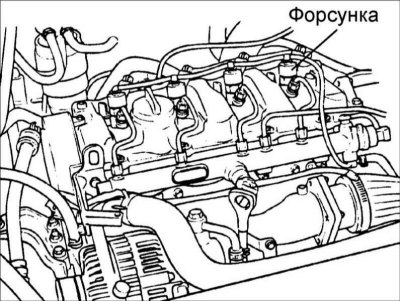
The Common Rail system uses special injectors with hydraulic boost and an electric starter element (solenoid valve) to ensure that the required amount of fuel is supplied to the combustion chamber.
To ensure a precise amount of fuel is injected, the injector opening must occur very quickly, which requires the ECU to supply high voltage. Once the spray needle is fully open, the current supplied to the solenoid valve is reduced to a value sufficient to hold the solenoid valve in the open position. The amount of fuel injected is determined by the opening period of the nozzle and the pressure in the system. After the voltage supply to the solenoid valve is cut off, the spray needle moves down and hermetically closes the supply of high-pressure fuel to the combustion chamber.
Functional check
1. Using the engine tester's current clamp meter, check the operation of the fuel injectors. Current clamps must meet the following requirements:
- measurement range more than 25 A;
- frequency range over 100 kHz.
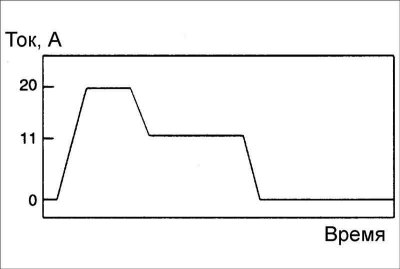
2. Connect the connector to the injector. Place the current clamp around the injector head, start the engine at idle speed and measure the current consumed by the injector and compare the current curve with the curve shown in the figure.
- The magnitude of the phase current consumption (maximum 12 A) depends on the engine crankshaft speed.
- The first section of the curve shows the preliminary fuel injection.
3. Check the fuel injection nozzle. Disconnect the connector from the injector and connect it to the additional injector.
- If the engine operation does not change, the injector being tested is not injecting fuel.
- If the engine operation has changed, then the injector being tested is working properly and is injecting fuel.
- This test does not allow you to determine the amount of fuel injected by the injector.
- Replace all fuel injectors if necessary.
4. With the ignition off, measure the supply voltage at terminals 33 (cylinder #1), 36 and 39 (cylinder #3), 40 (cylinder #2) and 37 of the ECM. Voltage: 0 V.
5. If the voltage does not correspond to the required one, check the condition of the electrical wiring. If the wiring is good, replace the ECM.
Measuring resistance
1. Disconnect the electrical connector from the injector.
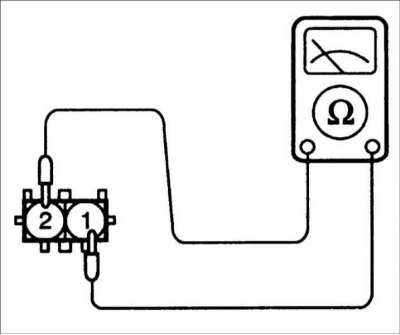
2. Measure the resistance between the connector contacts. Resistance: 0.3-0.6 Ohm at 20°C.
3. Connect the electrical connector to the injector.