
HyundaiBook.ru
Repair Chevrolet Repair Honda Repair Toyota Repair Land Rover Repair VAZ Repair Renault Repair Nissan
English Русский
Български
Беларускі
Український
Српски
Hrvatski
Română
Polski
Slovenský
Magyar
ArticlesSitemapContacts  


  Accent   Elantra   Getz   Grandeur   Sonata   Santa Fe   Tucson   Others
Santa Fe 2 (2007-2012, petrol)
  • Main
  • Santa Fe
  • CM (2007-2012)
  • Chassis
  • Brake system
  • Checking the operation of the brake booster without a tester

Checking the operation of the brake booster without a tester (Hyundai Santa Fe CM)

0
Run the engine for one or two minutes and then turn it off. Press the brake pedal several times with the usual force when braking. If the first time you press the brake pedal, it is pressed all the way down, and its travel gradually decreases with subsequent presses, the vacuum brake booster is working properly. If its travel remains unchanged with successive presses of the pedal, then the vacuum brake booster is faulty.

With the engine off, press the brake pedal several times and make sure that the brake pedal travel changes. Then, without releasing the brake pedal, start the engine. If the brake pedal drops slightly, this means that the vacuum booster is working properly. If the pedal remains in place after starting the engine, then the vacuum booster is faulty.
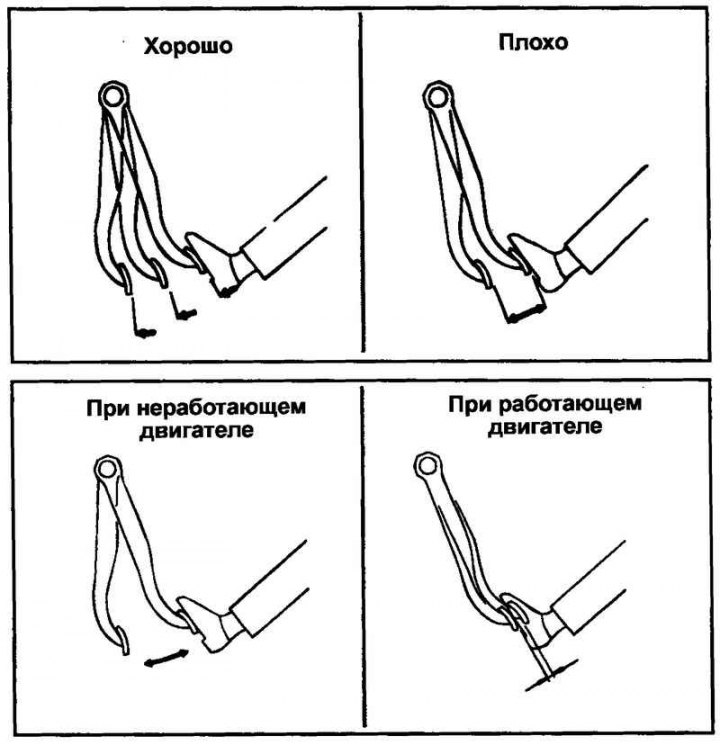
Fig. 6.3. Checking the serviceability…

Fig. 6.3. Checking the serviceability of the vacuum booster


With the engine running, press the brake pedal and then turn off the engine. Keep the brake pedal pressed for 30 seconds. If the pedal position does not change, the brake booster is OK. If the brake pedal rises, the brake booster is faulty (Fig. 6.3).

If the results of one of the tests performed are unsatisfactory, you should look for a fault in the vacuum hose, check valve or brake booster.

[The article is borrowed from an online resource: HyundaiBook.ru]
This article is available at russian, bulgarian, belarusian, ukrainian, serbian, croatian, romanian, polish, slovak, hungarian
This article has been reviewed by: Konstantin Smirnov
Add to social network:

Previous
Santa Fe 2: Brake system
Next

Checking and adjusting the brake pedal
Bleeding the brake hydraulic system
Removal, checking and installation the brake pedal
Disassembly, inspection, assembly and installation of the master brake cylinder
Rear brake pressure regulator
Removal, checking and installation front brake pads
We recommend other articles on the topic of Hyundai manuals:

Checking the brake booster Hyundai Accent 2 (1999-2005)
Checking the operation of the brake booster Hyundai Elantra 2 (1995-2000, petrol)
Checking the one-way valve of the brake booster Hyundai Getz (2002-2011)
Checking the operation of the brake booster Hyundai Sonata 3 (1993-1998)
Checking the operation of the brake booster Hyundai Tucson 1 (2005-2010)
Checking the operation of the brake booster without a tester Hyundai Matrix (2001-2010, petrol)

Link in different formats to this article

Visitor comments
No comments yet


How much will 44 + 41 ?


Santa Fe 2 (2007-2012, petrol) 
  • User manual
  • Control devices
  • Heating and ventilation
  • Seat control
  • Car driving
  • Maintenance and care
  • Vehicle Specifications
  • Engine 2.0 and 2.4 liters
  • Engine specifications
  • Engine maintenance
  • Engine repair
  • Cooling system
  • Intake and exhaust system
  • Fuel system
  • Engine 2.7 liter
  • Engine maintenance
  • Engine repair
  • Cooling system
  • Intake and exhaust system
  • Transmission
  • Transmission specifications
  • Mechanical gearbox
  • Automatic gearbox
  • Drive shafts
  • Chassis
  • Suspension and wheels
  • Steering
  • Brake system
  • Body
  • Exterior (external elements)
  • Electrical equipment
  • Equipment and devices
  • Power devices
  • Specifications
HyundaiBook.ru © 2018-2026 · Mobile version · Sitemap: EN BG BY UA RS HR RO PL SK HU · Administration · Site search · Hyundai owners Accent 1 · Accent 2 · Accent 3 · Elantra 1 · Elantra 2 · Elantra 3 · Getz · Sonata 3 · Sonata 4 · Santa Fe 2 · Tucson 1 · Tucson 2 · Matrix ·
This site uses cookies to optimize its functionality. By continuing, you agree to our terms.