


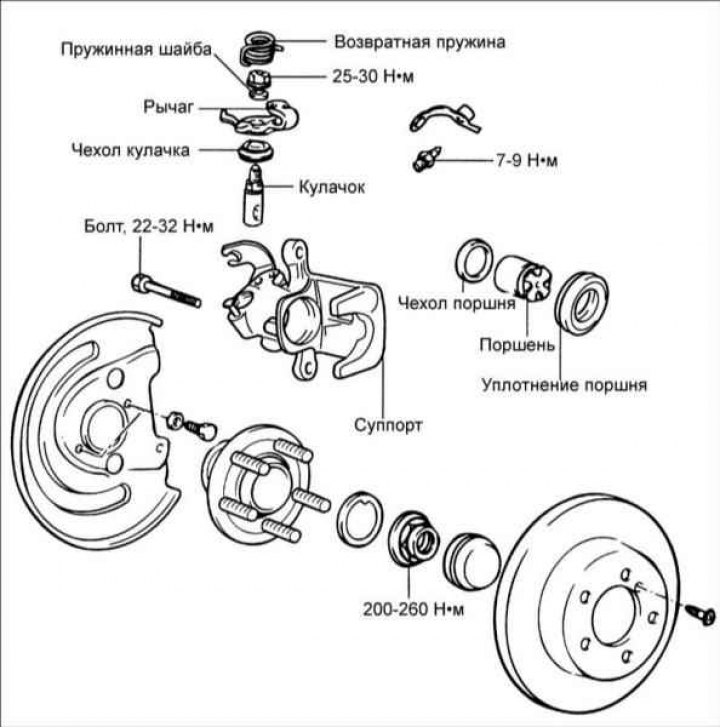
Removal
1. Loosen the parking brake cable adjusting nut.
2. Remove the wheel.
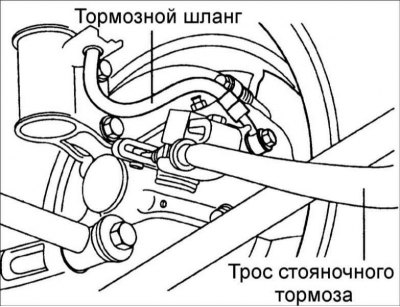
3. Disconnect the brake hose.
4. Remove the caliper mounting bolts (2EA).
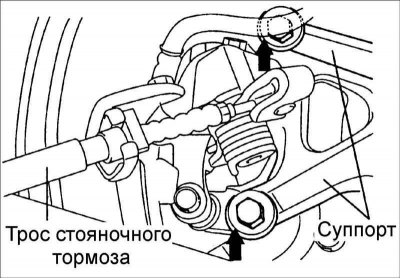
5. Remove the caliper and brake pads.
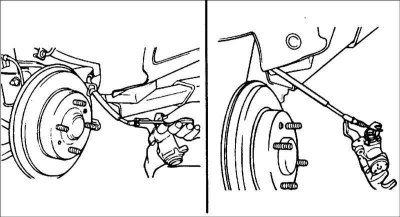
6. Remove the clamp and disconnect the parking brake cable.
Examination
1. Check the brake pads for wear or oil contamination and replace them if necessary.
Attention! Be sure to replace all the pads on one axle of the car, even if only one pad is worn out.
- Brake shoe lining thickness: 9.0 mm
- Minimum permissible brake shoe lining thickness: 2.0 mm
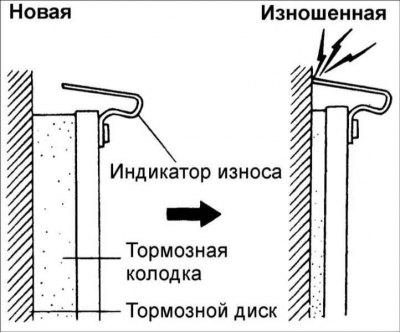
2. Check the front and rear brake pads and mounting bolts for wear or damage. When replacing the pads, also replace the screws.
3. Check the dust covers for wear or damage, as if dust has entered the caliper, the caliper will need to be replaced or repaired.
4. Before replacing the brake pads, remove half of the brake fluid from the master cylinder reservoir.
5. Measure the thickness of the brake disc. Using a dial indicator, measure the runout of the brake disc at a short distance from the outer edge.
Brake disc thickness:
- Nominal: 10 mm
- Minimum allowable: 8 mm
- Maximum permissible runout: 0.08 mm
- Maximum permissible difference in brake disc thickness: 0.01 mm
1. Using a micrometer, measure the thickness of the disc in eight places, approximately every 45° at a distance of 5 mm from the outer edge of the disc.
2. Use a dial indicator to check the runout of the brake disc. Attach a dial indicator in any convenient place and, by turning the brake disc, determine its runout at a distance of 5 mm from the outer edge.
6. If necessary, replace the brake disc.
Installation
1. Check the caliper and piston for wear, damage, cracks and rust.
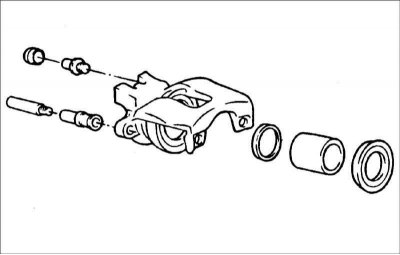
2. Check the piston seal and boot for wear or tear.
3. Apply the recommended lubricant to the following parts:
- piston seal: brake fluid DOT 3 or DOT 4;
- inner surface of the caliper cylinder: brake fluid DOT 3 or DOT 4;
- piston boot: brake fluid DOT 3 or DOT 4;
- outer surface of the piston: brake fluid DOT 3 or DOT 4;
- guide pin boots: rubber lubricant.
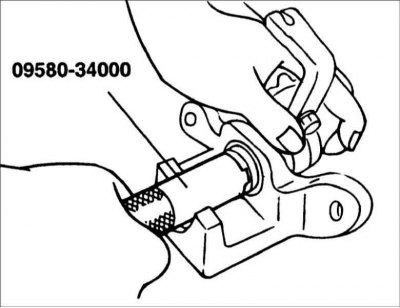
4. Using a special tool, press the piston into the caliper.