
HyundaiBook.ru
Repair Chevrolet Repair Honda Repair Toyota Repair Land Rover Repair VAZ Repair Renault Repair Nissan
English Русский
Български
Беларускі
Український
Српски
Hrvatski
Română
Polski
Slovenský
Magyar
ArticlesSitemapContacts  


  Accent   Elantra   Getz   Grandeur   Sonata   Santa Fe   Tucson   Others
Santa Fe 2 (2007-2012, petrol)
  • Main
  • Santa Fe
  • CM (2007-2012)
  • Chassis
  • Brake system
  • Disassembly and assembly of rear disc brakes

Disassembly and assembly of rear disc brakes (Hyundai Santa Fe CM)

0
Contents: Disassembly ⇓ Examination ⇓ Assembly ⇓ Removal the brake disc ⇓
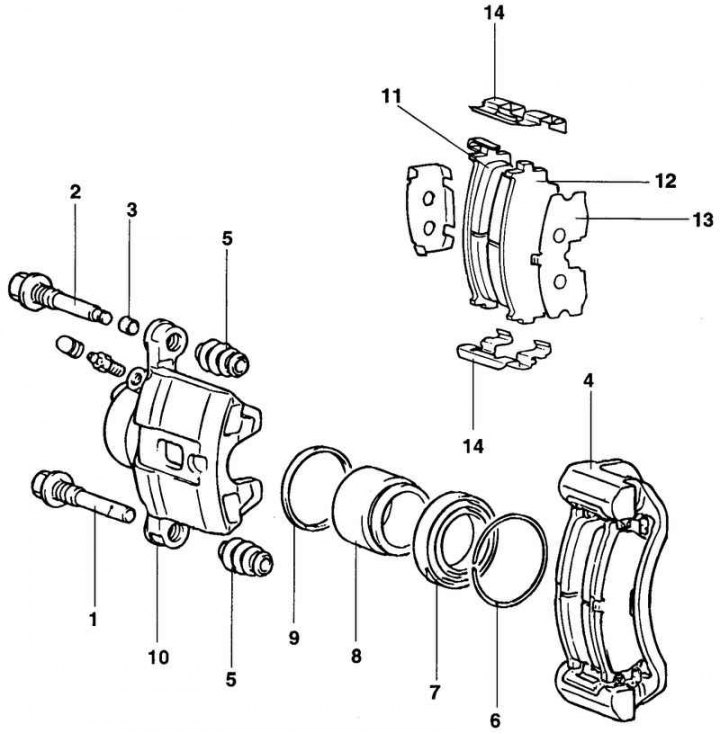
Fig. 6.38. Rear disc brake components:…

Fig. 6.38. Rear disc brake components: 1 – guide pin; 2 – guide pin; 3 – bushing; 4 – caliper bracket (with brake pads); 5 – anther; 6 – boot clamp; 7 – piston dust cover; 8 – piston; 9 – piston sealing ring; 10 – support; 11 – brake shoe; 12 – brake shoe; 13 – gasket; 14 – retainer


The components of the rear disc brake are shown in Fig. 6.38.
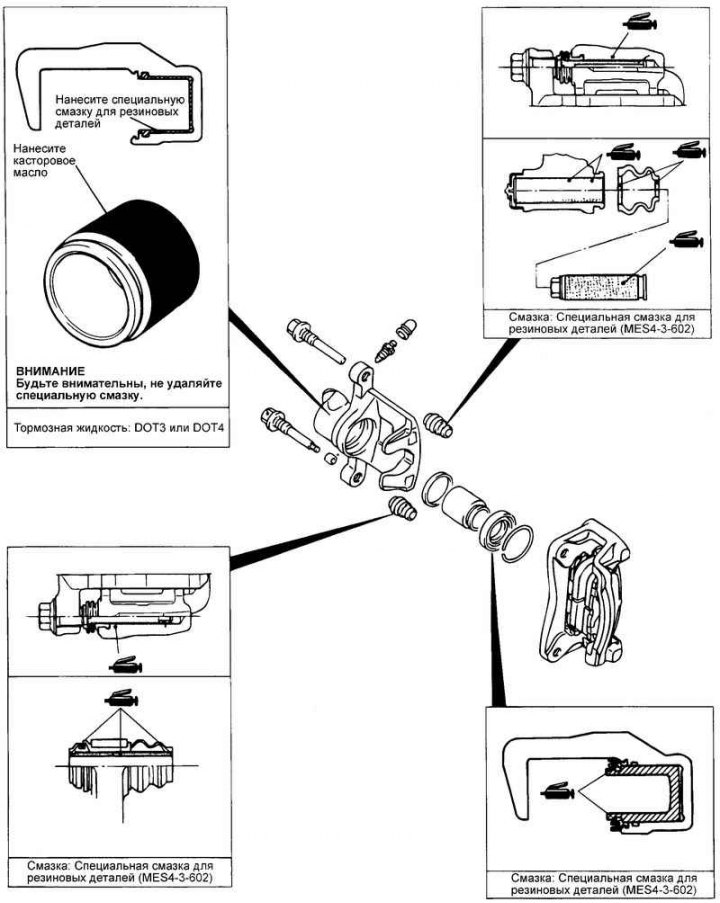
Fig. 6.39. Map of lubrication points

Fig. 6.39. Map of lubrication points


Disassembly


Remove the wheel.
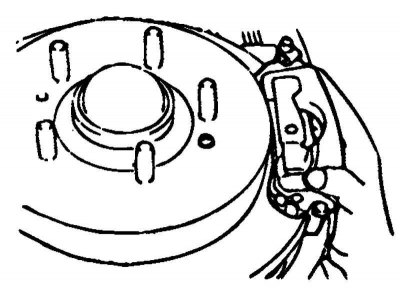
Fig. 6.40. Removing the brake pads

Fig. 6.40. Removing the brake pads


Remove the guide pins, lift the caliper assembly up and remove the pads assembly (Fig. 6.40).

When disassembling the rear disc brakes, disassemble from both sides of the car (left and right).

Removing the piston seal ring and piston.
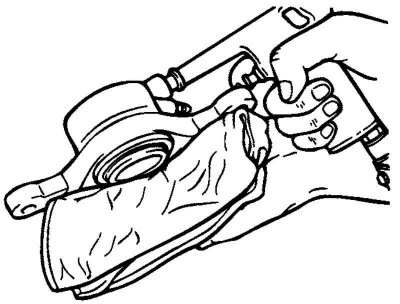
Fig. 6.41. Removing the piston

Fig. 6.41. Removing the piston


Wrap the caliper with a cloth. Apply compressed air to the brake hose hole to remove the piston and piston dust boot. Remove the piston seal ring and piston (Fig. 6.41).

Caution! Apply compressed air gradually.
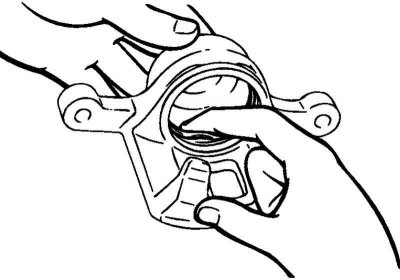

Fig. 6.42. Removing the piston sealing…

Fig. 6.42. Removing the piston sealing ring


Use your finger to remove the piston sealing ring (Fig. 6.42).

Caution: To prevent damage to the inner surface of the wheel cylinder, do not use a flat-head screwdriver or other tool.


Clean piston and cylinder surfaces with trichloroethylene, alcohol or recommended brake fluid.


Brake fluid used: DOT3 or DOT4.

Examination


Check the brake cylinder for signs of wear, damage or rust.

Check the surface of the brake cylinder piston for signs of wear, damage and rust.

Check the caliper bracket and bushing for signs of wear.

Check for damage or oil on the brake pad linings and for damage on the metal pad bases.
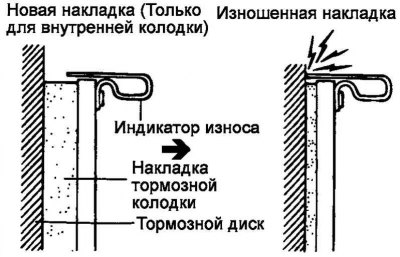
Fig. 6.43. Brake shoe lining test…

Fig. 6.43. Brake shoe lining test diagram


Check the brake shoe linings for excessive wear and oiling of the friction surface. Replace the brake shoes if necessary (Fig. 6.43).

Note: If it is necessary to replace the brake shoe and lining assembly, replace the entire set of brake shoes on the left and right sides of the vehicle.


Brake shoe lining thickness (maximum permissible value): 2 mm

Check the piston and its inner surface for signs of wear, damage and rust.

Replace damaged parts if necessary.

Check the piston seal ring, piston dust boot and guide pin dust boots for signs of wear or damage.

Assembly


When disassembling the caliper, use only new piston seal ring and piston dust boot.

Apply the recommended fluid to the working surfaces of the piston seal ring and piston. Install the piston seal ring into the groove of the caliper bore, try to ensure that the seal ring is not twisted.
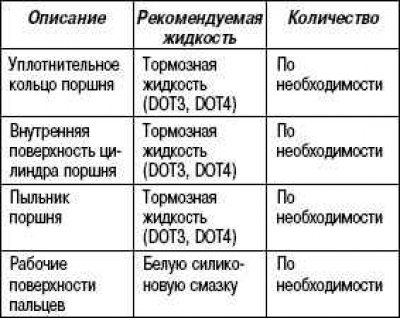


Apply the recommended fluid to the…

Install the piston dust boot onto the piston.
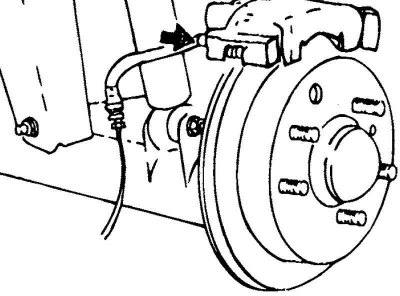
Fig. 6.44. Installing the piston in the…

Fig. 6.44. Installing the piston in the caliper


Install the piston and piston dust boot into the caliper (Fig. 6.44). Insert the dust boot clamp into the caliper and check the fit of the dust boot in the groove around the circumference of the piston.

Apply the recommended oil to the inside surface of the guide pin boot.

Removal the brake disc


Remove the wheel.

Remove the caliper assembly and hang it with wire.

Then loosen the two disk screws and remove the disk.
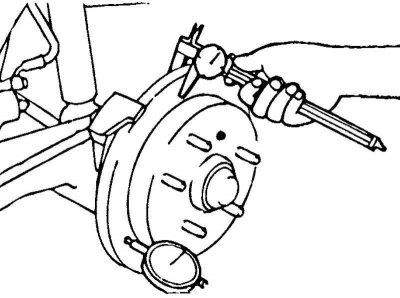
Fig. 6.45. Checking the thickness of…

Fig. 6.45. Checking the thickness of the brake disc


Check the disc for signs of wear or damage and replace it if necessary (Fig. 6.45).
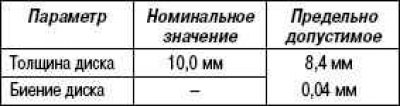
Check the disc for signs of wear or…
This article is available at russian, bulgarian, belarusian, ukrainian, serbian, croatian, romanian, polish, slovak, hungarian
This article has been reviewed by: Konstantin Smirnov
Add to social network:

Previous
Santa Fe 2: Brake system
Next

Disassembly and assembly of front disc brakes
Removal, checking and installation front brake pads
Rear brake pressure regulator
Disassembly, inspection, assembly and installation of the master brake cylinder
Removal, checking and installation the brake pedal
Removal, checking and installation rear drum brakes
Checking and adjusting the travel of the parking brake lever
Anti-lock braking system
Removal and installation the ABS electronic control unit
Checking the ABS hydraulic unit
We recommend other articles on the topic of Hyundai manuals:

Brake pads for front disc brakes Hyundai Accent 1 (1994-1999)
Rear disc brakes Hyundai Elantra 3 (2000-2006)
Replacing rear brake pads (drum brakes) Hyundai Getz (2002-2011)
Rear disc brake Hyundai Sonata 3 (1993-1998)
Checking the technical condition of the rear disc brakes Hyundai Tucson 1 (2005-2010)
Removal, checking and installation rear drum brakes Hyundai Matrix (2001-2010, petrol)

Link in different formats to this article

Visitor comments
No comments yet


How much will 49 + 12 ?


Santa Fe 2 (2007-2012, petrol) 
  • User manual
  • Control devices
  • Heating and ventilation
  • Seat control
  • Car driving
  • Maintenance and care
  • Vehicle Specifications
  • Engine 2.0 and 2.4 liters
  • Engine specifications
  • Engine maintenance
  • Engine repair
  • Cooling system
  • Intake and exhaust system
  • Fuel system
  • Engine 2.7 liter
  • Engine maintenance
  • Engine repair
  • Cooling system
  • Intake and exhaust system
  • Transmission
  • Transmission specifications
  • Mechanical gearbox
  • Automatic gearbox
  • Drive shafts
  • Chassis
  • Suspension and wheels
  • Steering
  • Brake system
  • Body
  • Exterior (external elements)
  • Electrical equipment
  • Equipment and devices
  • Power devices
  • Specifications
HyundaiBook.ru © 2018-2026 · Mobile version · Sitemap: EN BG BY UA RS HR RO PL SK HU · Administration · Site search · Hyundai owners Accent 1 · Accent 2 · Accent 3 · Elantra 1 · Elantra 2 · Elantra 3 · Getz · Sonata 3 · Sonata 4 · Santa Fe 2 · Tucson 1 · Tucson 2 · Matrix ·
This site uses cookies to optimize its functionality. By continuing, you agree to our terms.