
HyundaiBook.ru
Repair Chevrolet Repair Honda Repair Toyota Repair Land Rover Repair VAZ Repair Renault Repair Nissan
English Русский
Български
Беларускі
Український
Српски
Hrvatski
Română
Polski
Slovenský
Magyar
ArticlesSitemapContacts  


  Accent   Elantra   Getz   Grandeur   Sonata   Santa Fe   Tucson   Others
Santa Fe 2 (2007-2012, petrol)
  • Main
  • Santa Fe
  • CM (2007-2012)
  • Chassis
  • Brake system
  • Anti-lock braking system

Anti-lock braking system (Hyundai Santa Fe CM)

0
Contents: Electronic Brakeforce Distribution…⇓ Advantages of electronic control ⇓ Comparison of brake force…⇓ Checking the hydraulic and…⇓ ABS Electronic Control Unit (HECU)…⇓
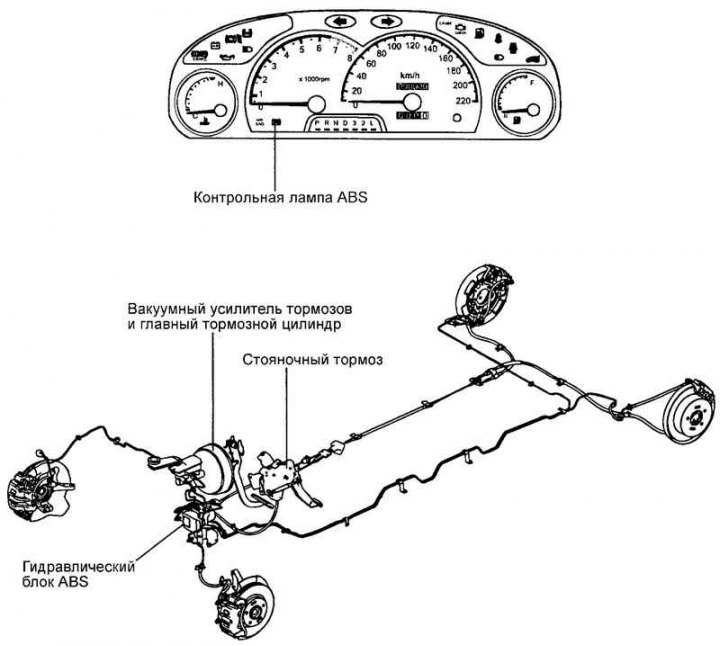
Fig. 6.56. Location of system components

Fig. 6.56. Location of system components


The anti-lock braking system (ABS) controls the pressure in the brake circuits of all four wheels when braking on dangerous (slippery) road sections, preventing the wheels from locking. The ABS system provides the following benefits:
  • allows you to avoid an obstacle with a high degree of confidence, even in the event of emergency braking;
  • allows you to stop the car during emergency braking while maintaining control and stability on the road, even on a curved trajectory.

In case of malfunction, the diagnostic function and emergency operation function included in the system ensure ease of operation and maintenance.

The ABS Integrated Control Unit (HESU), consisting of the ABS hydraulic unit and ABS electronic control unit assembly, receives signals about vehicle speed, road surface conditions and direction of travel from the wheel speed sensors.


Based on these signals, the electronic control unit determines the optimal wheel rotation speed.

Electronic Brakeforce Distribution (EBD)


The use of electronic brake force distribution, compared to the installation of a proportional valve, ensures ideal pressure distribution in the front and rear brake circuits. As a result, braking efficiency is significantly increased and locking of the rear wheels is prevented.

Advantages of electronic control


Functional improvement of the parameters of the main braking system.

Compensation for different coefficients of wheel-road adhesion.

Elimination of the installation of a proportional valve.

Indication of faults by means of a control lamp.

Comparison of brake force distribution characteristics
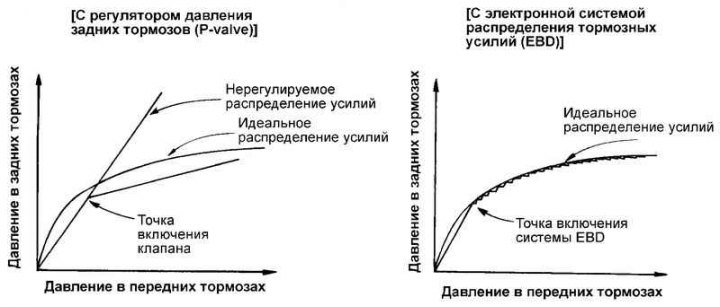


Fig. 6.57. Comparative characteristics…

Fig. 6.57. Comparative characteristics of the distribution of braking forces


Comparative characteristics of the distribution of braking forces are presented in Fig. 6.57.

Checking the hydraulic and electronic control unit of ABS
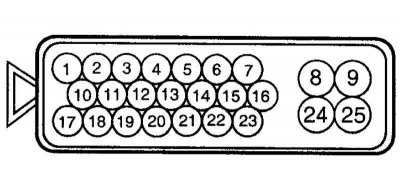


Fig. 6.58. ABS electronic control unit…

Fig. 6.58. ABS electronic control unit connector


See Fig. 6.58.

ABS Electronic Control Unit (HECU) Input/Output Wiring Diagram
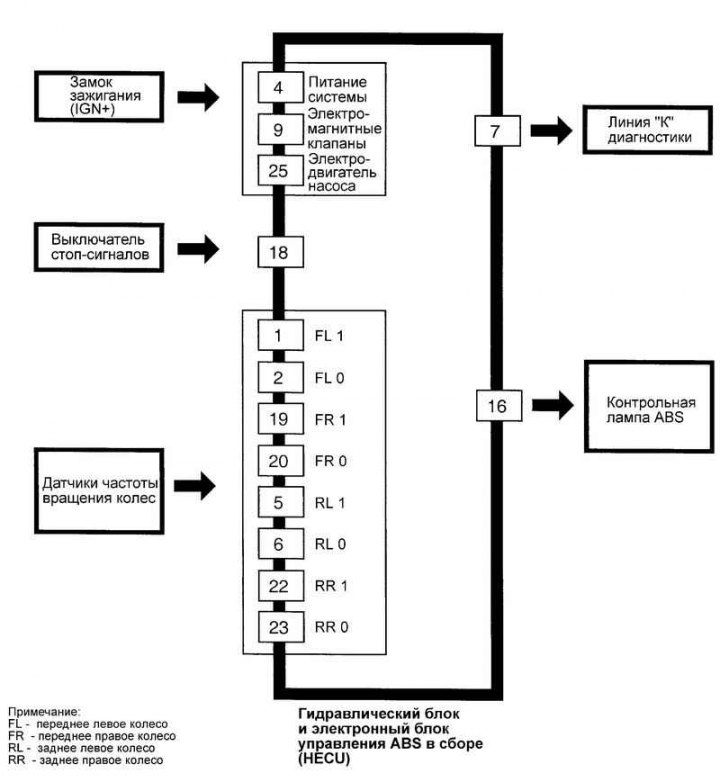


Fig. 6.59. Input/output diagram of the…

Fig. 6.59. Input/output diagram of the ABS electronic control unit


The input-output diagram of the ABS electronic control unit is shown in Fig. 6.59.
This article is available at russian, bulgarian, belarusian, ukrainian, serbian, croatian, romanian, polish, slovak, hungarian
This article has been reviewed by: Konstantin Smirnov
Add to social network:

Previous
Santa Fe 2: Brake system
Next

Checking and adjusting the travel of the parking brake lever
Removal, checking and installation rear drum brakes
Disassembly and assembly of rear disc brakes
Disassembly and assembly of front disc brakes
Removal, checking and installation front brake pads
Removal and installation the ABS electronic control unit
Checking the ABS hydraulic unit
Removal and checking wheel speed sensors (ABS)
Checking the operation of the ABS system
Table 6.1. Technical characteristics (main brake system)
We recommend other articles on the topic of Hyundai manuals:

Anti-lock braking system (ABS) Hyundai Accent 1 (1994-1999)
Anti-lock braking system (ABS) Hyundai Elantra 1 (1990-1995, petrol)
Anti-lock braking system (ABS) controls Hyundai Getz (2002-2011)
Anti-lock braking system — general information Hyundai Sonata 3 (1993-1998)
Anti-lock braking system (ABS) — device Hyundai Tucson 1 (2005-2010)
Anti-lock braking system Hyundai Matrix (2001-2010, petrol)

Link in different formats to this article

Visitor comments
No comments yet


How much will 10 + 45 ?


Santa Fe 2 (2007-2012, petrol) 
  • User manual
  • Control devices
  • Heating and ventilation
  • Seat control
  • Car driving
  • Maintenance and care
  • Vehicle Specifications
  • Engine 2.0 and 2.4 liters
  • Engine specifications
  • Engine maintenance
  • Engine repair
  • Cooling system
  • Intake and exhaust system
  • Fuel system
  • Engine 2.7 liter
  • Engine maintenance
  • Engine repair
  • Cooling system
  • Intake and exhaust system
  • Transmission
  • Transmission specifications
  • Mechanical gearbox
  • Automatic gearbox
  • Drive shafts
  • Chassis
  • Suspension and wheels
  • Steering
  • Brake system
  • Body
  • Exterior (external elements)
  • Electrical equipment
  • Equipment and devices
  • Power devices
  • Specifications
HyundaiBook.ru © 2018-2026 · Mobile version · Sitemap: EN BG BY UA RS HR RO PL SK HU · Administration · Site search · Hyundai owners Accent 1 · Accent 2 · Accent 3 · Elantra 1 · Elantra 2 · Elantra 3 · Getz · Sonata 3 · Sonata 4 · Santa Fe 2 · Tucson 1 · Tucson 2 · Matrix ·
This site uses cookies to optimize its functionality. By continuing, you agree to our terms.