


The pressure reducing valve, which is located at the outlet of the oil pump, opens when the oil pressure increases above 5.6 bar, and some of the oil goes back into the oil sump.
Oil enters the main circuit through the central axis of the filter cartridge. There is an oil pressure switch sensor that shows the driver a drop in oil pressure by lighting up a control lamp on the dashboard. The control lamp lights up when the oil pressure drops below 0.3 bar. The bypass valve ensures the passage of unfiltered oil into the main channel (when the fuel filter is clogged).
The main channel is connected to the lubrication channels for the crankshaft bearings. Oil is supplied to the connecting rod bearings through inclined holes, and at the same time it rises along an inclined channel into the cylinder head, lubricating the camshaft bearings, rocker arms, and valve stems there.
The oil pump is made together with the crankshaft oil seal on the engine toothed belt side. The inner rotor of the oil pump is connected to the crankshaft.
Some models also have an oil radiator. In this case, part of the oil after the oil pump goes to the oil radiator, which serves to improve the cooling of the oil and the engine.
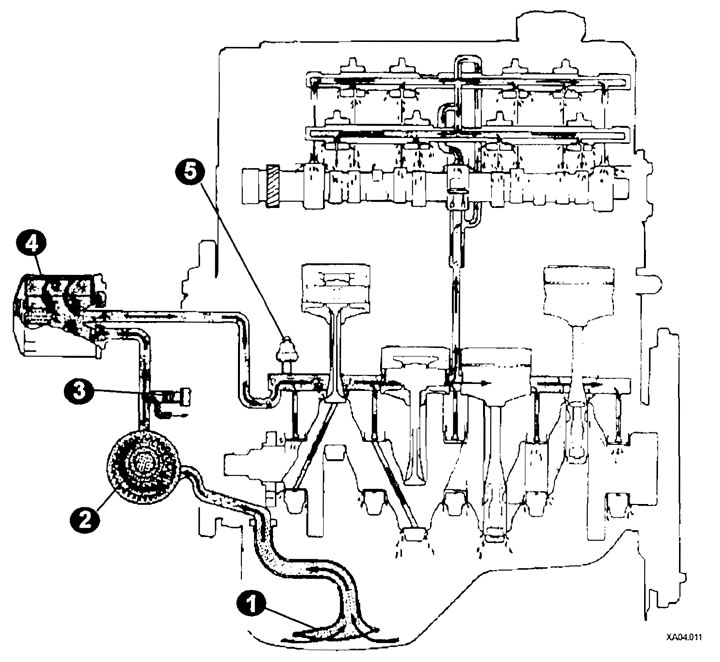
Oil circulation diagram
1 - oil receiver mesh;
2 - oil pump;
3 - pressure reducing valve;
4 - oil filter;
5 - oil pressure sensor.