


Contents: Recommendations for the use of motor…⇓ Motor oil additives ⇓ Synthetic oils ⇓ Simple definition of oil viscosity ⇓
Depending on the operating conditions, different requirements are imposed on motor oils. Therefore, it is very difficult to accurately select a lubricant based on its effect under various operating conditions. Engines that have been running at high speeds or under full load for long periods of time have high oil temperatures. Under the influence of high temperatures and atmospheric oxygen, the oil begins to oxidize. Oxidation products thicken the oil and can form a varnish-like coating on the upper parts of the piston, in the grooves of the piston rings and on the valve stems. This can lead to coking of the valve plate.
When an over-rich fuel mixture enters the cylinders, the engine will rarely or never produce full power and you will be driving with an over-cooled engine (city traffic), there will be no complete combustion of the combustible mixture, and as a result, oil deposits and other products will form. The unburned fuel itself and condensate lead to the formation of slag (sediment) and acid. Unburned fuel settles on the cold cylinder walls and enters the engine crankcase, washing away the oil film on the cylinder and piston. The consequence of this is a reduced effect of lubrication of the piston working surface and dilution of the oil, which worsens the lubricating properties depending on the fuel content.
Since some of the fuel dissolves in the oil during start-up, especially in winter (many starts with a cold engine - a high percentage of fuel in the oil), if the oil is significantly diluted, it must be replaced ahead of schedule.
Depending on the temperature, any oil has a tendency to decrease in viscosity. As heat increases, it becomes less viscous, resulting in deterioration of the adhesive ability and compressive strength of the lubricating film. In cold weather, the oil becomes thick and viscous, with fluidity decreasing and internal frictional resistance increasing. This property is necessary for the use of motor oil, the fluidity of which would change little at variable temperatures.
When the engine is cold, it is necessary that the oil be of sufficiently low viscosity so as not to impede the operation of the starter and so that, as quickly as possible, from the moment the engine is started, the oil reaches all lubrication points.
Recommendations for the use of motor oils
Viscosity is differentiated by the SAE system such as SAE 30, SAE 10, etc. A higher number means a thicker oil. Viscosity does not give an idea of the lubricating properties of the oil.
All-season motor oils can be used for the engine. All-season motor oils have the advantage of being suitable for temperature differences (summer/winter). All-season motor oils are based on low-viscosity seasonal motor oil (for example, 10W). Due to the so-called hardener, the oil is stabilized in a hot state, therefore providing the necessary oiliness for any operating condition. If you use all-season motor oil, you need to take a modern oil with a wide viscosity range (for example 10W-40, 15W-50).
The letter "W" in the SAE system means that the oil is suitable for winter use. When using easy-flowing oils, we are talking about all-season oils, to which a friction coefficient reducer is added, due to which fuel savings of up to 2% are ensured. Easy-flowing oils have low viscosity (for example, 10W-30). They require substandard base oils (synthetic oils). Basically, modern engines use oils
HD Oils HD are alloyed oils whose lubricating properties are significantly improved by the addition of various chemically active substances. These additives provide better protection against corrosion and oxidation phenomena. They provide, in particular, a low tendency to form slag in the engine crankcase, better viscosity, cleaning and dissolving properties. Cleaning and dissolving additives not only reduce the formation of residues in the engine, but also have the ability to dissolve these residues, distribute them and other impurities in the engine oil and constantly keep them in suspension, so that when changing the oil, impurities are also drained. The quality of HD motor oil is determined by the API system (API - American Petroleum Institute). It is designated by two letters. The first letter indicates the area of application: S-service, intended for gasoline engines, C-commercial, intended for diesel engines. The second letter represents the quality in alphabetical order. The highest quality API oils are classified SF for spark-ignition internal combustion engines and CD for diesel engines.
Motor oil additives
The use of additives, no matter what type, in lubricating oils can lead to an undesirable oil mixture composition, and the use of oils with additives that extend their service life remains questionable, especially when using oils for heavy-duty applications - this is the opinion of some leading automotive manufacturers. In any case, you need to use additives very carefully.
Please note: CD motor oils, which are designated by the manufacturer as oils for diesel engines, are not suitable for spark-ignition internal combustion engines. There are oils that are also suitable for gasoline engines. and for diesel. In this case, two classifications are indicated on the bank (for example, SE/CD).
Synthetic oils
There are many superior, high performance oils available that provide better mileage, longer service intervals and, in some cases, better engine protection. They help the engine run smoothly, but the main difference is that the price of synthetic oils is 3 or 4 times higher than that of conventional oils.
Synthetic oil is not for every driver and every driving style, so you need to analyze the condition of your car's engine and your driving style. Thus, the results of this analysis can be the basis for the use of synthetic oils.
New engines and older engines with high mileage are poor candidates for synthetic oil. Synthetic oils are so slippery that they can prevent a new engine from breaking in properly, most oil manufacturers recommend waiting until the engine has been driven for about 500 miles (in running-in mode), and only then use synthetic oil. Older engines with wear and tear also have problems when using synthetic oil: the older the engine, the more oil it consumes during operation. "Slippery" synthetic oils easily pass by worn parts. If your engine has a consumption of conventional oil, it will use synthetic oil much faster. If your car is leaking oil from the seals, then synthetic will leak even more.
Let's consider your driving style. If you do a lot of high-speed highway driving, a more expensive synthetic oil may be preferable. Heavy highway driving gives the engine a chance to warm up, collect fewer acids in the oil and not be subjected to heavy loads during long journeys. Under these conditions, the interval between oil changes may be extended (as long as the oil filter can maintain the oil in good condition) up to the limit specified by the synthetic oil manufacturer. Vehicles with synthetic oil use slightly less fuel when driving on the highway due to less internal friction. However, many auto experts agree that 30 thousand km is too much to find any oil in a car.
Vehicles operated under severe conditions such as stop-and-go traffic, city driving, short trips or frequent idling should be serviced more frequently. For engines in these vehicles, the higher price of synthetic oils can play a significant role in vehicle maintenance costs. Internal wear on these vehicles occurs more quickly, causing increased oil consumption and leaks.
Caution: Mixing conventional and synthetic oils is prohibited. If you use synthetic oil, it makes sense to carry a few liters of the same oil with you, since this type of oil may not be available everywhere.
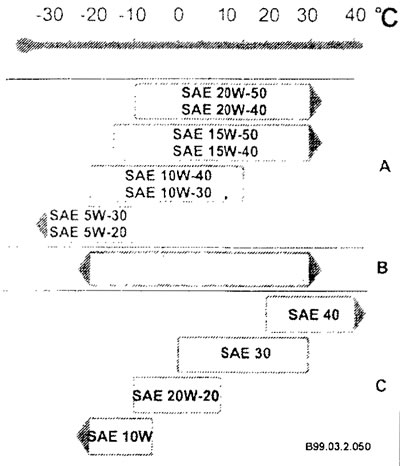
Oil application schedule depending on ambient temperature
A - all-season oil;
B - synthetic oil;
C - seasonal oil.
The temperatures indicated are the prevailing air temperatures. Short-term fluctuations do not matter.
Simple definition of oil viscosity
The viscosity of the oil can be roughly determined by rubbing a few drops between your fingers. The oil being rubbed should not be heated. If you feel warmth, the oil is not viscous enough. A sharp smell of gasoline in it indicates that the oil is diluted with fuel.
Caution: On a heavily worn engine, low oil pressure may be caused by a clogged coarse filter mesh in the intake manifold.