
HyundaiBook.ru
Repair Chevrolet Repair Honda Repair Toyota Repair Land Rover Repair VAZ Repair Renault Repair Nissan
English Русский
Български
Беларускі
Український
Српски
Hrvatski
Română
Polski
Slovenský
Magyar
ArticlesSitemapContacts  


  Accent   Elantra   Getz   Grandeur   Sonata   Santa Fe   Tucson   Others
Elantra 1 (1990-1995, petrol) Elantra 2 (1995-2000, petrol) Elantra 3 (2000-2006)
  • Main
  • Elantra
  • J1 (1990-1995)
  • Chassis
  • Brake system
  • Anti-lock braking system (ABS)

Anti-lock braking system (ABS) (Hyundai Elantra J1)

0
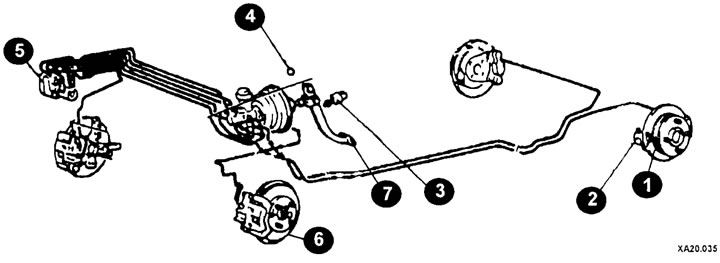
Elements of the braking system of…

Elements of the braking system of models with ABS
1 - rear brake mechanism;
2 - rear wheel speed sensor;
3 - brake light switch;
4 - ABS indicator light;
5 - hydraulic block assembly;
6 - front wheel brake;
7 - brake pedal.


Some models are equipped with an electronic anti-lock braking system (ABS). Additional installation of the ABS system is not possible.

This article is based on information from the website [HyundaiBook.ru]

The ABS system consists of a conventional brake mechanism and various additional elements. In this case, we are talking about a hydraulic control device, four-wheel speed sensors and an electronic control device.

The speed sensors are installed in the steering knuckle of the front wheels and in the rear suspension. The speed sensors generate a corresponding signal, which is communicated to the electronic control device. The device analyzes the braking of the wheels and the slip of the tires on the road surface and, based on this, determines the pressure value for the hydraulic control device. Each front wheel is controlled separately, while both rear wheels are controlled together. There is a warning light on the dashboard that lights up when a defect occurs in the system, i.e. when the ABS device has failed.


Stop, turn off and turn on the engine again.

If the battery voltage is below 9.5V, charge the battery.

If the ABS warning light comes on at the start of the trip and then goes out, this indicates that the battery voltage was low but then increased.
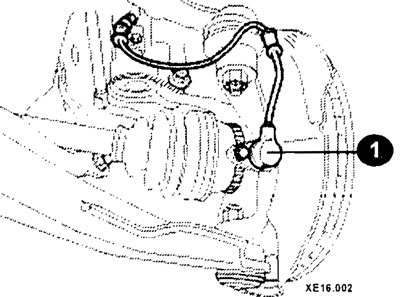
If the ABS warning light comes on at…


Checking the ABS system using a test lamp


Check the brake system and brake pipe and hose connections for leaks.

The ABS warning light should come on when the ignition is turned on.

After starting the engine, the control lamp should flash briefly twice.

If you leave the engine idling for approximately 2 minutes, the ABS warning light should not come on during this time.

On a short test drive (approximately 1 minute) at speeds not exceeding 30 km/h, the ABS warning light should not come on.
This article is available at russian, bulgarian, belarusian, ukrainian, serbian, croatian, romanian, polish, slovak, hungarian
This article has been reviewed by: Konstantin Smirnov
Add to social network:

Previous
Elantra 1: Brake system
Next

Diagnostics of brake system faults
Inspection and replacement of hydraulic tubes and hoses
Master Brake Cylinder — Disassembly and Assembly
Brake Master Cylinder/Vacuum Booster — Removal and Installation
Parking brake — adjustment
We recommend other articles on the topic of Hyundai manuals:

Anti-lock braking system (ABS) Hyundai Accent 1 (1994-1999)
Anti-lock braking system (ABS) controls Hyundai Getz (2002-2011)
Anti-lock braking system — general information Hyundai Sonata 3 (1993-1998)
Anti-lock braking system Hyundai Santa Fe 2 (2007-2012, petrol)
Anti-lock braking system (ABS) — device Hyundai Tucson 1 (2005-2010)
Anti-lock braking system Hyundai Matrix (2001-2010, petrol)

Link in different formats to this article

Visitor comments
No comments yet


How much will 14 + 32 ?


Elantra 3 (2000-2006) 
  • User manual
  • Control devices
  • Audio system
  • Starting the engine and driving
  • Faults en route
  • Maintenance and care
  • Technical information
  • Power unit
  • Gasoline engines
  • Diesel engines
  • Lubrication system
  • Cooling system
  • Fuel system (gasoline)
  • Fuel system (diesel)
  • Decreased toxicity
  • Ignition system
  • Transmission
  • Clutch
  • Mechanical gearbox
  • Automatic gearbox
  • Drive shafts and axles
  • Chassis
  • Car suspension
  • Steering
  • Brake system
  • Body
  • Exterior (external elements)
  • Interior (internal elements)
  • Air conditioning system
  • Electrical equipment
  • Equipment and devices
  • Headlights and lighting
  • Power devices
  • Electrical circuits
Elantra 2 (1995-2000, petrol) 
  • General information
  • Maintenance
  • Power unit
  • Engine repair
  • Cooling system
  • Intake and exhaust system
  • Fuel system
  • Transmission
  • Clutch
  • Manual gearbox
  • Automatic gearbox
  • Drive shafts and axles
  • Chassis
  • Front suspension
  • Rear suspension
  • Steering
  • Brake system
  • Body
  • Body elements
  • Electrical equipment
  • Equipment and devices
  • Electrical diagrams
Elantra 1 (1990-1995, petrol) 
  • General information
  • Introduction to the guide
  • Maintenance
  • Power unit
  • Minor engine repair
  • Engine overhaul
  • Lubrication system
  • Cooling system
  • Fuel injection system
  • Ignition system
  • Exhaust system
  • Transmission
  • Clutch
  • Manual gearbox
  • Automatic gearbox
  • Drive shafts
  • Chassis
  • Front suspension
  • Rear suspension
  • Steering
  • Wheels and tires
  • Troubleshooting
  • Brake system
  • Body
  • Body elements
  • Electrical equipment
  • Equipment and devices
  • Power devices
  • Heating and air conditioning
  • Electrical circuits
HyundaiBook.ru © 2018-2026 · Mobile version · Sitemap: EN BG BY UA RS HR RO PL SK HU · Administration · Site search · Hyundai owners Accent 1 · Accent 2 · Accent 3 · Elantra 1 · Elantra 2 · Elantra 3 · Getz · Sonata 3 · Sonata 4 · Santa Fe 2 · Tucson 1 · Tucson 2 · Matrix ·
This site uses cookies to optimize its functionality. By continuing, you agree to our terms.