


Collector
1. Check the anchor surface for damage and wear. If there is damage or wear, replace the anchor.
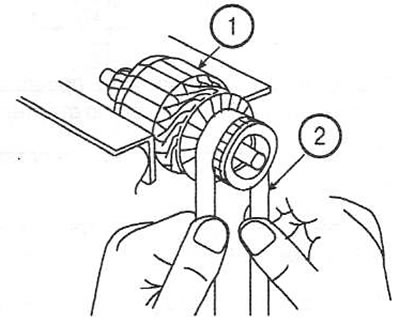
2. Check the surface of the commutator (1). If carbon deposits or contamination are found, sand it with sandpaper (No. 500 or No.600) (2).
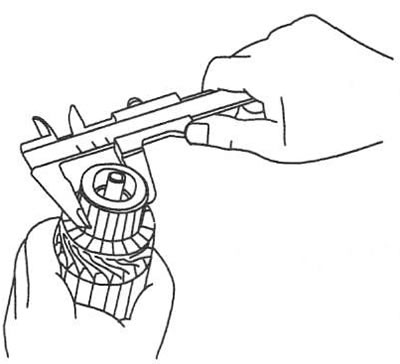
3. Measure the commutator diameter. Nominal value: 33.0 mm. Wear limit: 32.4 mm. If the diameter is below the maximum permissible value, replace the anchor.
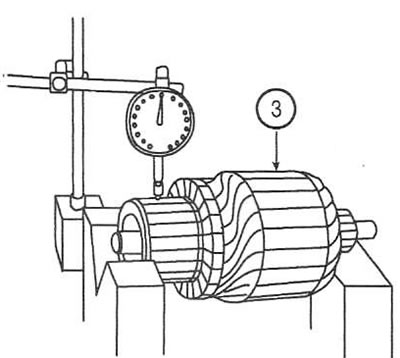
4. Measure the radial runout of the commutator (3). Nominal value: 0.02 mm. Wear limit: 0.05 mm. If necessary, clean the spaces between the commutator lamellas from carbon deposits. If the measured value is less than the maximum permissible value, replace the anchor.
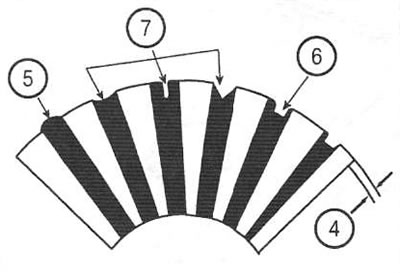
5. Check the amount of protrusion (4) of the collector lamellas. Nominal value: 0.5 mm. Limit value: 0.2 mm.
Note: Clean the spaces (6) between the collector lamellas. The grooves between the lamellas must not protrude outward (5) or have a V-shape (7).
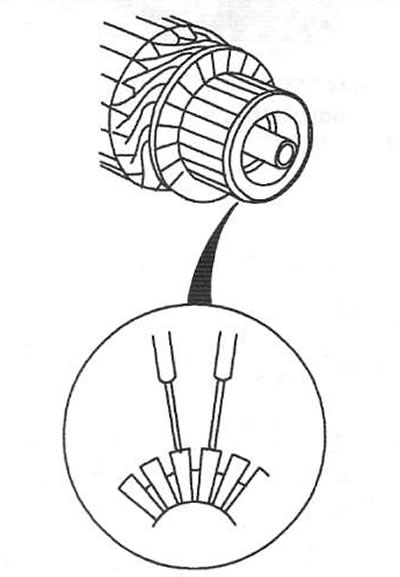
6. Check the continuity of the circuit between the collector lamellas. If there is a break between any of the collector lamellas, replace the anchor.
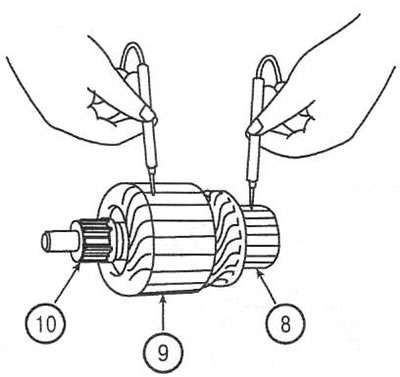
7. Using an ohmmeter, check the insulation between the commutator (8) and the armature winding (9), as well as between the commutator (8) and the shaft (10). If the circuit is shorted, replace the armature.
The original material is located on the website hyundaibook.ru
Brushes and brush holder
Note: Damaged or oily brushes must be replaced.
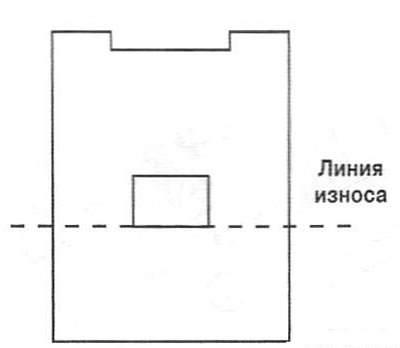
8. Measure the brush protrusion. If the brush protrusion length extends beyond the wear line, replace the brush.
Note: When installing new brushes, lap them onto the commutator. To do this, place sandpaper (No. 500 or No.600) with the abrasive facing outward between the commutator and the brushes. Gently rotate the armature so that the brushes take the shape of the commutator.
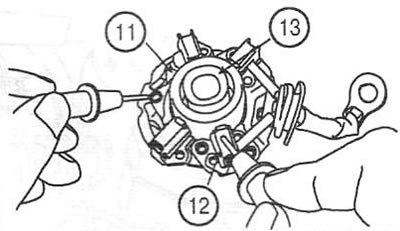
9. Check the insulation between the positive (11) and negative (12) poles and the brush holder. If the insulation is damaged, replace the brush holder.
Note: To prevent the brushes from falling out during inspection, secure them with a suitable bushing (13).
Overrunning clutch
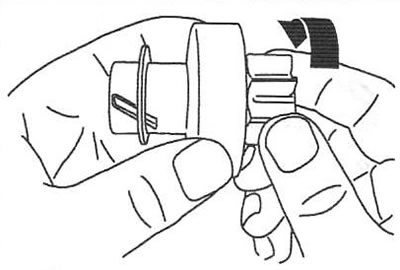
10. Hold the clutch housing and turn the drive pinion: the pinion should rotate evenly in one direction. The pinion should not rotate in both directions. If the pinion rotates in both directions, replace the overrunning clutch.
11. Check for excessive wear or damage to the gear teeth.