

Contents: Adjusting the clearance between the…⇓ Checking the pull-in winding of the…⇓ Checking the holding winding of the…⇓ Idling test ⇓ Checking the release of the traction…⇓
Adjusting the clearance between the end of the drive gear and the stop
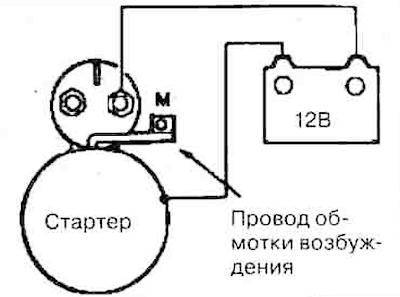
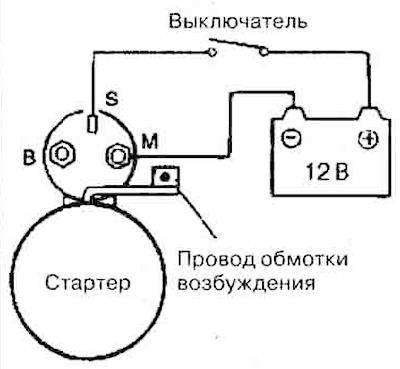
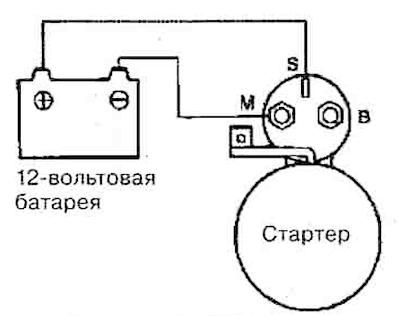
1. Disconnect the excitation winding wire from the "M" terminal of the traction relay.
2. Connect a 12-volt battery to terminals "S" and "M".
3. The drive gear should move to the engaged position.

4. Using a feeler gauge, check the gap between the end of the drive gear and the stop (standard value is 0.5-2.0 mm).
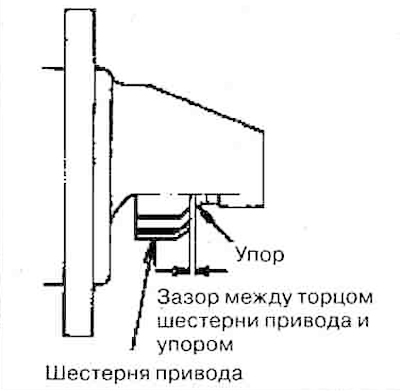
5. If the axial play of the armature shaft is not within the specified limits, adjust it by installing or removing adjusting linings between the traction relay and the cover on the drive side.
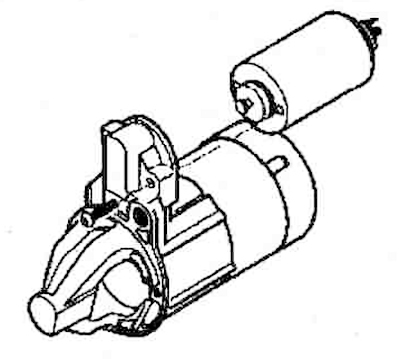
Checking the pull-in winding of the traction relay
1. Disconnect the excitation winding wire from the "M" terminal of the traction relay.
2. Connect a 12-volt battery to terminals "S" and "M".

3. If the drive gear shifts to the engagement position, the relay pull-in winding is OK. If this does not happen, replace the traction relay.
Checking the holding winding of the traction relay
1. Disconnect the excitation winding wire from the "M" terminal of the traction relay.
2. Connect a 12-volt battery to the "S" terminal and ground.

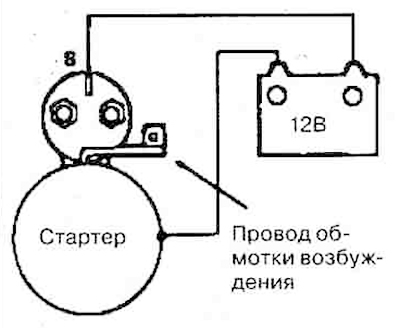
3. If the drive pinion extends to the engagement position, the relay is in good condition. If the pinion extends and returns to its original position multiple times, this indicates a break in the holding winding. Replace the traction relay.
Idling test
1. Clamp the starter in a vice with soft pads and connect a fully charged 12-volt battery to the starter as follows:
2. Connect the control ammeter (with a 100 A scale) and the carbon rheostat as shown in the figure.
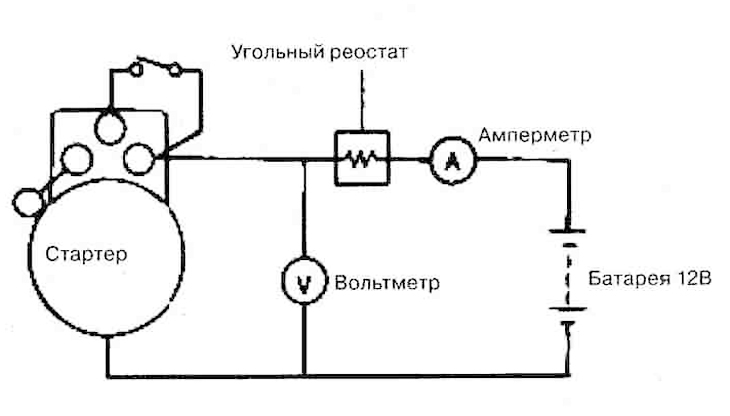
3. Connect a voltmeter (with a 15 V scale) parallel to the starter.
4. Set the carbon rheostat to the off position.
5. Connect the wire from the negative terminal of the battery to the starter housing.
6. Use a rheostat to set the voltage to 11 V according to the voltmeter.
7. Turn on the starter and check that the maximum current consumption corresponds to the standard, as well as the smoothness and ease of rotation of the starter anchor. (Standard values: current consumption: no more than 90 A; anchor rotation frequency: not less than 3000 rpm)
Checking the release of the traction relay
1. Disconnect the excitation winding wire from the "M" terminal of the traction relay.
2. Connect a 12-volt battery to the "M" terminal and the "ground" ("-").

3. Extend and retract the drive pinion. If the pinion quickly returns to its original position, the traction relay is in good condition. Otherwise, replace the traction relay.