HyundaiBook.ru
Repair Chevrolet Repair Honda Repair Toyota Repair Land Rover Repair VAZ Repair Renault Repair Nissan
English Русский
Български
Беларускі
Український
Српски
Hrvatski
Română
Polski
Slovenský
Magyar
ArticlesSitemapContacts  


  Accent   Elantra   Getz   Grandeur   Sonata   Santa Fe   Tucson   Others
Sonata 3 (1993-1998) Sonata 4 (2001-2012, petrol)
  • Main
  • Sonata
  • EF (2001-2012)
  • General information
  • User manual
  • Checking tire pressure and condition

Checking tire pressure and condition (Hyundai Sonata EF)

0
1. Check your tires regularly for damage and air leaks. Check the tire pressure every two weeks or at least once a month. Don't forget to check the pressure in the spare tire.

Note:
  • The lower the tread depth, the greater the risk of tire slippage. The effectiveness of tires for driving on snow is significantly reduced if the tread wears to a height of less than 4 mm.
  • Incorrect tire pressure can reduce tire life and make your vehicle less safe to drive.
  • Underinflation results in excessive tire wear, increased risk of punctures due to overheated tires, poor handling and increased fuel consumption.
  • High tire pressure results in reduced comfort, poor vehicle handling, and increased wear on the center tread of the tire.


2. Check the pressure only when the tires are cold. If the car is parked for at least three hours, the pressure gauge readings will be correct.
  • Recommended tire pressure is 210 kPa

Note: The required pressure for the tires recommended by the manufacturer is indicated on a label attached to the driver's side door pillar.


Attention:
  • Always use a pressure gauge. The appearance of the tire can be misleading.
  • Remember to replace the tire valve cap as dirt and moisture can get into the valve, which can cause air leaks.


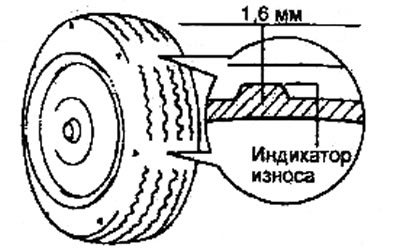
3. Check the tire tread depth. If the tread depth is less than the maximum permissible value, the tire must be replaced.
  • The maximum permissible value is 1.6 mm

Note: When the tread depth decreases to 1.6 mm or less, wear limit stripes (wear indicator) appear on the tire.


Note: When the tread depth decreases to…


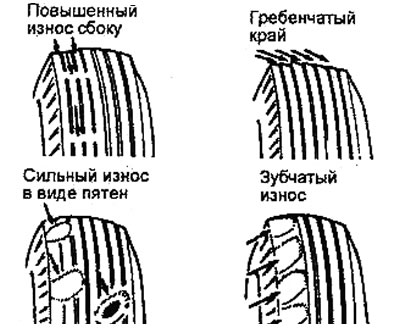
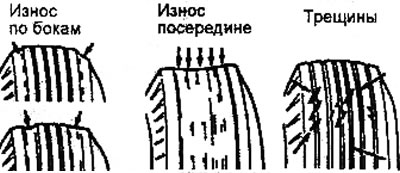
4. Visual inspection of the tire condition.
  • a) The reason for rapid wear of the tread on the sides or in the middle of the tread or the appearance of cracks in the tread is low tire pressure or failure to comply with the regulated periods/mileages for wheel rotation.
  • b) The reason for increased wear on one side of the tread is a violation of the camber angle of the wheels.
  • c) The reason for the appearance of a comb-shaped edge of the tread is incorrect wheel alignment.
  • d) The reason for the appearance of severe wear in the form of spots ("bald spots") on the tread is the imbalance of the wheel.
  • d) The cause of the appearance of toothed wear on the side (in the form of "combs") is non-compliance with the regulations for wheel rotation, increased wear or improper adjustment of suspension units.
d) The cause of the appearance of…
This article is available at russian, bulgarian, belarusian, ukrainian, serbian, croatian, romanian, polish, slovak, hungarian
This article has been reviewed by: Konstantin Smirnov
Add to social network:

Previous
Sonata 4: User manual
Next

Recommendations for choosing tires
Wheel replacement
Jacking up a car
Spare tire, jack and tools
Engine malfunctions while driving
Tire replacement
Features of using aluminum wheels
Replacement of wheel disks
Brake pad wear indicators
Catalytic converter and exhaust system
We recommend other articles on the topic of Hyundai manuals:

Checking the condition and repairing the oil pressure sensor Hyundai Accent 3 (2005-2010)
Checking tire pressure Hyundai Elantra 1 (1990-1995, petrol)
Checking Transmission Fluid Pressure Hyundai Getz (2002-2011)
Table 1.6. Recommended tire pressure Hyundai Santa Fe 2 (2007-2012, petrol)
Oil pressure sensor — checking technical condition Hyundai Tucson 2 (2009-2015)
Checking the technical condition of the car Hyundai Matrix (2001-2010, petrol)

Link in different formats to this article

Visitor comments
No comments yet


How much will 31 + 49 ?


Sonata 4 (2001-2012, petrol) 
  • General information
  • User manual
  • Maintenance
  • Power unit
  • 2.0 and 2.4 liter engines
  • 2.7 liter engines
  • Engine overhaul
  • Cooling system
  • Intake and exhaust systems
  • Lubrication system
  • MFI fuel injection system
  • Engine electrical equipment
  • Transmission
  • Clutch
  • Mechanical gearbox
  • Automatic gearbox
  • Drive shafts
  • Chassis
  • Front suspension
  • Rear suspension
  • Steering
  • Brake system
  • Body
  • Exterior
  • Interior
  • Heater and air conditioner
  • Security systems
  • Electrical equipment
  • Troubleshooting
  • Electrical circuits
Sonata 3 (1993-1998) 
  • General information
  • Maintenance
  • Power unit
  • Engine repair I4 DOHC
  • Engine repair I4 SOHC
  • Engine repair V6 SOHC
  • Cooling system
  • Intake and exhaust system
  • Exhaust gas treatment
  • Fuel system
  • Transmission
  • Clutch
  • Mechanical gearbox
  • Automatic transmission KM-175
  • Automatic transmission F4A33
  • Chassis
  • Front suspension
  • Rear suspension
  • Steering
  • Brake system
  • Body
  • Body elements
  • Electrical equipment
  • Equipment and devices
HyundaiBook.ru © 2018-2026 · Mobile version · Sitemap: EN BG BY UA RS HR RO PL SK HU · Administration · Site search · Hyundai owners Accent 1 · Accent 2 · Accent 3 · Elantra 1 · Elantra 2 · Elantra 3 · Getz · Sonata 3 · Sonata 4 · Santa Fe 2 · Tucson 1 · Tucson 2 · Matrix ·
This site uses cookies to optimize its functionality. By continuing, you agree to our terms.