


2. Turn off the engine, turn the ignition key to the "LOCK" position and turn on the hazard warning lights.
3. Securely set the parking brake, move the shift lever to the reverse position (models with manual transmission) or the selector lever to the "P" position (models with automatic transmission).
4. Remove the jack and tools.
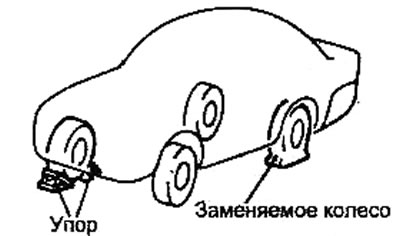
5. Place a wheel chock under the wheel that is diagonal to the jacking point.
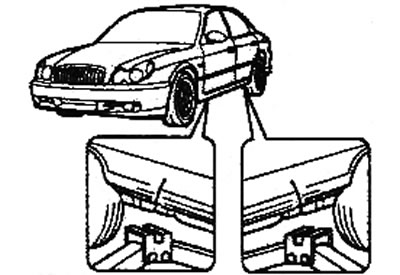
6. Install the jack in one of the specially designed places shown in the figure.
Attention:
- Avoid installing the jack on a slope, uneven or soft surface and make sure there is no sand or small stones on the supporting surface. Otherwise, the jack may tilt and move from the installation position or fall, which may cause an accident. Always install the jack on a flat, hard surface.
- Install the jack only in the recommended position. Raising the car with an incorrectly positioned jack may result in damage to the car (dents on the body, etc.), the car slipping off the jack, or the jack may fall, injuring you.
- Before installing the jack, make sure that there is no sand or small stones on the supporting surface.
- Do not start the engine or leave the engine running while the vehicle is jacked up, as the vehicle may move.
- Never stand under a vehicle unless the vehicle is supported only by a jack.
- Use the jack only to raise the vehicle when changing a tire.
- Do not lift the vehicle if anyone is inside.
7. Assemble the jack handle as shown in the figure.

8. Turn the handle clockwise to jack up the vehicle.
9. After completing the work, lower the vehicle and put away the jack and tools.