Contents: Ignition switch ⇓ Before launch ⇓ Starting the engine ⇓ If the engine does not start... ⇓ Jump starting with an additional…⇓ Features of starting the engine on…⇓ Starting with a faulty immobilizer ⇓
Caution: Do not allow the engine to run at high speed for a long time or accelerate sharply when the engine is not warmed up.
Ignition switch
1. "LOCK" position. The engine is not running and the steering wheel is locked, only in this position can the key be inserted into the lock and removed from the ignition switch.
Note: After opening the driver's door, the ignition switch light comes on if the ignition key is in any position except "ON". The light goes out 10 seconds after the ignition key is turned to the "ON" position or the door is closed.
2. Position "ACC". The engine does not work, the radio, cigarette lighter, etc. can work.
3. Position "ON". The ignition is on (the engine is running or not running) and all electrical circuits are on.
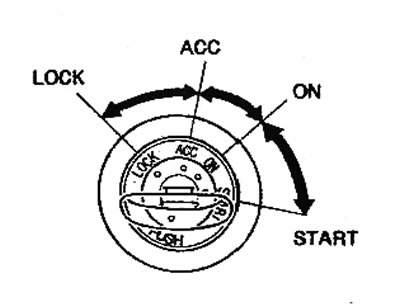
4. "START" position. The engine crankshaft is turned by the starter. After the engine starts, release the key and it will automatically return to the "ON" position.
Attention:
- Do not remove the key from the ignition while the vehicle is moving, as this will lock the steering wheel and make it impossible to control the vehicle.
- When the engine stops while the vehicle is moving, the brake booster stops working and braking efficiency is reduced. The power steering also does not work, and significant physical effort is required to operate the steering wheel.
- Do not leave the key in the "ON" position for long periods of time when the engine is not running, as this will drain the battery.
- Do not turn the ignition key to the "START" position while the engine is running. This may damage the starter.
- To remove the key from the ignition lock, turn it to the "ACC" position (for models with automatic transmission, set the selector lever to the "P" position), and then, by pressing, turn the key to the position "LOCK"
- If the vehicle is equipped with an electronic blocking device (immobilizer), then in order to start the engine, the identification code generated by the built-in transponder key must match the identification code registered in the blocking device's computer.
Before launch
1. Apply the parking brake.
2. Turn off unnecessary lights and auxiliary equipment.
Caution: If the exterior lights (headlights or front fog lights) are on, the battery charge will be reduced and it will be difficult to start the engine.
3. For models with manual transmission:
- a) Press the clutch pedal all the way down and move the gearshift lever to neutral position.
- b) Keep the clutch pedal depressed until the engine starts.
Caution: On a vehicle with a manual transmission, the vehicle may move when starting if the gearshift lever is not in neutral and the clutch pedal is not pressed.
4. For models with automatic transmission:
- a) Set the automatic transmission selector to position "P". When restarting (engine stalls), set the automatic transmission selector lever to position "N".
- b) Press the brake pedal and hold it until you start moving.
Starting the engine
Attention:
- Do not crank the engine for more than 15 seconds at a time. This may discharge the battery, overheat the starter and electrical connections. If the engine does not start within 15 seconds, turn the ignition key to the "LOCK" position and wait at least one minute before trying again.
- Do not start or leave the vehicle engine running in a closed area, as this may result in poisoning from exhaust gases.
- After starting, warm up the engine until the coolant temperature gauge needle starts moving (engine crankshaft speed decreases). Warming up too long will increase fuel consumption.
(The original text is published on the website HYUNDAIBOOK)
1. Turn the ignition key to the "ON" position.
2. Under normal conditions, without pressing the accelerator pedal, turn the ignition key to the "START" position and crank the engine with the starter until the engine starts. Release the key as soon as the engine starts.
Note:
If the engine does not start in very cold weather, press the accelerator pedal halfway before starting the engine. After the engine starts, gradually release the accelerator pedal. On models with the ABS system, extraneous sounds (clicks) and the noise of the pump electric motor will be heard from the engine compartment during engine start-up. In addition, pulsation will be felt on the brake pedal. These sounds are associated with the self-diagnostic procedures of this system.
3. If the engine is cold, warm it up. After the engine warm-up speed is automatically reduced, the car is ready to drive.
If the engine does not start...
1. Before performing any checks, ensure that the starting procedure has been performed correctly and that there is sufficient fuel in the tank.
2. If the engine crankshaft does not turn or turns too slowly:
- a) Check that the battery terminals are clean and securely tightened.
- b) If the battery terminals are OK, turn on the interior lighting. If there is no lighting, it is dim, or it goes out when the engine is cranked by the starter, the battery is discharged. Perform a jump start using an additional battery.
- c) If the lighting is normal, but the engine does not start, then it is faulty.
Warning: Do not attempt to start the engine by towing or pushing for a long time, as the timing belt may jump several teeth and cause the piston to hit the valves. In addition, the catalytic converter may fail, overheat and cause a fire.
3. If the engine crankshaft turns normally, but the engine does not start, then:
- a) Check the tightness of the connectors (e.g. spark plug connections, ignition coils, etc.).
- b) If the connectors are OK, the spark plugs can be "flooded".
Jump starting with an additional battery
Caution: The booster battery voltage must be 12 V. Do not start the engine using a booster battery unless you are sure that its parameters meet the required ones.
1. Turn off all unnecessary lights and accessories and ensure that the vehicles do not touch.
Caution: Apply the parking brake securely on each vehicle. Move the automatic transmission selector lever to the "P" position or the manual transmission selector lever to the "N" position.
2. If necessary, remove all vent plugs from the booster and discharged batteries. Place a cloth over the open vents on the batteries (this helps reduce the risk of explosion).
3. If the engine of the vehicle with the booster battery does not work, start it and let it run for a few minutes. When starting with the booster battery, the engine should run at approximately 2000 rpm.
4. Connecting cables.
- a) Make the cable connections in the order shown in the figure.
Note: To avoid serious injury when making connections, do not lean over the battery or allow cables or clamps to accidentally touch anything other than the appropriate battery terminals or ground.
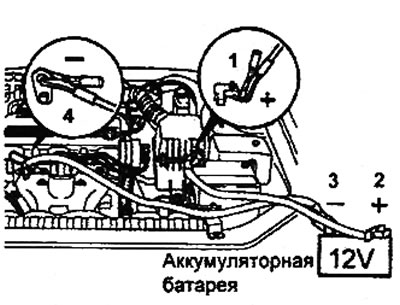
- b) Connect the clamp from the other end of the negative cable of the booster battery to a rigid, stationary, unpainted metal part of the engine of the vehicle with the discharged battery.
Caution: Do not connect the cable near any part that may move when the engine cranks.
5. Start the engine in the normal way. Once started, it should run for a few minutes.
6. Carefully disconnect the cables, first the negative, then the positive, in the reverse order of their connection.
7. Carefully remove any cloths covering the batteries as they may contain sulfuric acid.
8. If the ventilation plugs were removed, install them in their places.
Features of starting the engine on models with ABS system with a completely discharged battery
If, with a completely discharged battery, an external power source is connected via jumper wires to start the engine, and the car immediately starts moving (without giving the discharged battery some time to recharge), then the ignition system may begin to fail, which will lead to the car stopping and the inability to continue moving.
This phenomenon occurs as a result of the high current consumption of the ABS system for self-diagnosis. To avoid this phenomenon, it is necessary to either allow the battery to charge while the engine is idling, or to turn off the system by removing the corresponding fuse from the circuit of this system in the engine compartment.
Note: The ABS indicator will illuminate if the corresponding fuse link is removed.
After the battery is sufficiently charged, turn off the engine, reinstall the fuse (for the ABS system) and start the engine again. Make sure that the ABS indicator is off.
Starting with a faulty immobilizer
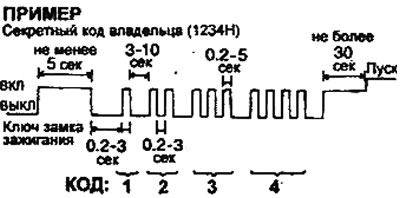
1. To start the car with a faulty immobilizer, a 4-digit owner's secret code is required, which is entered into the immobilizer system using a special sequence of ignition ON/OFF cycles.
Note: The owner's secret code can be obtained from an authorized HYUNDAI dealer.
2. To enter each digit, you need to turn the ignition key "OFF" → "ON" → "OFF" the number of times corresponding to the digit. After entering each digit, you need to wait 3-10 seconds.
3. After entering the owner's secret code, the system will be unlocked for 30 seconds to start the engine. After this period of time has elapsed, starting the engine will be impossible.
Please note: if the engine stalls while driving in emergency mode, it can only be started within 8 seconds.