


2. Raise the front of the vehicle so that the drive wheels can turn freely.
3. Connect the tachometer and position it so that it is clearly visible.
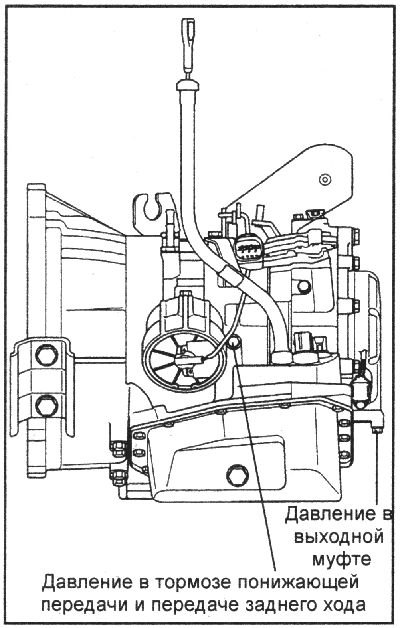
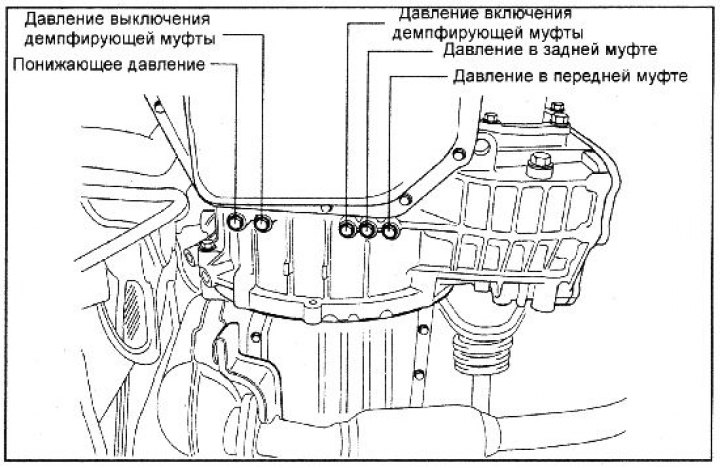
4. Connect the special test pressure gauge 09452–21500 with the adapter 09452–21002 to each oil pressure supply nipple.
For reverse pressure, a pressure gauge with a measurement limit of 3,000 kPa must be used.
5. Measure the transmission fluid pressure at various selector lever positions and engine speeds. If the pressure does not correspond to the required values, check and repair the transmission components.
Transmission Fluid Pressure Control Values
The text is provided by the web resource: www.HyundaiBook.ru
| № | State | Standard transmission fluid pressure, kPa | ||||||||||
| Selector positions | Speed km/h | Crankshaft speed | Selector lever position | 1 Lowering pressure | 2 Kickdown Brake Pressure | 3 Front Clutch Pressure | 4 Pressure in the outlet coupling | 5 Pressure in brake lower. trans. and Z.Kh. | 6 Pressure on. damping clutch | 7 Pressure. off. damper. couplings | 8 Rear Clutch Pressure | |
| 1 | N | 0 | H.H. | Neutral. | 400–440 | — | — | — | — | — | — | |
| 2 | D | 0 | H.H. | 2nd lane. | 400–440 | 58–147 | — | — | — | — | — | — |
| 3 | D(SW-ON) | 110 | 2500 | 4th lane. | 400–440 | 637–695 | — | 650–710 | — | 637–793 | — | 833–911 |
| 4 | D(SW-OFF) | 75 | 2500 | 3rd lane. | 400–440 | 840–900 | 813–872 | 833–911 | — | 637–793 | — | 833–911 |
| 5 | 2 | 50 | 2500 | 2nd lane. | 400–440 | 840–900 | — | — | — | 637–793 | — | |
| 6 | L | 0 | 2500 | 1st lane. | 400–440 | — | — | — | 235–294 | 245–400 | 510–610 | 833–911 |
| 7 | R | 35 | 2500 | 3.x. | 420–480 | — | 1,666–2,058 | — | 1,666–2,058 | 245–450 | 450–646 | 833–911 |
Preliminary actions if oil pressure is abnormal
| Sign of malfunction | Probable cause | Actions |
| 1. The pressures in the pipeline are very low (or high). See the pressure values in columns 2, 3, 4, 5, 6, 7, 8 of the table "Transmission fluid pressure control values" | 1. The oil filter is dirty 2. Incorrect adjustment of the main pressure regulator valve | • Visually inspect the oil filter and replace it if necessary. • Check the pipeline pressure according to criterion 2 • Check the operation of the regulator valve and, |
| The pressures in the pipeline are very low (or high). | • Regulator valve jamming • Loosening of valve body fastening • Incorrect pressure at the oil pump outlet | • Check the operation of the regulator valve • Tighten the valve body mounting bolts and the installation bolt • Check the axial clearance of the oil pump gear and, if necessary, replace the oil pump |
| Inadequate pressure reduction | • Inadequate pressure in the pipeline • Filter clogging (L-type) • Incorrect adjustment of the reducing pressure • Jamming of the pressure reducing valve • Loosening of valve body fastening | • Check the pressure according to criterion 2. If the pressure • Disassemble the valve body, check the condition • Check the reducing pressure 1. If the pressure • Check the operation of the pressure reducer and replace the valve body if necessary • Tighten the valve body mounting bolts and the installation bolt |
| Inadequate kickdown brake pressure | • Damaged B-ring, O-ring, bushing or kickdown servo piston • Loosening of valve body fastening • Functional failure of the valve body | • Remove the kickdown servo piston and check the condition of the O-ring and D-ring. If there are any scratches, replace the D-ring or O-ring • Tighten the valve body mounting bolts and the installation bolt • Replace the valve body |
| Inadequate front clutch pressure a | • D-ring, bushing or ser is damaged • Loosening of valve body fastening • Valve body is damaged • Wear of the front piston •Oil pump gasket or sealing ring is damaged (2) | • Remove the kickdown servo piston and check the condition of the sealing ring. If there are any scratches • Tighten the valve body mounting bolts and the installation bolt • Replace the valve body • Disassemble the transmission and check for wear on the front clutch piston, inner circumference of the retainer, or damage to the D-ring. If there is wear and tear, |
| Inadequate final drive clutch pressure | •The D-ring, sealing is damaged • Loosening of valve body fasteners • Valve body is damaged | • Disassemble the output coupling and check the condition • Tighten the valve body mounting bolts and the installation bolt • Replace the valve body |
| Low brake pressure in low and reverse gears | • The seal between the housing is damaged • Loosening of valve body fastening • Valve body is damaged • The downshift and reverse gear brake sealing ring or the retainer sealing ring is damaged | • Remove the valve body, check the condition of the seal and replace it if necessary • Tighten the valve body mounting bolts and the installation bolt • Replace the valve body • Disassemble the gearbox, check the condition of the sealing ring and replace if necessary |
| Incorrect torque converter pressure | • Damping clutch control solenoid valve (DCCSV) stuck • Clogged or leaking oil cooler and/or lines | • Check the operation of the damper clutch and DCCSV • Repair or replace the radiator and/or |
| Incorrect torque converter pressure | • The sealing ring is damaged • The torque converter is damaged | • Disassemble the gearbox, check the condition of the sealing ring and replace it if necessary |
| Inadequate reverse clutch pressure | • The D-ring is damaged, sealing • Loosening of valve body fastening • Valve body is damaged | • Replace the torque converter • Disassemble the final drive clutch and check • Tighten the valve body mounting bolts and the installation bolt • Replace the valve body |
| Incorrect shock absorber clutch pressure | Probably the same reason as the reason for the pressure failure in the damper clutch control | Probably the same troubleshooting method as the cause of the pressure failure by controlling the damping clutch |