


How does a car stereo work
AM and FM signals are transmitted through repeaters located around the city. The signals coming from them are received by the car antenna. When a strong radio signal comes to the radio antenna, a modern audio system provides high-quality reproduction. However, in some cases, the incoming signal is not strong and clear. This may be due to the distance from the radio station, proximity to other radio stations, or the presence of buildings, bridges, or other large objects in your area.
Generally, AM signals are better received than FM signals. This is because AM radio waves are transmitted at low broadcast frequencies. Long, low-frequency radio waves can travel through the atmosphere in a straight line or bend around the curvature of the earth's surface. Moreover, they can bend around objects and provide better radio coverage. As a result, AM signals can be clearly received over longer distances than FM signals.
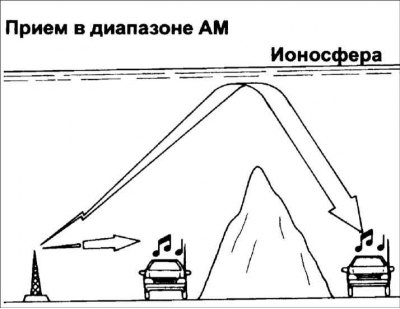
AM radio wave propagation
FM radio waves are transmitted at high broadcast frequencies and cannot bend around the earth's surface. As a result, FM radio waves generally begin to weaken a short distance from the transmitting station. FM radio waves are more susceptible to the influence of buildings, mountains, or other objects. This may result in poor playback quality, and you may mistake this for a malfunction of the radio. The following conditions are normal and do not indicate a malfunction of the radio:
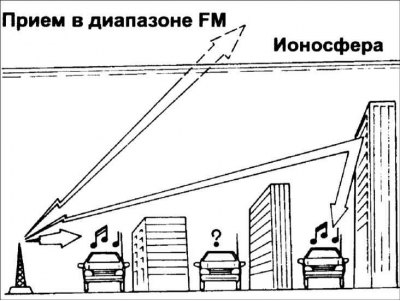
Propagation of FM radio waves
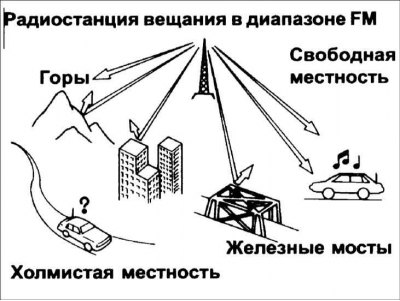
Propagation of FM radio waves in different areas
– attenuation – as the distance of the car from the transmitting antenna of the radio station increases, the power of the radio signal decreases and the sound begins to fade. In this case, it is recommended to choose another station with a stronger signal;
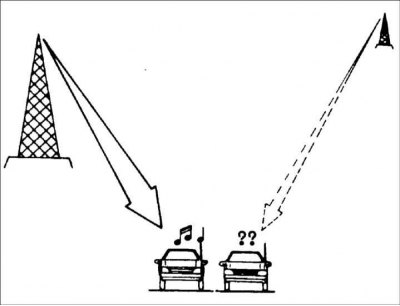
The occurrence of signal attenuation in the FM range with increasing distance of the vehicle from the transmitting antenna of the radio station
– constant buzzing noise – a weak FM radio signal or large obstacles between the radio transmitter and the vehicle"s receiving antenna will cause interference in the form of a constant buzzing noise. This effect can be reduced by lowering the tone control in the high-frequency range;
– signal mixing – as the signal in the FM range weakens, another stronger signal with a close broadcast frequency may appear. This happens when the tuning system of the radio receiver works on the clearest signal. In this case, switch to another station with a stronger signal;
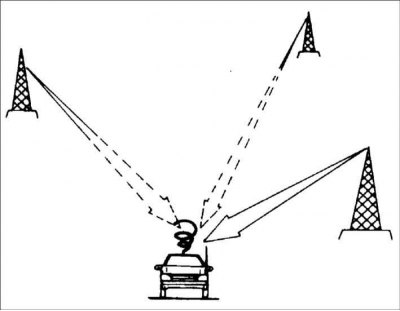
The emergence of signal mixing as the signal in the FM range weakens and another stronger signal with a close broadcast frequency appears
– interference noise – radio signals coming from different directions hitting the car antenna can cause a constant buzzing noise. This can be caused by a direct radio signal and a reflected signal from one broadcasting station or two signals from stations broadcasting on close frequencies hitting the car antenna. In this case, switch to another station until the condition disappears.