


Contents: Fan mode switch ⇓ Air intake mode selection switch ⇓ Selecting a ventilation mode ⇓ Air temperature control knob ⇓ Heater control knobs ⇓ Air supply mode to the legs/head area ⇓ Ventilation mode ⇓ Central deflector ⇓ Side deflector ⇓ Frost/condensation removal (fogging) ⇓ Tips for managing your ventilation…⇓ Air conditioner switch ⇓ Air conditioner operation ⇓ Air Conditioner Control Tips ⇓
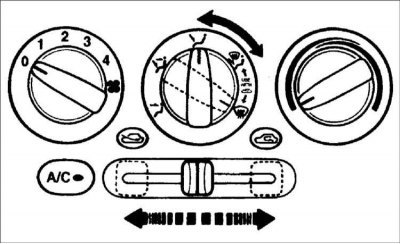
The heating and ventilation system panel is shown in the figure.
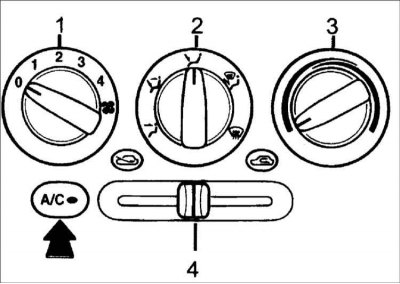
Heating and ventilation system panel:
1 - fan operation mode switch;
2 – ventilation mode selection handle;
3 – air temperature control handle;
4 – air intake mode selection switch.
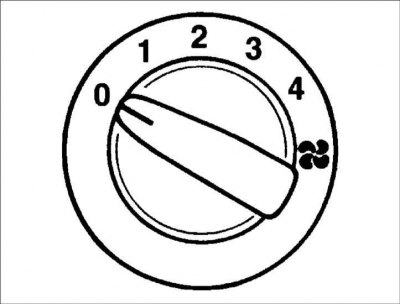
Fan mode switch
The switch is designed to turn the fan on and off and select its rotation speed. The fan rotation speed and, therefore, the amount of air flow coming from the ventilation system can be changed manually by turning the switch between positions "1" and "4".
Fan mode switch
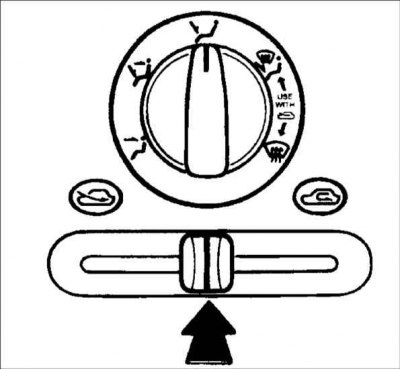
Air intake mode selection switch
The switch is designed to switch ventilation modes between the outside air intake mode and the recirculation mode.
Air intake mode selection switch
 Outdoor air intake mode
Outside air enters the vehicle interior, heated or cooled depending on the selection of other functions.
 Air recirculation mode
The air in the car interior is recirculated and heated or cooled depending on the selection of other functions.
Warning! Using the air recirculation mode for a long time may cause the windshield and side windows to fog up and the air inside the vehicle to become stale. Furthermore, using the air conditioner in the air recirculation mode for a long time may cause the air inside the vehicle to become too dry.
Selecting a ventilation mode
The ventilation mode selection knob is used to select the air flow direction.
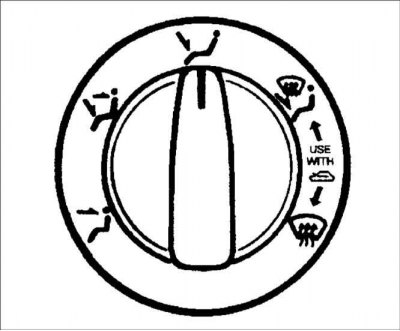
 In the head area
The air flow through the deflectors enters the upper part of the car interior.
 To the legs/head area
Air flows through the deflectors to the upper part of the car interior and to the foot area. This allows warm air to be supplied through the deflectors to the feet at the same time, and not heated or slightly heated air through the deflectors to the upper part of the car interior.
 In the leg area
Air flows only to the leg area.
 In the foot area/to the windshield and side window heating deflectors.
Air flows through the deflectors to the footwell area, as well as to the windshield and door windows. When selecting a mode (to the windshield and side window heating deflectors), the air conditioner will be automatically turned on.
 To the windshield and side window heating deflectors.
Air through the deflectors goes only to the windshield and door windows of the car. When selecting the mode (to the deflectors of the heating of the windshield and side windows), the air conditioner will be automatically turned on.
Air temperature control knob
The handle is used to turn the heater on and off and select the desired air temperature.

Air temperature control knob
Heater control knobs
For normal operation of the heater, set the air intake mode selection switch to the outside air intake mode
 and the ventilation mode selection knob to the position (to the feet area) .
Heater control knobs
For faster heating, set the air intake mode selector switch to recirculated air mode

If the windows fog up, set the ventilation mode selection knob to the position (towards the windshield and side window heating deflectors)
 (in this case, the air conditioner will be automatically turned on), and the air intake mode selection switch to the outside air intake mode .
For maximum heat, set the air temperature control knob to the Warm position.
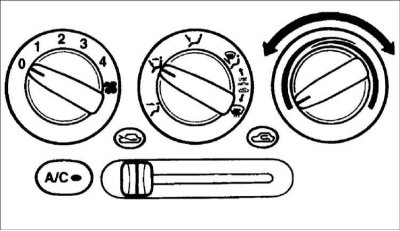
Air supply mode to the legs/head area
The footwell/headwell air mode simultaneously delivers warm air through the footwell vents and cool air through the upper vents. To activate this mode, set the controls to the following positions:
Position of the handles in the air supply mode to the legs/head area
– set the air intake mode selection switch to the outside air intake mode
 ;
;
– set the ventilation mode selection knob to the position (to the feet/head area)
 ;
;
– Set the air temperature control knob between the Cool (cold air) and Warm (hot air) positions.
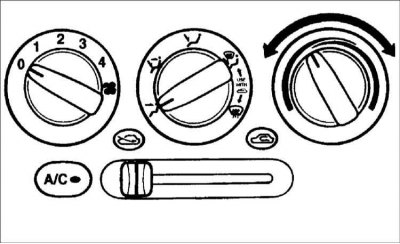
Ventilation mode
To turn on the ventilation system, set the handles to the following positions:
The full version is located on the website: hyundaibook
Position of the handles in ventilation mode
– set the air intake mode selection switch to the outside air intake mode
 ;
;
– to direct all air flow through the heated windshield and side window deflectors, set the ventilation mode selection knob to the (head) position
 ;
;
– use the fan mode switch to select the desired fan speed;
– Set the air temperature control knob between the Cool (cold air) and Warm (hot air) positions.
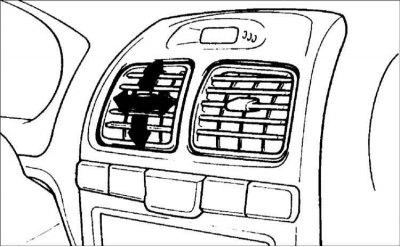
Central deflector
The central ventilation deflectors are located in the center of the instrument panel.
To change the direction of the air flow, turn the control knob located in the middle of the central deflector to the desired position.
Directions of movement of the central deflector control handle
Side deflector
The side deflectors are located at the edges of the instrument panel. To change the direction of the air flow, turn the control knob located in the middle of the side deflector to the desired position.
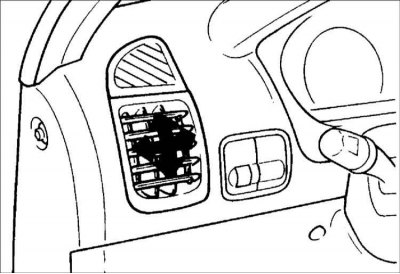
Directions of movement of the side deflector control handle
Frost/condensation removal (fogging)
Use this mode to remove frost or condensation (fogging).
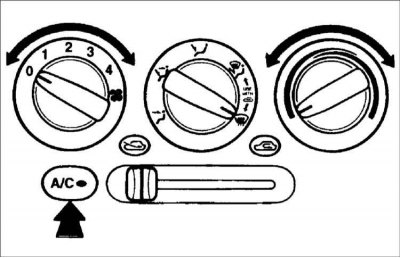
Position of the handles in the frost/condensation removal (fogging) mode
To remove frost or condensation (fogging) from the inside of the windshield:
– set the air intake mode selection switch to the outside air intake mode in the position
 ;
;
– set the ventilation mode selection knob to the position towards the windshield and side window heating deflectors
 (the air conditioner will be turned on automatically);
– set the air temperature control knob to the desired position;
– set the fan mode switch between positions "1" and "4".
To remove frost or condensation (fogging) from the outside of the windshield:
– set the air intake mode selection switch to the outside air intake mode
 ;
;
– set the ventilation mode selection knob to position (towards the windshield and side window heating deflectors)
 (the air conditioner will be turned on automatically);
– set the air temperature control knob to the Warm position (Hot air);
– set the fan mode switch to position 3 or 4.
Tips for managing your ventilation system
To prevent dust or unwanted odors from entering the vehicle interior, temporarily set the air intake mode selector switch to the recirculated air mode
 .
.
To maintain fresh air in your vehicle, be sure to return the air intake mode selector switch to the outside air intake mode
 .
.
This contributes to the driver's cheerfulness and comfort.
Air for the heating/cooling system is supplied through louvers located directly in front of the windshield. Keep these louvers free of leaves, snow, ice or other foreign objects.
Air conditioner switch
The air conditioner is turned on by pressing the air conditioner switch on the heater/air conditioner control panel.
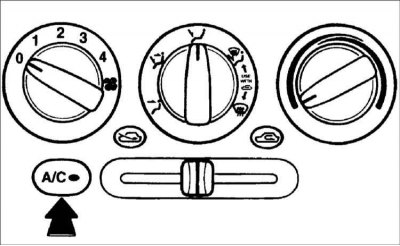
Air conditioner switch
Air conditioner operation
Cooling
Using an air conditioner to cool the air inside the car:
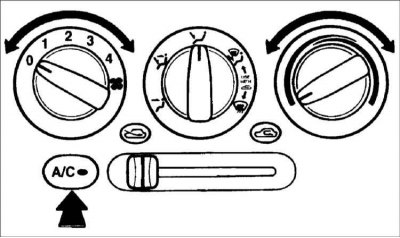
Location of handles when the air conditioner is operating in cooling mode
– turn the fan mode switch to turn off the fan;
– Press the air conditioner switch to turn on the air conditioner. The air conditioner indicator light will light up in the instrument cluster;
– set the air intake mode selection switch to the outside air intake mode
 ;
;
– Set the air temperature control knob to the Cool position. This position provides maximum air cooling. The temperature of the air entering the passenger compartment can be changed by moving the knob toward the Warn position;
– Use the fan mode selector to select the desired fan speed. For maximum cooling, turn the fan mode selector to one of the highest speeds or temporarily set the air intake mode selector to air recirculation mode
 .
.
Dehumidifying heating
For dehumidifying heating, follow these steps:
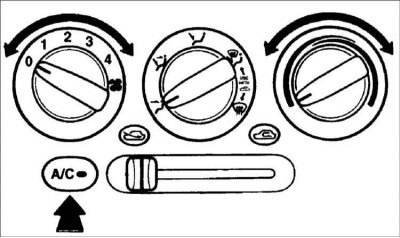
The location of the handles when the air conditioner is operating in the dehumidifying heating mode
– turn on the fan by turning the fan mode switch. Press the air conditioner switch to turn on the air conditioner. The air conditioner indicator light will light up in the instrument cluster;
– set the air intake mode selection switch to the outside air intake mode
 ;
;
– set the ventilation mode selection knob to the head position
 ;
;
– use the fan mode switch to select the desired fan speed;
– to speed up the process, turn the fan mode switch to one of the highest speeds;
– Use the air temperature control knob to set the desired temperature.
Air Conditioner Control Tips
If the air inside the car is too hot, open all the windows for a few minutes to cool the air inside the car.
When the air conditioner is running, all windows must be closed to prevent warm air from entering the car interior.
When the car is moving slowly, for example in a traffic jam, engage a lower gear. This will increase the engine speed, which in turn will increase the speed of the air conditioning compressor.
On steep climbs, turn off the air conditioner to prevent the engine from overheating.
During the winter or when the air conditioner is not used regularly, turn on the air conditioner once a month for a few minutes. This prevents deterioration of the lubrication of the internal parts of the compressor and ensures that the air conditioning system is maintained in good condition.