
HyundaiBook.ru
Repair Chevrolet Repair Honda Repair Toyota Repair Land Rover Repair VAZ Repair Renault Repair Nissan
English Русский
Български
Беларускі
Український
Српски
Hrvatski
Română
Polski
Slovenský
Magyar
ArticlesSitemapContacts  


  Accent   Elantra   Getz   Grandeur   Sonata   Santa Fe   Tucson   Others
Tucson 1 (2005-2010) Tucson 2 (2009-2015)
  • Main
  • Tucson
  • LM (2009-2015)
  • Chassis
  • Brake system
  • Anti-lock braking system — device

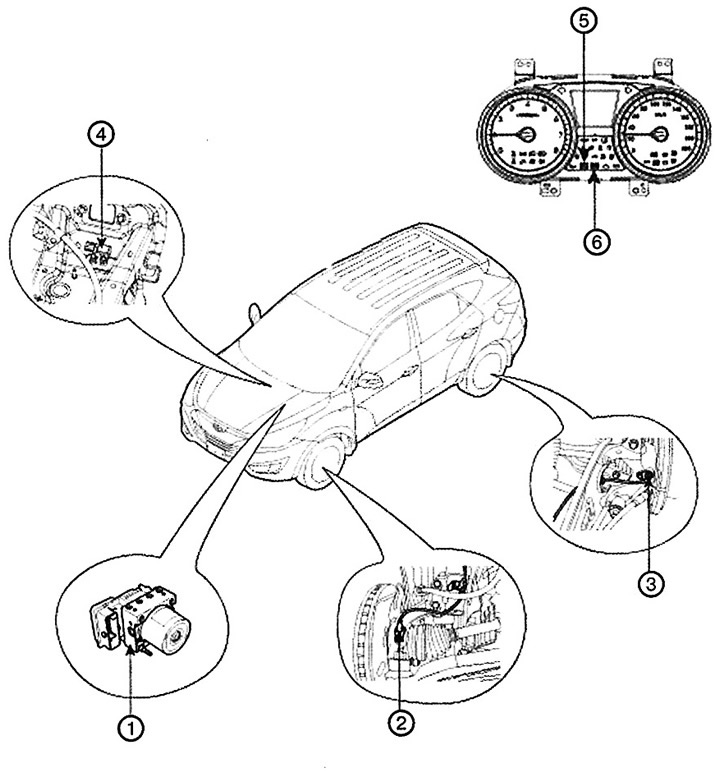
Anti-lock braking system — device (Hyundai Tucson LM)

0
1. Hydroelectronic control unit of the…

1. Hydroelectronic control unit of the anti-lock braking system
2. Front wheel speed sensor
3. Rear wheel speed sensor
4. Longitudinal acceleration sensor (4 WD only)
5. Parking brake/EBD indicator lamp
6. Anti-lock brake system indicator light


The anti-lock braking system (ABS) is used to regulate the pressure in the brake mechanisms of all wheels when braking in difficult road conditions, preventing wheel locking. ABS provides the following benefits:

1. Avoiding obstacles with a higher degree of safety, including during emergency braking.

2. Reducing the braking distance during emergency braking while maintaining vehicle stability and control, including when turning.

In case of system failure, a diagnostic function and a fail-safe system are provided.

Traction control system (TCS) is a variable system designed to regulate traction during acceleration or cornering. The system controls the vehicle's movement by braking one of the vehicle's wheels or by suppressing excess engine power, so that the vehicle does not skid and maintains directional stability.

The hydroelectronic control unit (HECU) receives information about the vehicle speed, direction of travel and road conditions from the wheel speed sensors.


Based on this information, the control unit determines the optimal wheel braking mode.

The Electronic Brakeforce Distribution (EBDF) system is a subsystem of the ABS and serves to ensure effective traction of the rear wheels.

In addition, based on the high efficiency of the perfect ABS, the ERTS prevents skidding of the rear wheels under partial braking conditions.

The braking force is maintained close to the optimum value and is regulated electronically, which eliminates the need for a conventional pressure regulator. Since the pressure regulator is a mechanical device, it has limitations in terms of achieving ideal distribution of braking force to the rear wheels, as well as flexible distribution of forces depending on the degree of vehicle loading. In addition, if the mechanical pressure regulator is faulty, it is not detected by the driver.

The ERTS, controlled by the ABS electronic brake control unit, calculates the slippage of each wheel at any given moment and regulates the pressure in the rear brakes so that it exceeds the pressure in the front brakes. If the ERTS malfunctions, the ERTS (EBD) (and parking brake) indicator lamp lights up in the instrument cluster.

Advantages of ERTS:
  • Improving the performance of the basic braking system.
  • Compensation for differences in friction coefficients.
  • Elimination of pressure regulator.
  • Malfunction signaling by control lamp.

Attention. Any work related to diagnostics and repair of the anti-lock braking system (ABS) should be carried out only at specialized service stations by qualified specialists, since this is directly related to road safety.
This article is available at russian, bulgarian, belarusian, ukrainian, serbian, croatian, romanian, polish, slovak, hungarian
This article has been reviewed by: Konstantin Smirnov
Add to social network:

Previous
Tucson 2: Brake system
Next

Parking brake system — adjustment
Parking brake system — installation
Parking brake system — removal
Parking brake system — device
Rear brakes
Hydroelectronic control unit (HECU)
Front wheel speed sensors
Rear wheel speed sensors
Longitudinal acceleration sensor
Electronic stabilization system
We recommend other articles on the topic of Hyundai manuals:

General information about the anti-lock braking system Hyundai Accent 1 (1994-1999)
Electrical diagram of the anti-lock braking system Hyundai Elantra 3 (2000-2006)
Anti-lock braking system (ABS) controls Hyundai Getz (2002-2011)
Anti-lock braking system — general information Hyundai Sonata 3 (1993-1998)
Anti-lock braking system Hyundai Santa Fe 2 (2007-2012, petrol)
Anti-lock braking system Hyundai Matrix (2001-2010, petrol)
Link in different formats to this article

Visitor comments
No comments yet


How much will 27 + 40 ?


Tucson 2 (2009-2015) 
  • General information
  • Faults en route
  • User manual
  • Maintenance
  • Power unit
  • Gasoline engines
  • Diesel engines
  • Engine cooling system
  • Engine lubrication system
  • Engine power system
  • Control system
  • Intake and exhaust systems
  • Engine electrical equipment
  • Transmission
  • Clutch
  • Mechanical gearbox
  • Automatic gearbox
  • Drive shafts
  • Chassis
  • Suspension and wheels
  • Brake system
  • Steering
  • Body
  • Exterior (external elements)
  • Interior (internal elements)
  • Security systems
  • Air conditioning and heater
  • Electrical equipment
  • Electrical circuits
Tucson 1 (2005-2010) 
  • General information
  • User manual
  • Maintenance
  • Power unit
  • Gasoline engine G6BA
  • Gasoline engine G4GC
  • Diesel engine D4EA
  • Fuel system (gasoline)
  • Fuel system (diesel)
  • Engine lubrication system
  • Engine cooling system
  • Engine electrical equipment
  • Transmission
  • Clutch
  • Car gearbox
  • Drive shafts and cardan
  • Chassis
  • Car suspension
  • Steering
  • Brake system
  • Body
  • Exterior (external elements)
  • Interior (internal elements)
  • Air conditioning and heater
  • Airbags
  • Electrical equipment
  • Equipment and devices
  • Electrical circuits
HyundaiBook.ru © 2018-2026 · Mobile version · Sitemap: EN BG BY UA RS HR RO PL SK HU · Administration · Site search · Hyundai owners Accent 1 · Accent 2 · Accent 3 · Elantra 1 · Elantra 2 · Elantra 3 · Getz · Sonata 3 · Sonata 4 · Santa Fe 2 · Tucson 1 · Tucson 2 · Matrix ·
This site uses cookies to optimize its functionality. By continuing, you agree to our terms.