Contents: The engine does not turn over or…⇓ The engine turns over normally with…⇓ The engine stalled while driving ⇓ Starting the engine from an external…⇓ Engine overheating ⇓

The engine does not turn over or turns over slowly with the starter

1. On a vehicle with an automatic transmission, make sure the selector lever is in the "N" or "P" position and that the parking brake is applied.
2. Check the reliability of the connection and the cleanliness of the battery wires.
3. Turn on the interior lights. If the lights dim or go out when you turn on the starter, this indicates that the battery is discharged.
4. Check the reliability of the wires connection to the starter.
5. Do not start the engine by pushing or towing. See "Starting the motor from an external power source" below.
The engine turns over normally with the starter, but does not start
1. Check the fuel level.
2. Check the reliability of all ignition system connections, coil and spark plugs. Restore disconnected or weak connections.
3. Check the fuel lines in the engine compartment.
4. If the engine still does not start, contact your Hyundai dealer or other qualified service personnel for assistance.
The engine stalled while driving
1. Reduce speed gradually, continuing to move straight ahead. Carefully turn off the roadway in a safe place.
2. Turn on the hazard warning lights.
3. Try to start the engine. If it does not start, contact your Hyundai dealer or other qualified assistance.
Starting the engine from an external power source
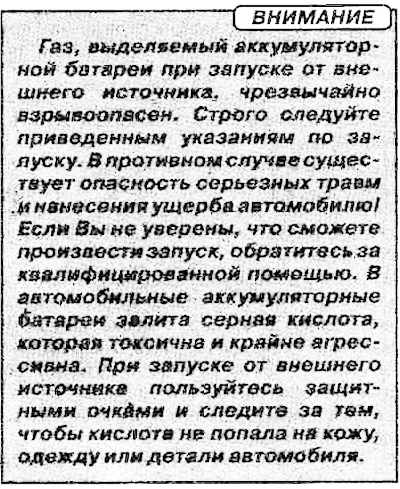
If acid comes into contact with clothing, skin or eyes, remove clothing immediately and rinse affected areas with clean water for at least 15 minutes. Then seek medical attention as soon as possible. Continue to rinse affected areas with a sponge or cloth while transporting to a medical facility.
The gas released by the battery when starting from an external source is extremely explosive. Do not smoke and make sure that there is no sparking or open flame in the vicinity.
The booster battery used for starting must have a voltage of 12 V. If the battery voltage cannot be determined, do not use it for starting.
Starting the engine from an external power source when the vehicle battery is discharged is carried out in strict accordance with the following instructions:
1. If the booster battery is installed in another vehicle, ensure that the vehicles do not touch each other.
2. Turn off all unnecessary lights and accessories on both vehicles.
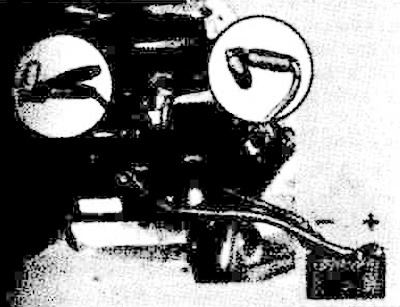
3. Connect the wires to the battery terminals as shown in the illustrations on the previous page. First, attach the clamp on the wire to the positive ("+") terminal or cable of the dead battery. Then attach the clamp on the other end of the same wire to the positive ("+") terminal or cable of the booster battery. Next, attach the clamp on the second wire to the negative ("-") terminal or cable of the booster battery, then attach the other clamp on the same wire to a solid metal part of the engine away from the battery. Do not attach the wire to any moving part.
(The original material is located on the website HyundaiBook)
4. Start the engine of the vehicle with the battery being jump-started and let it run for a few minutes to recharge the battery. When starting the engine with a discharged battery, increase the crankshaft speed of the donor vehicle engine to approximately 2000 rpm.
5. Start your car's engine as normal. After starting the engine, without disconnecting it from the external battery, let it run for a few minutes at fast idle or at a speed of about 2000 rpm.
6. Carefully disconnect the connecting wires in the reverse order of their connection.
If the cause of the battery discharge is not clear (the cause may be failure to turn off the outside lights, etc.), have the battery charging circuit checked by a Hyundai dealer.
Engine overheating
If the coolant temperature gauge needle is in the overheating zone, you feel a loss of engine power, or you hear a loud or dull engine knocking noise, the likely cause is engine overheating. If this occurs, you should:
1. Turn off the road and stop in a safe place.
2. Set the selector lever to position "P" (on a car with an automatic transmission) or engage neutral (on a car with an automatic transmission) and apply the parking brake. If the air conditioner is running, turn it off.
3. If coolant is leaking from under the vehicle or steam is coming from under the hood, stop the engine. Do not open the hood until the coolant has stopped leaking or steam is coming from under the hood. If there is no visible coolant leak or steam, do not stop the engine and check that the cooling fan is working. If the fan is not working, stop the engine.
4. Check if the water pump drive belt is in place. If it is in place, check its tension. If the belt is OK, check for coolant leaks from the radiator, hoses, and under the car (condensation from the air conditioner flows under the parked car if it is on).


5. If the water pump drive belt breaks or coolant leaks, stop the engine immediately and contact your nearest Hyundai dealer for assistance.

6. If you are unable to determine the cause of overheating, wait until the engine cools down to normal temperature. Then, if there is a coolant leak, carefully open the radiator cap and add enough coolant to bring the level between the marks on the expansion tank.
7. Continue driving carefully, watching for signs of overheating again. If the engine overheats again, contact your Hyundai dealer for assistance.