
HyundaiBook.ru
Repair Chevrolet Repair Honda Repair Toyota Repair Land Rover Repair VAZ Repair Renault Repair Nissan
English Русский
Български
Беларускі
Український
Српски
Hrvatski
Română
Polski
Slovenský
Magyar
ArticlesSitemapContacts  


  Accent   Elantra   Getz   Grandeur   Sonata   Santa Fe   Tucson   Others
Elantra 1 (1990-1995, petrol) Elantra 2 (1995-2000, petrol) Elantra 3 (2000-2006)
  • Main
  • Elantra
  • XD (2000-2006)
  • Electrical equipment
  • Power devices
  • Starter for gasoline engines

Starter for gasoline engines (Hyundai Elantra XD)

0
Contents: Removal and installation ⇓ Checking and replacing stator…⇓ Operational tests (idling) ⇓ Assembling the starter ⇓
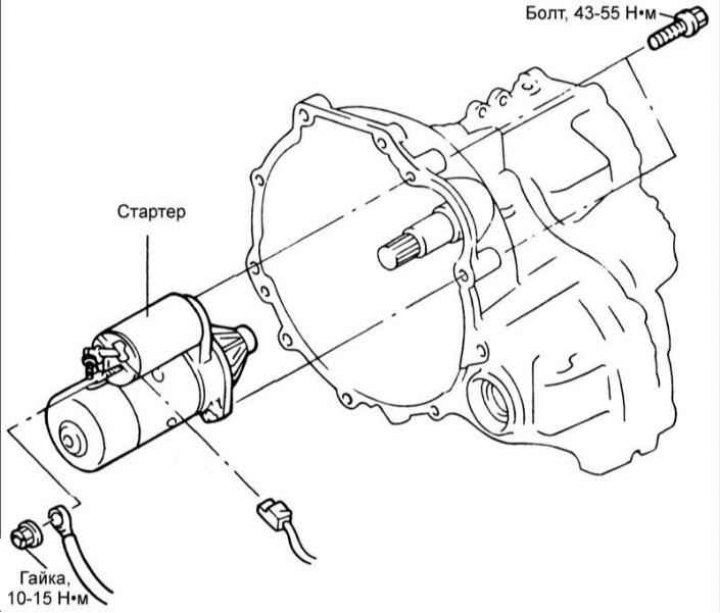
Removal and installation


Removal and installation


1. Disconnect the cable from the negative terminal of the battery.

2. Disconnect the speedometer and gear shift cable.

3. Disconnect the connector from the starter and the wire from the terminal.

4. Unscrew the bolts and remove the starter.

5. Installation is carried out in the reverse order of removal.
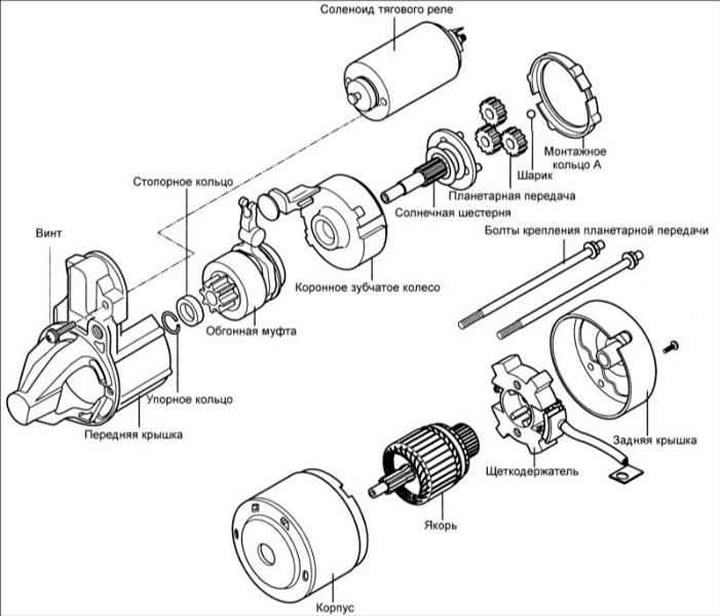
Checking and replacing stator elements


Checking and replacing stator elements


Adjusting the gear clearance


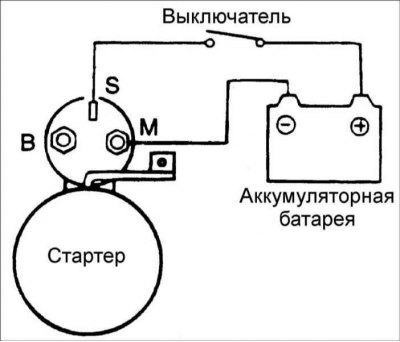
1. Disconnect the starter motor wire from the "M" terminal.
2. Using additional wires, connect the battery terminals to terminals «S» and…


2. Using additional wires, connect the battery terminals to terminals "S" and "M".


3. Turn on the ignition, the starter gear will move forward.

Warning! This test must be performed within 10 seconds, otherwise the traction relay solenoid may burn out.

4. Use a feeler gauge to check the gap between the gear and the stopper. If the…


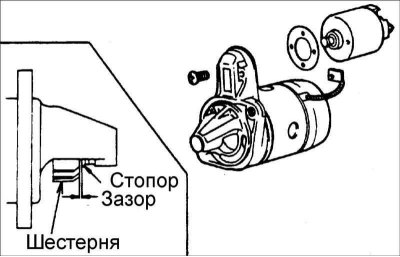
4. Use a feeler gauge to check the gap between the gear and the stopper. If the gap is different from the required one, adjust it by adding or removing shims between the traction relay and the front cover. Gear clearance: 0.5–0.2 mm.

Checking the starter traction relay


1. Disconnect the starter motor wire from the "M" terminal.
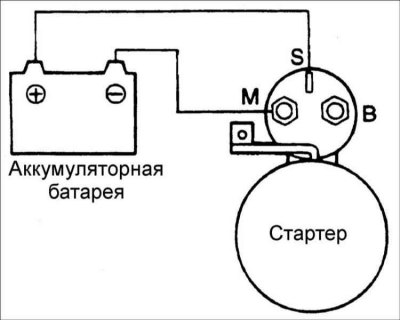
2. Using additional wires, connect the battery terminals to terminals «S» and…


2. Using additional wires, connect the battery terminals to terminals "S" and "M".

3. Turn on the ignition, the starter gear will move forward. If the pinion does not extend, replace the traction relay.

Warning! This test must be performed within 10 seconds, otherwise the traction relay coil may burn out.


Checking the holding winding of the traction relay
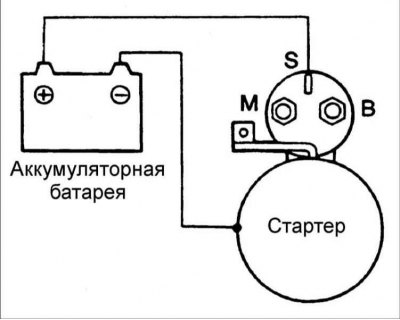


1. Disconnect the starter motor wire from the «M» terminal.


1. Disconnect the starter motor wire from the "M" terminal.

2. Using additional wires, connect the battery terminals to the "S" terminal and the traction relay housing.

Warning! This test must be performed within 10 seconds, otherwise the traction relay coil may burn out.
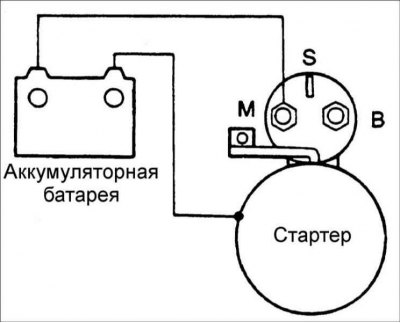

3. If the gear remains in place, then the holding winding of the traction relay is damaged and the traction relay must be replaced.

Checking the return of the traction relay plunger


1. Disconnect the starter motor wire from the "M" terminal.

2. Using additional wires, connect the battery terminals to terminal M and the traction relay housing.

Warning! This test must be performed within 10 seconds, otherwise the traction relay coil may burn out.


3. The starter gear should move forward. Once the wires are disconnected, the…


3. The starter gear should move forward. Once the wires are disconnected, the starter gear should quickly return to its original position.


Operational tests (idling)
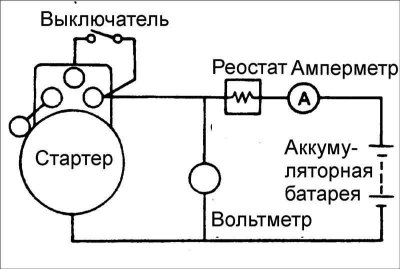


1. To perform the idle test, assemble the circuit shown in the figure.


1. To perform the idle test, assemble the circuit shown in the figure.

2. Set the rheostat slider to a position where the voltmeter shows a voltage of 11.5 V, while checking the current consumed by the starter and making sure that the starter shaft turns easily and smoothly. Current: no more than 60 A.

Overrunning clutch gear


To remove the overrunning clutch from the rotor shaft, it is necessary to first remove the thrust ring.
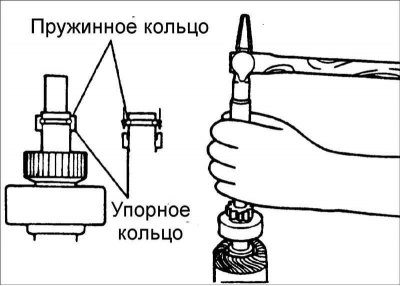
Move the thrust ring towards the gear and remove the snap ring. The thrust ring…


Move the thrust ring towards the gear and remove the snap ring. The thrust ring can now be removed from the shaft.

Checking the rotor winding
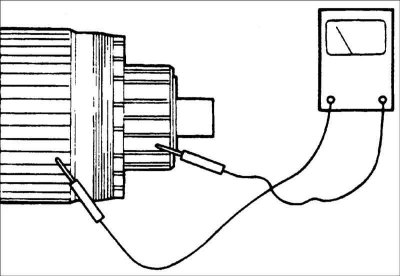


1. Use an ohmmeter to check the conductivity between the collector and the…


1. Use an ohmmeter to check the conductivity between the collector and the rotor. If there is continuity, replace the rotor.
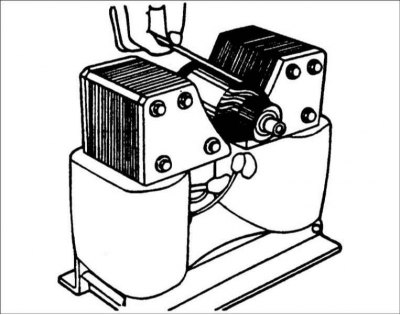


2. Check the rotor winding using a special device. If there are short circuits,…


2. Check the rotor winding using a special device. If there are short circuits, replace the rotor. If a steel strip applied to the rotor vibrates, there are short circuits in the rotor windings.
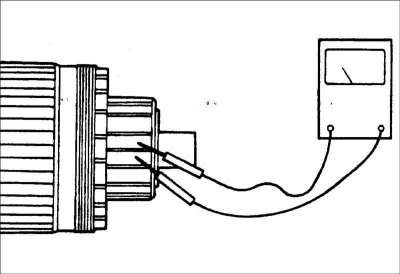
3. Use an ohmmeter to check the conductivity between the collector segments. If…


3. Use an ohmmeter to check the conductivity between the collector segments. If there is no conductivity, replace the rotor.

Checking the stator coils
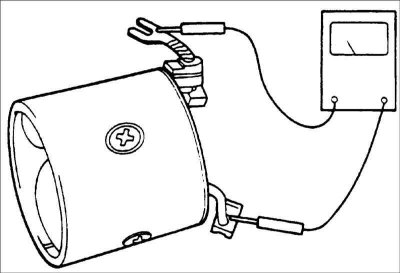


1. Use an ohmmeter to check the conductivity of the stator coils. If there is…


1. Use an ohmmeter to check the conductivity of the stator coils. If there is no conductivity, replace the stator coils.
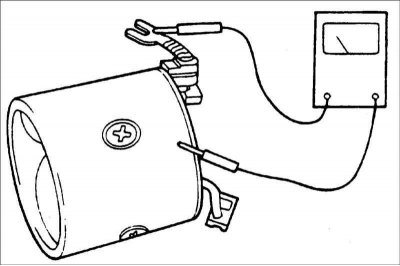


2. With the coil installed in the housing, check the continuity between the…


2. With the coil installed in the housing, check the continuity between the coil terminal and the starter housing. If there is continuity, replace the stator coils.

Checking the brushes
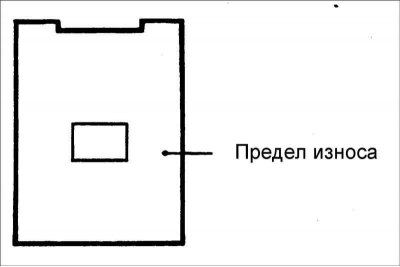


If the brush is worn to the specified limit, replace it.


If the brush is worn to the specified limit, replace it.

Checking the brush holder
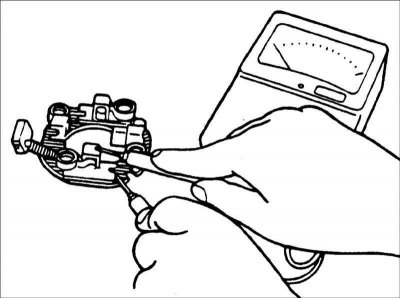


Use an ohmmeter to check the conductivity between each insulated brush and the…


Use an ohmmeter to check the conductivity between each insulated brush and the plate. If there is conductivity, replace the brush holder.


Checking the overrunning clutch


1. Check the condition of the teeth of the overrunning clutch gear and, if damaged, replace it. Also check the condition of the flywheel ring gear teeth.
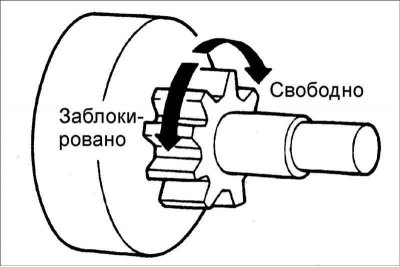
2. Turn the gear. The gear should rotate freely clockwise and lock when turned…


2. Turn the gear. The gear should rotate freely clockwise and lock when turned counterclockwise

Replacing brushes


1. Remove the worn brush, being careful not to damage the braided wire.

2. Use sandpaper to smooth the end of the braided lead to ensure good contact with the new brush.
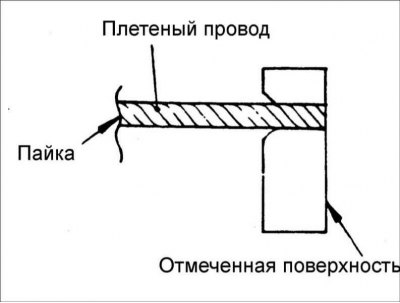
3. Solder the braided wire.


3. Solder the braided wire.

Replacing the rear bushing


1. Before removing the bushing, it is necessary to measure the depth of its installation.
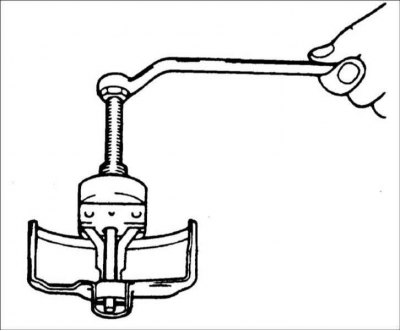
2. The bushing can be removed using a puller as shown in the figure.


2. The bushing can be removed using a puller as shown in the figure.


3. Install the new bushing to the pre-measured depth.

Assembling the starter


1. Install the overrunning clutch onto the front end of the rotor shaft.
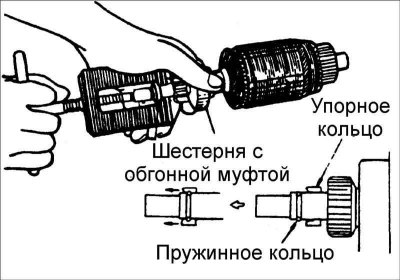
2. Install the thrust ring and snap ring on the front side of the rotor shaft,…


2. Install the thrust ring and snap ring on the front side of the rotor shaft, then move the thrust ring all the way to the snap ring.

3. When installing the lever into the front cover, pay attention to its…


3. When installing the lever into the front cover, pay attention to its position. If the lever is installed the other way around, the gear will be permanently pushed out and will not work properly.

Ignition interlock switch
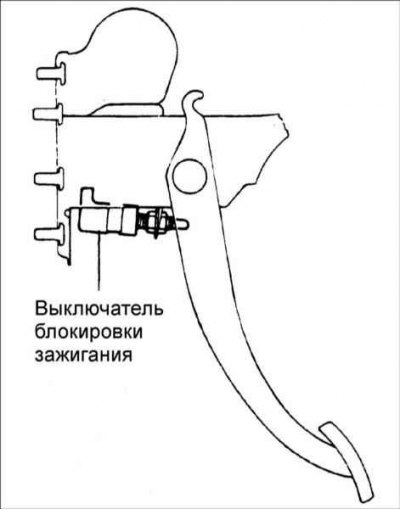


Check that the installation height, free play and clearance of the pin with the…


Check that the installation height, free play and clearance of the pin with the head and hole for the clutch pedal cotter pin are within normal limits.

Checking the starter relay
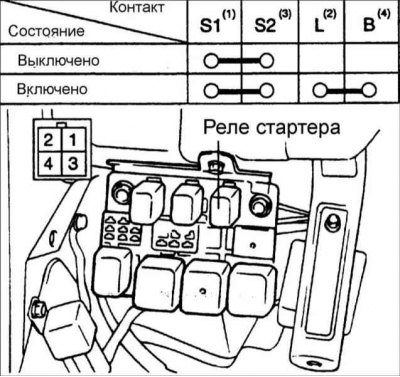


Remove the starter relay and check the continuity between its terminals. If the…


Remove the starter relay and check the continuity between its terminals. If the conductivity is not as required, replace the relay.

Checking the ignition interlock switch
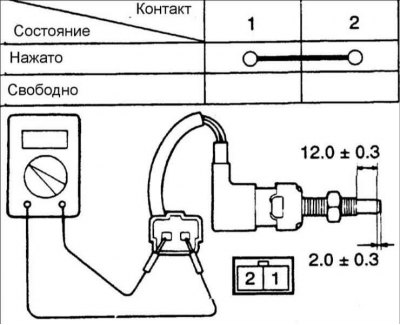


Check the continuity between the ignition interlock switch terminals.


Check the continuity between the ignition interlock switch terminals.
This article is available at russian, bulgarian, belarusian, ukrainian, serbian, croatian, romanian, polish, slovak, hungarian
This article has been reviewed by: Konstantin Smirnov
Add to social network:

Previous
Elantra 3: Power devices
Next

Launch system
Rechargeable battery
Diesel Engine Generator
Gasoline Engine Generator
Checking the generated voltage
Diesel engine starter
Troubleshooting the Charging and Starting System
We recommend other articles on the topic of Hyundai manuals:

Coolant pump (single camshaft engines) Hyundai Accent 1 (1994-1999)
Selecting Motor Oil for Gasoline Engines Hyundai Getz (2002-2011)
Single Overhead Camshaft Engines — Specifications Hyundai Sonata 3 (1993-1998)
Table 2.1. Technical characteristics, 2.0/2.4 l engines Hyundai Santa Fe 2 (2007-2012, petrol)
Characteristics of the fuel system of gasoline engines (G4GC,… Hyundai Tucson 1 (2005-2010)
Table 1.1. Technical characteristics of the Hyundai Matrix car… Hyundai Matrix (2001-2010, petrol)

Link in different formats to this article

Visitor comments
No comments yet


How much will 30 + 48 ?


Elantra 3 (2000-2006) 
  • User manual
  • Control devices
  • Audio system
  • Starting the engine and driving
  • Faults en route
  • Maintenance and care
  • Technical information
  • Power unit
  • Gasoline engines
  • Diesel engines
  • Lubrication system
  • Cooling system
  • Fuel system (gasoline)
  • Fuel system (diesel)
  • Decreased toxicity
  • Ignition system
  • Transmission
  • Clutch
  • Mechanical gearbox
  • Automatic gearbox
  • Drive shafts and axles
  • Chassis
  • Car suspension
  • Steering
  • Brake system
  • Body
  • Exterior (external elements)
  • Interior (internal elements)
  • Air conditioning system
  • Electrical equipment
  • Equipment and devices
  • Headlights and lighting
  • Power devices
  • Electrical circuits
Elantra 2 (1995-2000, petrol) 
  • General information
  • Maintenance
  • Power unit
  • Engine repair
  • Cooling system
  • Intake and exhaust system
  • Fuel system
  • Transmission
  • Clutch
  • Manual gearbox
  • Automatic gearbox
  • Drive shafts and axles
  • Chassis
  • Front suspension
  • Rear suspension
  • Steering
  • Brake system
  • Body
  • Body elements
  • Electrical equipment
  • Equipment and devices
  • Electrical diagrams
Elantra 1 (1990-1995, petrol) 
  • General information
  • Introduction to the guide
  • Maintenance
  • Power unit
  • Minor engine repair
  • Engine overhaul
  • Lubrication system
  • Cooling system
  • Fuel injection system
  • Ignition system
  • Exhaust system
  • Transmission
  • Clutch
  • Manual gearbox
  • Automatic gearbox
  • Drive shafts
  • Chassis
  • Front suspension
  • Rear suspension
  • Steering
  • Wheels and tires
  • Troubleshooting
  • Brake system
  • Body
  • Body elements
  • Electrical equipment
  • Equipment and devices
  • Power devices
  • Heating and air conditioning
  • Electrical circuits
HyundaiBook.ru © 2018-2026 · Mobile version · Sitemap: EN BG BY UA RS HR RO PL SK HU · Administration · Site search · Hyundai owners Accent 1 · Accent 2 · Accent 3 · Elantra 1 · Elantra 2 · Elantra 3 · Getz · Sonata 3 · Sonata 4 · Santa Fe 2 · Tucson 1 · Tucson 2 · Matrix ·
This site uses cookies to optimize its functionality. By continuing, you agree to our terms.