
HyundaiBook.ru
Repair Chevrolet Repair Honda Repair Toyota Repair Land Rover Repair VAZ Repair Renault Repair Nissan
English Русский
Български
Беларускі
Український
Српски
Hrvatski
Română
Polski
Slovenský
Magyar
ArticlesSitemapContacts  


  Accent   Elantra   Getz   Grandeur   Sonata   Santa Fe   Tucson   Others
Elantra 1 (1990-1995, petrol) Elantra 2 (1995-2000, petrol) Elantra 3 (2000-2006)
  • Main
  • Elantra
  • XD (2000-2006)
  • Electrical equipment
  • Power devices
  • Rechargeable battery

Rechargeable battery (Hyundai Elantra XD)

0
Contents: Battery inspection ⇓ Battery testing ⇓ Checking the specific gravity of the…⇓ Charging the battery ⇓
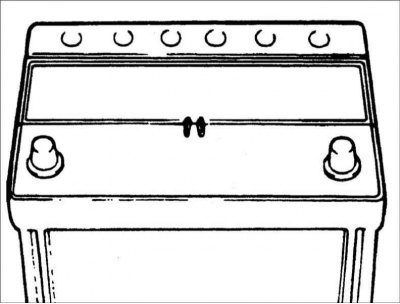
A battery is a device for storing energy in chemical form, which can then be…


A battery is a device for storing energy in chemical form, which can then be used as electricity.

A battery works because two different metals, when placed in an acidic solution, create a potential difference, resulting in the generation of an electric current.

1. Maintenance-free batteries are installed on vehicles.

2. There is no need to add distilled water to the battery.

3. The battery is completely sealed except for small ventilation holes in the cover.

Battery inspection


1. Turn off the ignition and all electrical consumers.

2. Disconnect the wires from the battery terminals. The negative wire should be disconnected first and reconnected last.

3. Remove the battery from the vehicle.

Warning: If the battery case is damaged, remove the battery wearing rubber gloves to protect your skin from the electrolyte.
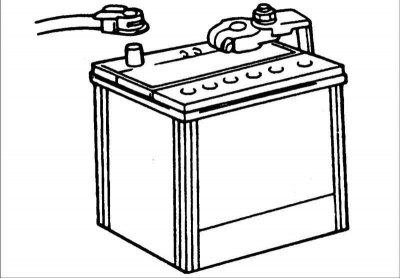

4. Check the battery mounting elements as they may be damaged by electrolyte…


4. Check the battery mounting elements as they may be damaged by electrolyte that has come into contact with them. If necessary, clean them with a warm soda solution.


5. Clean the top of the battery with the same solution.

6. Inspect the battery for cracks. If there are cracks, replace the battery.

7. Clean the battery terminals.

8. Clean the inside surface of the wire clamps connected to the battery terminals.

9. Install the battery into the vehicle.

10.. Connect the wires to the battery terminals.

11. Securely tighten the wire clamps to the battery terminals.

12. Apply a thin layer of petroleum jelly to the battery terminals.

Warning! When charging batteries, an explosive gas mixture is released.


Warning! When working with wires and electrical devices, it is prohibited to use fire, sparking devices, open fire-hazardous lighting devices, and smoking. Avoid sparking when handling wires and electrical devices.


Warning: Never short-circuit the battery terminals directly - there is a high risk of injury due to strong sparking.


Battery testing
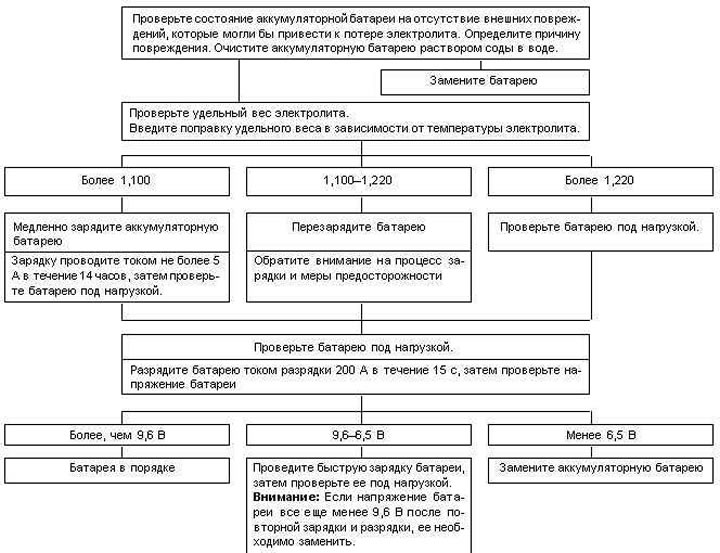


Checking the specific gravity of the electrolyte
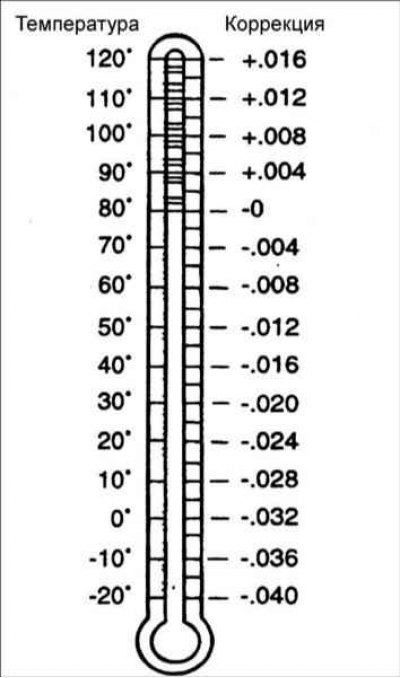

Checking the specific gravity of the electrolyte


The specific gravity of battery electrolyte changes with temperature. An…


The specific gravity of battery electrolyte changes with temperature. An increase in temperature leads to a decrease in specific gravity and vice versa.


The specific gravity of the electrolyte of a fully charged battery should be between 1.260 and 1.280, at a temperature of 26.7°C.

The specific gravity adjustment shall be made by adding 0.04 points for every 5.56°C above 26.7°C or by subtracting 0.04 points for every 5.56°C below 26.7°C.

Example: The hydrometer reading is 1.280 at a temperature of 5.56°C. In accordance with the temperature difference, it is necessary to correct the specific gravity by 0.028 points. The true specific gravity is 1.252.

1,280–0,028=1,252

Do not measure the specific gravity of the electrolyte immediately after adding distilled water.

Warning! A difference in the specific gravity of the electrolyte of 50 or more points between the cells of the battery indicates that the battery is faulty and must be replaced.


Charging the battery


Specific gravity
Charging method
Slow charging (5A)
Fast charging (20A)
Less than 1,000
14 h
4 h
1,000–1,300
12 h
3 h
1,300–1,600
10 h
2.5 h
1,600–1,900
8 h
2.0 h
1,900–1,220
6 h
1.5 h
Over 1,220
4 h
1.0 h
This article is available at russian, bulgarian, belarusian, ukrainian, serbian, croatian, romanian, polish, slovak, hungarian
This article has been reviewed by: Konstantin Smirnov
Add to social network:

Previous
Elantra 3: Power devices
Next

Diesel Engine Generator
Gasoline Engine Generator
Checking the generated voltage
Checking the current generated by the generator
Checking the voltage drop on the wire connecting the battery to the generator
Launch system
Starter for gasoline engines
Diesel engine starter
Troubleshooting the Charging and Starting System
We recommend other articles on the topic of Hyundai manuals:

Checking the battery Hyundai Accent 3 (2005-2010)
Checking the battery Hyundai Getz (2002-2011)
Rechargeable battery Hyundai Sonata 4 (2001-2012, petrol)
Checking the battery Hyundai Santa Fe 2 (2007-2012, petrol)
Rechargeable battery Hyundai Tucson 2 (2009-2015)
Checking the battery Hyundai Matrix (2001-2010, petrol)

Link in different formats to this article

Visitor comments
No comments yet


How much will 12 + 28 ?


Elantra 3 (2000-2006) 
  • User manual
  • Control devices
  • Audio system
  • Starting the engine and driving
  • Faults en route
  • Maintenance and care
  • Technical information
  • Power unit
  • Gasoline engines
  • Diesel engines
  • Lubrication system
  • Cooling system
  • Fuel system (gasoline)
  • Fuel system (diesel)
  • Decreased toxicity
  • Ignition system
  • Transmission
  • Clutch
  • Mechanical gearbox
  • Automatic gearbox
  • Drive shafts and axles
  • Chassis
  • Car suspension
  • Steering
  • Brake system
  • Body
  • Exterior (external elements)
  • Interior (internal elements)
  • Air conditioning system
  • Electrical equipment
  • Equipment and devices
  • Headlights and lighting
  • Power devices
  • Electrical circuits
Elantra 2 (1995-2000, petrol) 
  • General information
  • Maintenance
  • Power unit
  • Engine repair
  • Cooling system
  • Intake and exhaust system
  • Fuel system
  • Transmission
  • Clutch
  • Manual gearbox
  • Automatic gearbox
  • Drive shafts and axles
  • Chassis
  • Front suspension
  • Rear suspension
  • Steering
  • Brake system
  • Body
  • Body elements
  • Electrical equipment
  • Equipment and devices
  • Electrical diagrams
Elantra 1 (1990-1995, petrol) 
  • General information
  • Introduction to the guide
  • Maintenance
  • Power unit
  • Minor engine repair
  • Engine overhaul
  • Lubrication system
  • Cooling system
  • Fuel injection system
  • Ignition system
  • Exhaust system
  • Transmission
  • Clutch
  • Manual gearbox
  • Automatic gearbox
  • Drive shafts
  • Chassis
  • Front suspension
  • Rear suspension
  • Steering
  • Wheels and tires
  • Troubleshooting
  • Brake system
  • Body
  • Body elements
  • Electrical equipment
  • Equipment and devices
  • Power devices
  • Heating and air conditioning
  • Electrical circuits
HyundaiBook.ru © 2018-2026 · Mobile version · Sitemap: EN BG BY UA RS HR RO PL SK HU · Administration · Site search · Hyundai owners Accent 1 · Accent 2 · Accent 3 · Elantra 1 · Elantra 2 · Elantra 3 · Getz · Sonata 3 · Sonata 4 · Santa Fe 2 · Tucson 1 · Tucson 2 · Matrix ·
This site uses cookies to optimize its functionality. By continuing, you agree to our terms.