


Typical broken clutch disc springs
Check the clutch disc friction linings for wear and loose rivets, check the disc for edge damage, cracks, damaged springs and worn splines.
If significant unevenness is detected, the friction pads can be cleaned with sandpaper.
Determine the wear of the clutch friction linings by measuring the distance from the surface of the linings to the top of the rivet heads using a caliper.
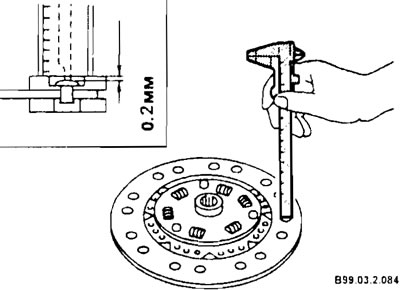
If this dimension is less than 0.20 mm, the disc or pads must be replaced.
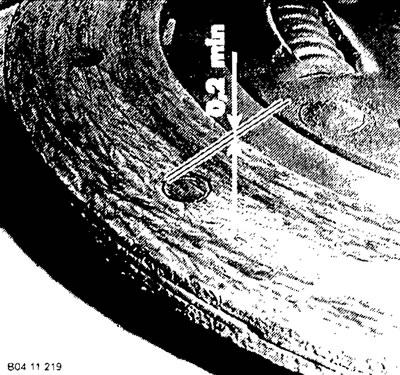
Note: To avoid further problems, it is always better to replace the driven disc assembly. Manufacturers do not recommend replacing fractional pads alone. The authors' personal experience confirms this.
To check the runout of the driven disk, secure it between two rods or clamp the clutch shaft between the stop centers of a lathe.
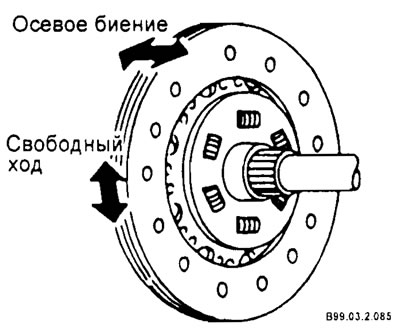
On a special holder, install the pointer indicator next to the disk so that the indicator finger is located opposite the edge of the disk (at a distance of approximately 5 mm). Rotate the disk slowly and read the dial indicator. If the readings are greater than 0.5 mm, you can carefully straighten the disc using pliers or replace the disc.
Check the sliding of the driven disk hub on the toothed ring of the clutch shaft. To do this, put on the disc and grab its outer edge with your thumb and index finger. Move the disc in the direction of rotation. If the clearance value is more than 0.4 mm, we can talk about wear of the wedge-shaped teeth, which most often occurs in the driven disk.
Check the inner ends of the diaphragm spring for wear. If deep traces of grinding are found, the clutch must be replaced.
The ends of the membrane spring should be at the same height within 0.5 mm. Bent ends of the spring can be straightened. A special tool is usually used for this, but you can also bend the ends using a special strip with a cut.
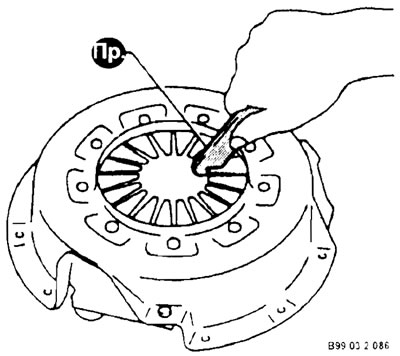
Place a steel ruler on the friction surface of the clutch pressure plate and use a feeler gauge to measure the clearance at the location shown in the figure. The skew in this place should not exceed 0.5 mm.
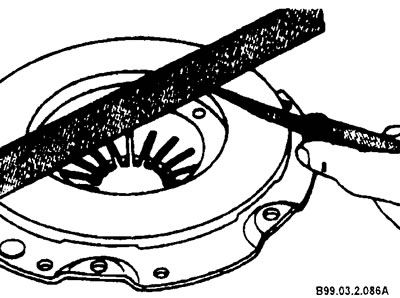
If there are grooves, they must be removed by machine processing or the parts must be replaced with new ones.
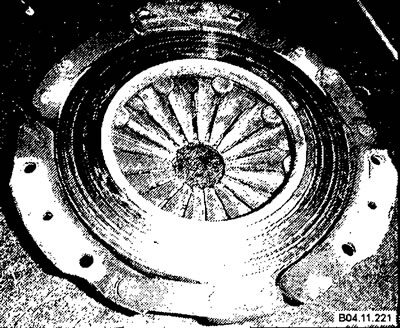
Typical pressure plate with wear marks (grooves)