
HyundaiBook.ru
Repair Chevrolet Repair Honda Repair Toyota Repair Land Rover Repair VAZ Repair Renault Repair Nissan
English Русский
Български
Беларускі
Український
Српски
Hrvatski
Română
Polski
Slovenský
Magyar
ArticlesSitemapContacts  


  Accent   Elantra   Getz   Grandeur   Sonata   Santa Fe   Tucson   Others
Elantra 1 (1990-1995, petrol) Elantra 2 (1995-2000, petrol) Elantra 3 (2000-2006)
  • Main
  • Elantra
  • J1 (1990-1995)
  • Transmission
  • Automatic gearbox
  • Torque converter — testing on a fully braked vehicle

Torque converter — testing on a fully braked vehicle (Hyundai Elantra J1)

0
Contents: Examination ⇓ Analysis of the test results ⇓
The test is carried out to determine the maximum rotation frequency of the engine crankshaft with the output shaft of the gearbox completely stopped in the D and R ranges. The value of this frequency can be used to determine the operability of the torque converter, freewheel clutches, as well as the presence of slip in some friction elements of the gearbox control.

Examination


Check the oil level and temperature (80-100°C) and the engine coolant temperature (80-100°C).

Place blocks under the rear wheels.

With the parking brake fully applied and the brake pedal fully depressed, start the engine.

Set the gear selector lever to position D, press the accelerator pedal all the way down and determine the engine speed at this moment.
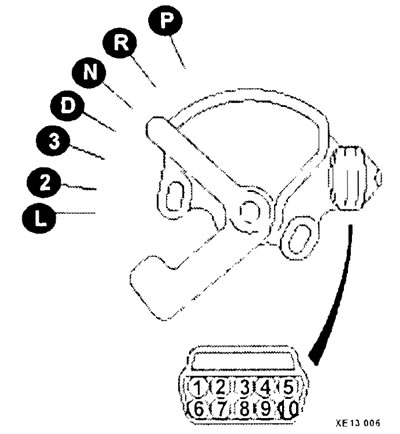
Control lever position

Control lever position


Caution: Do not hold the accelerator pedal for more than eight seconds.


After each check, move the selector lever to position N and run the engine at 1000 rpm until the transmission fluid temperature reaches the operating value, after which the next check can be carried out,

Repeat the same check for the R selector lever position.


Analysis of the test results


If the engine crankshaft speed during testing in ranges D and R is greater than the maximum value (3000 rpm), then this speaks about:
  • low pressure in the main line;
  • slipping of the brake of the first gear and reverse gear.

If the engine crankshaft speed is higher than the nominal value only in the D range, this indicates slippage of the downshift clutch.

If the engine crankshaft speed is higher than the nominal value only in the R range, this indicates that the reverse clutch is slipping.

If the engine crankshaft speed in ranges D and R is less than the minimum nominal value, this indicates:
  • torque converter malfunctions;
  • engine malfunctions (insufficient power).
This article is available at russian, bulgarian, belarusian, ukrainian, serbian, croatian, romanian, polish, slovak, hungarian
This article has been reviewed by: Konstantin Smirnov
Add to social network:

Previous
Elantra 1: Automatic gearbox
Next

Trouble codes — reading
Working fluid pressure — adjustment
Kickdown forced downshift mechanism — adjustment
Selector switch and control cable — adjustment
Mode Switch Lock Mechanism — Check
Selector lever — check
Automatic Transmission Controls — Removal and Installation
Towing cars with automatic transmission
We recommend other articles on the topic of Hyundai manuals:

Testing the torque converter Hyundai Accent 1 (1994-1999)
Testing the joint operation of an automatic transmission and… Hyundai Getz (2002-2011)
Torque Converter Lockup Test Hyundai Sonata 3 (1993-1998)
Testing the torque converter on a fully braked vehicle (Torque… Hyundai Santa Fe 2 (2007-2012, petrol)
Rear axle coupling (all-wheel drive vehicle) — device Hyundai Tucson 1 (2005-2010)
Testing the torque converter on a fully braked vehicle (torque… Hyundai Matrix (2001-2010, petrol)

Link in different formats to this article

Visitor comments
No comments yet


How much will 17 + 29 ?


Elantra 3 (2000-2006) 
  • User manual
  • Control devices
  • Audio system
  • Starting the engine and driving
  • Faults en route
  • Maintenance and care
  • Technical information
  • Power unit
  • Gasoline engines
  • Diesel engines
  • Lubrication system
  • Cooling system
  • Fuel system (gasoline)
  • Fuel system (diesel)
  • Decreased toxicity
  • Ignition system
  • Transmission
  • Clutch
  • Mechanical gearbox
  • Automatic gearbox
  • Drive shafts and axles
  • Chassis
  • Car suspension
  • Steering
  • Brake system
  • Body
  • Exterior (external elements)
  • Interior (internal elements)
  • Air conditioning system
  • Electrical equipment
  • Equipment and devices
  • Headlights and lighting
  • Power devices
  • Electrical circuits
Elantra 2 (1995-2000, petrol) 
  • General information
  • Maintenance
  • Power unit
  • Engine repair
  • Cooling system
  • Intake and exhaust system
  • Fuel system
  • Transmission
  • Clutch
  • Manual gearbox
  • Automatic gearbox
  • Drive shafts and axles
  • Chassis
  • Front suspension
  • Rear suspension
  • Steering
  • Brake system
  • Body
  • Body elements
  • Electrical equipment
  • Equipment and devices
  • Electrical diagrams
Elantra 1 (1990-1995, petrol) 
  • General information
  • Introduction to the guide
  • Maintenance
  • Power unit
  • Minor engine repair
  • Engine overhaul
  • Lubrication system
  • Cooling system
  • Fuel injection system
  • Ignition system
  • Exhaust system
  • Transmission
  • Clutch
  • Manual gearbox
  • Automatic gearbox
  • Drive shafts
  • Chassis
  • Front suspension
  • Rear suspension
  • Steering
  • Wheels and tires
  • Troubleshooting
  • Brake system
  • Body
  • Body elements
  • Electrical equipment
  • Equipment and devices
  • Power devices
  • Heating and air conditioning
  • Electrical circuits
HyundaiBook.ru © 2018-2026 · Mobile version · Sitemap: EN BG BY UA RS HR RO PL SK HU · Administration · Site search · Hyundai owners Accent 1 · Accent 2 · Accent 3 · Elantra 1 · Elantra 2 · Elantra 3 · Getz · Sonata 3 · Sonata 4 · Santa Fe 2 · Tucson 1 · Tucson 2 · Matrix ·
This site uses cookies to optimize its functionality. By continuing, you agree to our terms.