
HyundaiBook.ru
Repair Chevrolet Repair Honda Repair Toyota Repair Land Rover Repair VAZ Repair Renault Repair Nissan
English Русский
Български
Беларускі
Український
Српски
Hrvatski
Română
Polski
Slovenský
Magyar
ArticlesSitemapContacts  


  Accent   Elantra   Getz   Grandeur   Sonata   Santa Fe   Tucson   Others
Elantra 1 (1990-1995, petrol) Elantra 2 (1995-2000, petrol) Elantra 3 (2000-2006)
  • Main
  • Elantra
  • J1 (1990-1995)
  • Electrical equipment
  • Heating and air conditioning
  • Air conditioning compressor

Air conditioning compressor (Hyundai Elantra J1)

0
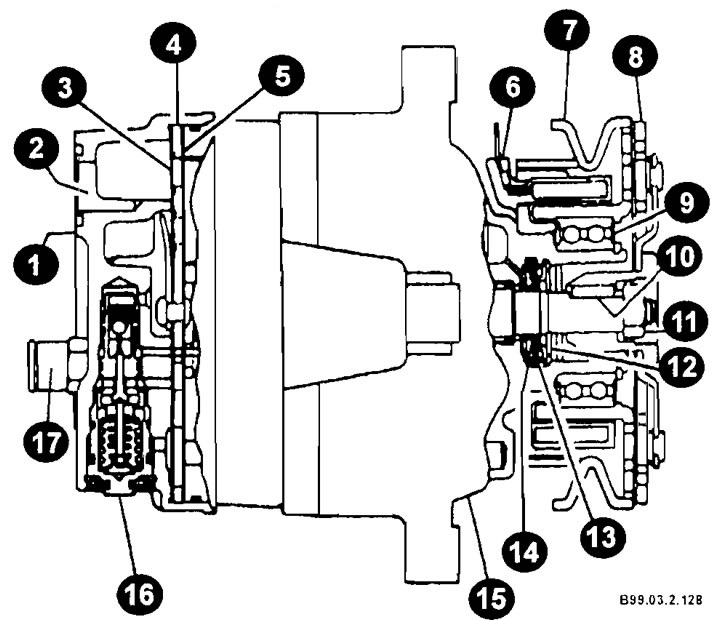
Compressor cross section

Compressor cross section
1 - back part;
2 - suction hole;
3 - gasket on the back;
4 - valve plate;
5 - tongue plate;
6 - coupling winding;
7 - pulley;
8 - leading disk;
9 - pulley bearing;
10 - shaft key;
11 - shaft nut;
12 - Front gasket holder;
13 - front gasket;
14 - Front gasket sealing ring;
15 - front part;
16 - compressor control valve;
17 - high pressure relief valve.


There are different types of compressors used in cars. The basic methods for carrying out major repairs on all compressors remain the same.

When performing maintenance, do not allow contamination or foreign objects to enter or affect the compressor parts and system. Before any repair or before removing the compressor, it is necessary to wipe the compressor connectors and its exterior. All parts of the compressor must be kept clean at all times, and those parts that are to be reinstalled must be wiped with trichloroethane, gasoline solvent, kerosene or a similar solvent, and then dried with dry air. For wiping, use only lint-free and fluff-free cloth.

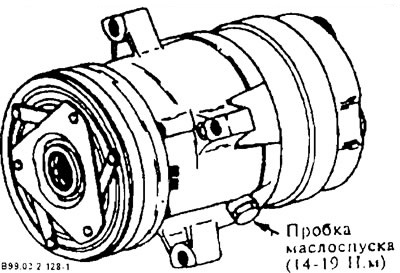
When you remove the compressor from the machine for maintenance, the oil remaining in the compressor must be pumped out and measured. It will then need to be discarded and new 525 viscosity grade cooling oil added to the compressor.


When you remove the compressor from the…


Job Description


The main mechanism of the compressor is a variable-angle inclined disk, which has five cylinders located along the axis. The compressor feed is controlled by a regulating valve, controlled by a corrugated membrane, located at the rear of the compressor, where its suction pressure is measured. The angle of the swash plate and the compressor feed are adjusted depending on the pressure difference in the engine crankcase and in the intake manifold. If the consumption of conditioned air is high, the suction pressure will be higher than the set point, the gas coming from the crankcase to the manifold will be released through the valve, there will be no pressure difference in the engine crankcase and in the suction manifold, and then the working volume of the compressor will be maximum. If the load on the air conditioning system is lower and the suction pressure reaches the control point, then the exhaust gas will flow through the valve into the engine crankcase and the passage from the crankcase to the suction chamber will close.

The angle of the disc depends on the force balance on the five pistons. A slight increase in the pressure difference in the engine crankcase and in the intake manifold creates a resultant force on the pistons, which sets them in motion around the axis of rotation of the inclined disk, which reduces the angle of the disk. The compressor is equipped with a unique lubrication system. The oil flowing out of the crankcase goes through a rotating inclined disc to lubricate the bearing of this disc. During rotation, some of the oil is separated from the general flow and is again directed to the crankcase, where the compressor mechanism is lubricated.


Oil may accumulate in the crankcase. Therefore, when replacing a compressor, it is important to pump out the oil from the crankcase of the old compressor through the drain hole and measure it (after measuring, throw away the old oil).

All compressors supplied for replacement have oil pumped into the crankcases; this oil needs to be pumped out and stored. Then replace the oil in the same quantity that was measured on the old compressor.
This article is available at russian, bulgarian, belarusian, ukrainian, serbian, croatian, romanian, polish, slovak, hungarian
This article has been reviewed by: Konstantin Smirnov
Add to social network:

Previous
Elantra 1: Heating and air conditioning
Next

Unloading the air conditioning system
Procedure for conducting a technical inspection of the air conditioning system
Checking the air conditioner drive
Basic elements of the air conditioning system
Description of the operation of the air conditioning system
Diagnostics of air conditioning system malfunctions
Rules for using the heater/air conditioner
What to do if the air conditioner is not used for a long time?
We recommend other articles on the topic of Hyundai manuals:

Air Conditioning Compressor Lubricant Oil Hyundai Accent 2 (1999-2005)
Air Conditioning Compressor Lubricant Oil Hyundai Getz (2002-2011)
Air conditioning system refill Hyundai Sonata 4 (2001-2012, petrol)
Air conditioning system Hyundai Santa Fe 2 (2007-2012, petrol)
Technical characteristics of the air conditioning, heating and… Hyundai Tucson 1 (2005-2010)
Air conditioning system Hyundai Matrix (2001-2010, petrol)

Link in different formats to this article

Visitor comments
No comments yet


How much will 24 + 29 ?


Elantra 3 (2000-2006) 
  • User manual
  • Control devices
  • Audio system
  • Starting the engine and driving
  • Faults en route
  • Maintenance and care
  • Technical information
  • Power unit
  • Gasoline engines
  • Diesel engines
  • Lubrication system
  • Cooling system
  • Fuel system (gasoline)
  • Fuel system (diesel)
  • Decreased toxicity
  • Ignition system
  • Transmission
  • Clutch
  • Mechanical gearbox
  • Automatic gearbox
  • Drive shafts and axles
  • Chassis
  • Car suspension
  • Steering
  • Brake system
  • Body
  • Exterior (external elements)
  • Interior (internal elements)
  • Air conditioning system
  • Electrical equipment
  • Equipment and devices
  • Headlights and lighting
  • Power devices
  • Electrical circuits
Elantra 2 (1995-2000, petrol) 
  • General information
  • Maintenance
  • Power unit
  • Engine repair
  • Cooling system
  • Intake and exhaust system
  • Fuel system
  • Transmission
  • Clutch
  • Manual gearbox
  • Automatic gearbox
  • Drive shafts and axles
  • Chassis
  • Front suspension
  • Rear suspension
  • Steering
  • Brake system
  • Body
  • Body elements
  • Electrical equipment
  • Equipment and devices
  • Electrical diagrams
Elantra 1 (1990-1995, petrol) 
  • General information
  • Introduction to the guide
  • Maintenance
  • Power unit
  • Minor engine repair
  • Engine overhaul
  • Lubrication system
  • Cooling system
  • Fuel injection system
  • Ignition system
  • Exhaust system
  • Transmission
  • Clutch
  • Manual gearbox
  • Automatic gearbox
  • Drive shafts
  • Chassis
  • Front suspension
  • Rear suspension
  • Steering
  • Wheels and tires
  • Troubleshooting
  • Brake system
  • Body
  • Body elements
  • Electrical equipment
  • Equipment and devices
  • Power devices
  • Heating and air conditioning
  • Electrical circuits
HyundaiBook.ru © 2018-2026 · Mobile version · Sitemap: EN BG BY UA RS HR RO PL SK HU · Administration · Site search · Hyundai owners Accent 1 · Accent 2 · Accent 3 · Elantra 1 · Elantra 2 · Elantra 3 · Getz · Sonata 3 · Sonata 4 · Santa Fe 2 · Tucson 1 · Tucson 2 · Matrix ·
This site uses cookies to optimize its functionality. By continuing, you agree to our terms.