


Attention: Any repair and maintenance operations on the air conditioning system must be carried out in specialized workshops. Don't trust your car to self-taught craftsmen.
When assembling connections, always use new O-rings soaked in clean 525 grade cooling oil. It is much easier to assemble parts lubricated with oil, and the oil will also ensure that the connections are tight. When tightening connections, use a second wrench to hold the fixed parts of the connection more firmly. This way you can ensure the strength of the assembly.
Replacing the sealing ring
Every time you remove a connection or fitting, new gaskets must be installed to replace them in the air conditioning system, unless these rings are already installed on the new parts. Although all O-rings look the same, it is extremely important to only use the ones recommended for replacement in your air conditioning system when replacing them, otherwise refrigerant leaks may occur.
When replacing O-rings (A) on air conditioning system components, the fitting configuration must be precisely determined so that the ring being replaced matches the contour of the component. Some butt joints and components have what are called "grip" fittings, which have grooves (B) to hold the O-rings, but there are also some that do not have a groove and use "non-grip" or "standard" O-rings.
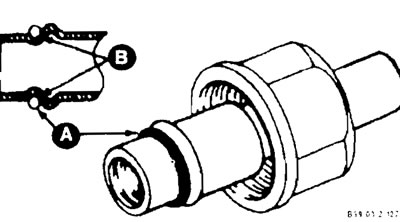
The installation and tightening process is the same for both designs, but the sealing rings are different.
Before installation, also check that neither the rings nor the fittings are damaged or deformed. Deformed or damaged parts must be replaced.
Maintenance of cooling system lines and fittings
Flexible hose lines must not be twisted to a radius greater than four times the hose diameter.
Flexible hose lines should be inspected regularly as they may leak due to their fragility and replaced with new lines if a leak or line failure is detected.
Before disconnecting a fitting in the cooling system, all refrigerant must first be drained. This must be done very carefully, regardless of the sensor readings. Open the system very slowly, keeping your face and hands away from them so as not to injure them if liquid refrigerant suddenly appears in the line. If you notice that the refrigerant is under pressure when loosening a fitting, first relieve the pressure as described when relieving the air conditioning system.
If you find one of the refrigeration lines open, immediately replace the caps or tighten them to prevent moisture and dirt from getting in and causing wear on the compressor's internal parts or blocking the lines, condenser and evaporator core tubes, expansion (expansion) tube or compressor inlet filters.
When installing connections on O-ring fittings, appropriate wrenches must be used. To prevent bending of connecting lines or components, always support the fitting located on the opposite side with a wrench. When connecting flexible hose connectors, it is important that the swaged fitting and flare nut, as well as the union ferrule to which they are attached, are held simultaneously with three different wrenches to prevent the fitting from rotating and to prevent damage to the main socket.
O-rings and seats must always be in excellent condition. A burr or piece of dirt can cause refrigerant to leak. When replacing the O-ring, first soak it in clean 525 viscosity coolant oil.
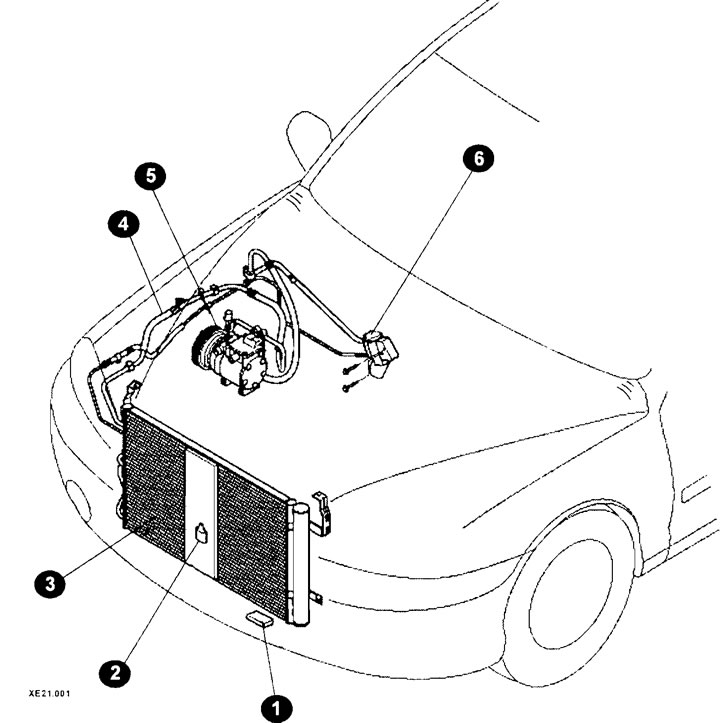
Location of air conditioning system components on a vehicle (late model cars)
1 - vehicle speed sensor;
2 - temperature sensor;
3 - capacitor;
4 - working fitting;
5 - compressor;
6 - expansion tube.