
HyundaiBook.ru
Repair Chevrolet Repair Honda Repair Toyota Repair Land Rover Repair VAZ Repair Renault Repair Nissan
English Русский
Български
Беларускі
Український
Српски
Hrvatski
Română
Polski
Slovenský
Magyar
ArticlesSitemapContacts  


  Accent   Elantra   Getz   Grandeur   Sonata   Santa Fe   Tucson   Others
Accent 1 (1994-1999) Accent 2 (1999-2005) Accent 3 (2005-2010)
  • Main
  • Accent
  • LC (1999-2005)
  • Chassis
  • Car suspension
  • Rear suspension strut

Rear suspension strut (Hyundai Accent LC)

0
Contents: Removal ⇓ Disassembly ⇓ Examination ⇓ Assembly ⇓
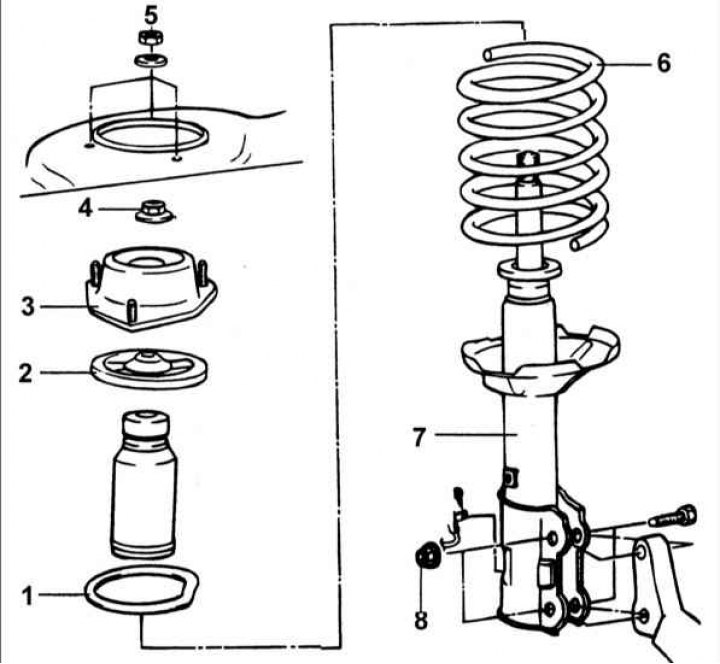
1 – lower spring support; 2 – upper spring support; 3 – rack bracket; 4 –…

1 – lower spring support; 2 – upper spring support; 3 – rack bracket; 4 – self-locking nut, 40–55 Nm; 5 – nut, 20–30 Nm; 6 – spring; 7 – rear suspension strut; 8 – nut, 75–90 Nm.


Rear suspension elements
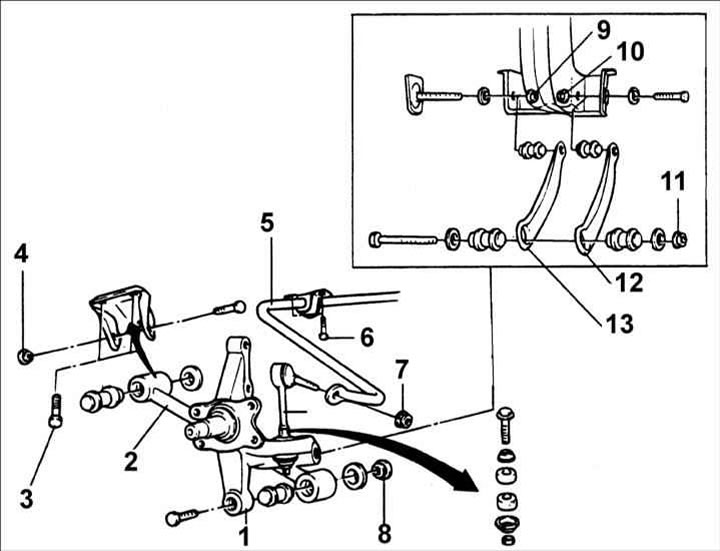


1 – rear axle fastening element; 2 – lower trailing arm; 3 – bolt, 40–50 Nm; 4…

1 – rear axle fastening element; 2 – lower trailing arm; 3 – bolt, 40–50 Nm; 4 – nut, 100–120 Nm; 5 – rear anti-roll bar; 6 – bolt, 17–26 Nm; 7 – bolt, 35–45 Nm; 8 – nut*, 130–150 Nm; 9 – nut*, 100–120 Nm; 10 – nut*, 88–100 Nm; 11 – nut*, 130–150 Nm; 12 – lower transverse arm (B) of the rear suspension; 13 – lower transverse arm (A) of the rear suspension.


Warning! * Nuts marked must be tightened to the specified torque only after the vehicle has been installed on the wheels.


Removal


1. Fold the rear seat.

2. Remove the rear cover from the wheel arch.
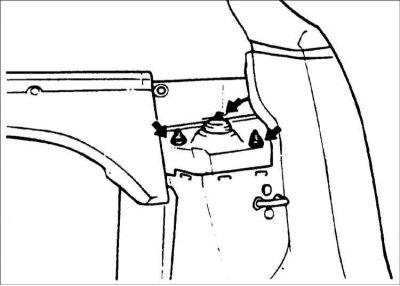
2. Remove the rear cover from the wheel arch.


3. Remove the three upper rear strut mounting nuts.

4. Remove the rear wheel.

5. Disconnect the brake pipe and wheel speed sensor from the rear strut.

6. Loosen the nuts and remove the bolts securing the strut to the rear axle mounting element and remove the strut from under the vehicle wing.

Warning: Be careful not to damage the rear suspension strut.


Disassembly


1. Using a special tool, compress the rear suspension strut spring.
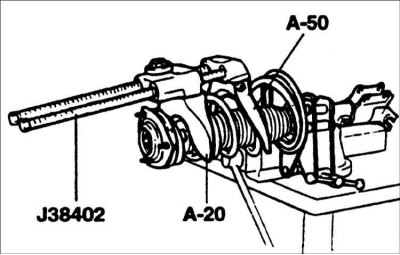
1. Using a special tool, compress the rear suspension strut spring.


Warning: Use only a reliable tool to compress the spring.


2. Loosen the lock nut at the top of the shock absorber rod.

3. Remove the strut mount, upper spring seat, coil spring, dust boot and lower spring seat.


Examination


1. Check the strut support for wear or damage.

2. Check rubber parts for damage or deterioration.

3. Check the coil spring for deflection and loss of elasticity.

3. Check the coil spring for deflection and loss of elasticity.


4. Check the shock absorber as follows:
  • a. Grasp the shock absorber rod with your hand and push it in and out of the shock absorber several times;
  • b. Check that the piston rod moves smoothly, without sticking, and that the force applied to the piston rod does not change with each stroke;
  • c. Make sure that there is no extraneous noise when moving the rod.

Assembly
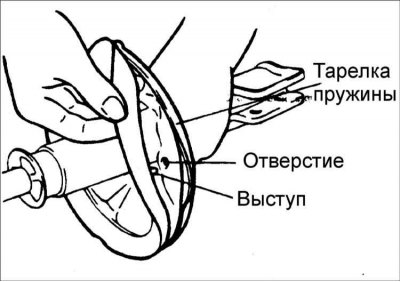


Assembly


1. Install the lower spring support so that its protrusions enter the holes in the spring plate.

2. Install the dust cover on the shock absorber.
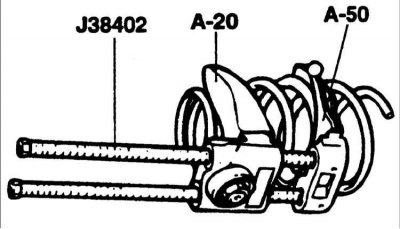
2. Install the dust cover on the shock absorber.


3. Use a special tool to compress the front suspension strut spring. After the spring is fully compressed, install it on the shock absorber.


4. Fully extend the shock absorber rod and install the upper spring seat and strut seat.
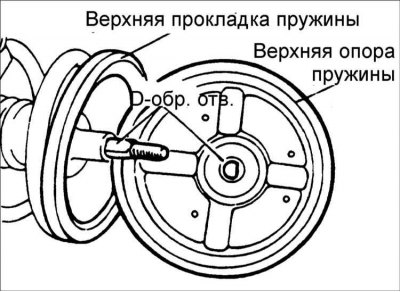
4. Fully extend the shock absorber rod and install the upper spring seat and…


Caution: Align the D-shaped hole in the upper spring seat with the flat on the shock absorber piston rod.
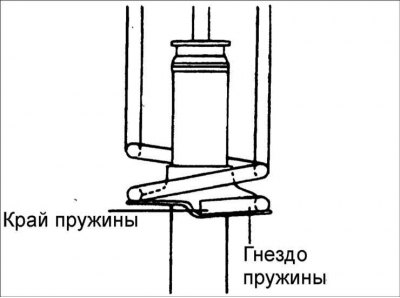

Caution: Align the D-shaped hole in the upper spring seat with the flat on the…


5. Position the upper and lower ends of the coil spring correctly, fitting them into the recesses, and screw on the self-locking nut, but do not tighten it completely.
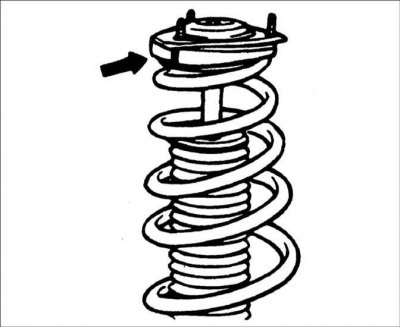
5. Position the upper and lower ends of the coil spring correctly, fitting them…


6. Position the spring support mounting bolt so that the projections of the gaskets are aligned as shown in the figure.


7. Remove the spring compressor.

8. Tighten the self-locking nut to the specified torque.

Tightening torque: 40–55 Nm
This article is available at russian, bulgarian, belarusian, ukrainian, serbian, croatian, romanian, polish, slovak, hungarian
This article has been reviewed by: Konstantin Smirnov
Add to social network:

Previous
Accent 2: Car suspension
Next

Front cross stabilizer
Replacing the bushing (G) of the lower arm
Replacing the lower arm bushing
Lower control arm of the front suspension
Front suspension shock absorber
Replacing the rear trailing arm bushing of the rear suspension
Replacing the rear wishbone bushing (A and B) of the rear suspension
Rear stabilizer bar
Front wheel alignment angles
Rear wheel alignment adjustment
We recommend other articles on the topic of Hyundai manuals:

Rear suspension strut Hyundai Elantra 3 (2000-2006)
Rear suspension strut Hyundai Getz (2002-2011)
Rear Suspension Strut (Pre-2001 Models) Hyundai Sonata 4 (2001-2012, petrol)
Rear suspension trailing arm Hyundai Santa Fe 2 (2007-2012, petrol)
Rear suspension — device Hyundai Tucson 1 (2005-2010)
Removal and checking the rear suspension trailing arm Hyundai Matrix (2001-2010, petrol)

Link in different formats to this article

Visitor comments
No comments yet


How much will 28 + 42 ?


Accent 3 (2005-2010) 
  • General information
  • User manual
  • Maintenance
  • Power unit
  • Engine repair
  • Cooling and lubrication system
  • Power and exhaust system
  • Engine electrical equipment
  • Engine management
  • Transmission
  • Clutch
  • Mechanical gearbox
  • Automatic gearbox
  • Chassis
  • Front suspension
  • Rear suspension
  • Wheels and tires
  • Steering
  • Brake system
  • Body
  • Exterior (external elements)
  • Interior (internal elements)
  • Heating and ventilation
  • Electrical equipment
  • Equipment and devices
  • Electrical circuits
Accent 2 (1999-2005) 
  • User manual
  • Control devices
  • Starting engine and driving
  • Troubleshooting
  • Power unit
  • SOHC engines
  • DOHC engines
  • Lubrication system
  • Cooling system
  • Decreased toxicity
  • Fuel system
  • Ignition system
  • Transmission
  • Clutch
  • Mechanical gearbox
  • Automatic gearbox
  • Axles and drive shafts
  • Chassis
  • Car suspension
  • Steering
  • Brake system
  • Body
  • Exterior (external elements)
  • Interior (internal elements)
  • Air conditioning system
  • Electrical equipment
  • Equipment and devices
  • Power devices
Accent 1 (1994-1999) 
  • General information
  • Maintenance
  • Power unit
  • SOHC engines
  • DOHC engines
  • Cooling system
  • Intake and exhaust systems
  • Fuel supply (1.3 l, injection)
  • Fuel supply (1.5 l, injection)
  • Fuel supply (carburetor)
  • Transmission
  • Clutch
  • Manual gearbox
  • Automatic gearbox
  • Drive shafts
  • Chassis
  • Car suspension
  • Steering
  • Brake system
  • Body
  • Body elements
  • Electrical equipment
  • Equipment and devices
  • Electrical circuits
HyundaiBook.ru © 2018-2026 · Mobile version · Sitemap: EN BG BY UA RS HR RO PL SK HU · Administration · Site search · Hyundai owners Accent 1 · Accent 2 · Accent 3 · Elantra 1 · Elantra 2 · Elantra 3 · Getz · Sonata 3 · Sonata 4 · Santa Fe 2 · Tucson 1 · Tucson 2 · Matrix ·
This site uses cookies to optimize its functionality. By continuing, you agree to our terms.