
HyundaiBook.ru
Repair Chevrolet Repair Honda Repair Toyota Repair Land Rover Repair VAZ Repair Renault Repair Nissan
English Русский
Български
Беларускі
Український
Српски
Hrvatski
Română
Polski
Slovenský
Magyar
ArticlesSitemapContacts  


  Accent   Elantra   Getz   Grandeur   Sonata   Santa Fe   Tucson   Others
Tucson 1 (2005-2010) Tucson 2 (2009-2015)
  • Main
  • Tucson
  • JM (2005-2010)
  • Body
  • Airbags
  • Electronic airbag control unit (EACU)

Electronic airbag control unit (EACU) (Hyundai Tucson JM)

0
The SRS airbag system includes complex electrical and electronic devices. For this reason, special care is required when handling system components.

The location of the airbag electronic control unit is shown in the figure.
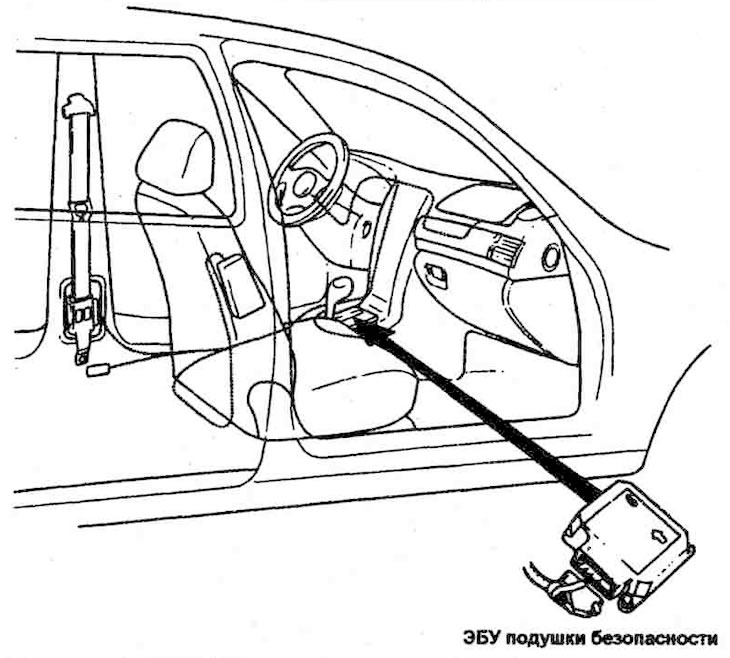
The location of the airbag electronic…

The airbag control unit fills the airbags based on a signal from the frontal impact sensor built into the airbags.

1. DC-DC converter: The DC-DC converter in the power supply circuit includes a step-up converter and a step-down converter, which supplies voltage to the four ignition circuits and the internal working voltage. When the internal working voltage falls below a certain limit, the system will be reset to its original state.

2. Impact sensor/safety sensor: The impact sensor/safety sensor, integrated into the airbag ignition circuit, serves to activate the airbag circuits under all deployment conditions and to maintain the ignition circuits in a non-activated state under normal driving conditions. The impact sensor is designed as a two-contact electromechanical switch, the contacts of which are closed by negative acceleration exceeding a certain threshold value.


3. Backup power supply: The airbag control unit has a backup power supply that ensures that the airbags are activated for a short period of time if the voltage in the vehicle electrical system is insufficient or if the power supply is interrupted in the event of a frontal impact.

4. Detection of malfunctions: When the ignition is on, the PB ECU constantly monitors the system status and detects possible malfunctions. Malfunctions are displayed using the Hi-Scan device as diagnostic trouble codes.

5. Malfunction Indicator Lamp (MIL): When a malfunction is detected, the ECU warns the driver by illuminating the indicator lamp in the instrument cluster. The MIL is the primary means of alerting the driver to malfunctions in the airbag system. When the ignition is first turned on, the indicator lamp flashes six times, indicating a malfunction in the lamp itself and the ECU.

6. Recording fault codes: When a fault occurs in the system, the ECU records a diagnostic code in its memory, which can only be deleted using the Hi-Scan device.

7. Using the data line connector located under the instrument panel on the driver's side, the data stored in the ECU memory is transmitted to an external device, in particular to the Hi-Scan device.

(The material is reprinted from another resource: www.hyundaibook.ru)

8. When only the seat belt pretensioners are activated.

9. Door lock unlocking output. This output is used to unlock the door locks upon impact. The signal from this output is 0-200 μA in the off mode and 200 mA in the on mode. When the unlocking command is issued, the switch closes for 200 ms.
This article is available at russian, bulgarian, belarusian, ukrainian, serbian, croatian, romanian, polish, slovak, hungarian
This article has been reviewed by: Konstantin Smirnov
Add to social network:

Previous
Tucson 1: Airbags
Next

Warning labels
Precautionary measures
Airbag — device
Airbag — General Information
Autonomous operation of the airbag malfunction indicator lamp
Driver Airbag Module — Device
Removal and installation of the PBB module
Checking the technical condition of the PBB module
Passenger Airbag Module — Removal and Installation
We recommend other articles on the topic of Hyundai manuals:

Checking the input and output signals of the engine control unit… Hyundai Accent 3 (2005-2010)
Engine control unit Hyundai Elantra 3 (2000-2006)
Replacement of the electronic control unit of the engine and… Hyundai Getz (2002-2011)
General rules when working with an electronic control system Hyundai Sonata 4 (2001-2012, petrol)
Removal and installation the ABS electronic control unit Hyundai Santa Fe 2 (2007-2012, petrol)
Electronic engine control unit Hyundai Matrix (2001-2010, petrol)

Link in different formats to this article

Visitor comments
No comments yet


How much will 21 + 38 ?


Tucson 2 (2009-2015) 
  • General information
  • Faults en route
  • User manual
  • Maintenance
  • Power unit
  • Gasoline engines
  • Diesel engines
  • Engine cooling system
  • Engine lubrication system
  • Engine power system
  • Control system
  • Intake and exhaust systems
  • Engine electrical equipment
  • Transmission
  • Clutch
  • Mechanical gearbox
  • Automatic gearbox
  • Drive shafts
  • Chassis
  • Suspension and wheels
  • Brake system
  • Steering
  • Body
  • Exterior (external elements)
  • Interior (internal elements)
  • Security systems
  • Air conditioning and heater
  • Electrical equipment
  • Electrical circuits
Tucson 1 (2005-2010) 
  • General information
  • User manual
  • Maintenance
  • Power unit
  • Gasoline engine G6BA
  • Gasoline engine G4GC
  • Diesel engine D4EA
  • Fuel system (gasoline)
  • Fuel system (diesel)
  • Engine lubrication system
  • Engine cooling system
  • Engine electrical equipment
  • Transmission
  • Clutch
  • Car gearbox
  • Drive shafts and cardan
  • Chassis
  • Car suspension
  • Steering
  • Brake system
  • Body
  • Exterior (external elements)
  • Interior (internal elements)
  • Air conditioning and heater
  • Airbags
  • Electrical equipment
  • Equipment and devices
  • Electrical circuits
HyundaiBook.ru © 2018-2026 · Mobile version · Sitemap: EN BG BY UA RS HR RO PL SK HU · Administration · Site search · Hyundai owners Accent 1 · Accent 2 · Accent 3 · Elantra 1 · Elantra 2 · Elantra 3 · Getz · Sonata 3 · Sonata 4 · Santa Fe 2 · Tucson 1 · Tucson 2 · Matrix ·
This site uses cookies to optimize its functionality. By continuing, you agree to our terms.