


Contents: Precautionary measures ⇓ Checking connectors ⇓ Checking the electrical wiring ⇓ Checking the circuit when the fuse…⇓ Troubleshooting intermittent problems ⇓
Attention: read the section "Rules for performing work in the engine compartment" chapters "Maintenance and general check and adjustment procedures".
Precautionary measures
1. Before you start troubleshooting the fuel injection system, check that the engine settings are correct (see chapter "Maintenance and general check and adjustment procedures").
2. Before disconnecting the electronic control unit connectors, it is necessary to disconnect the electrical power supply using either the ignition key or by removing the wires from the battery terminals.
Caution: Be sure to read diagnostic codes before disconnecting the battery cables.
3. When installing the battery, do not worry about the polarity of the wires connected to its terminals.
4. Do not subject fuel injection system components, especially the electronic control unit, to impact.
5. Be careful when troubleshooting, with a large number of transistor circuits, even a slight careless touch of the terminals can lead to serious damage.
6. Do not open the cover of the electronic control unit housing.
7. When working in rainy weather, protect electronic control units from water. The same should be done when washing the engine.
8. Be careful when disconnecting and connecting electrical wiring connectors.
9. To avoid misfires after repair, take the following precautions.
- a) Check the reliability of the connection of the wires to the battery terminals.
- b) Handle high voltage spark plug wires carefully.
- c) After completing the repair work, make sure that all ignition system wires are correctly and securely connected.
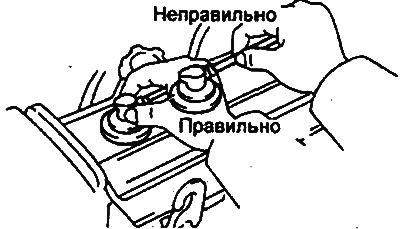
Checking connectors
1. Connecting and disconnecting connectors.
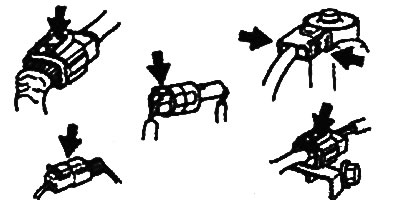
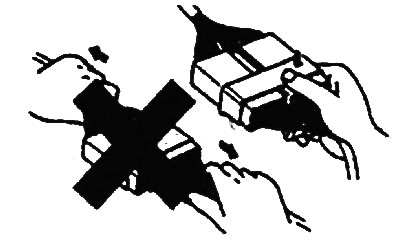
- a) When disconnecting, loosen the lock by pressing on the spring and pull out the connector, holding it by the body.
Caution: Do not disconnect the connector by the wire harness as this may damage the wire or cause poor contact at the connector.
 |
 |
- b) When connecting, insert the connector fully and make sure it is locked.
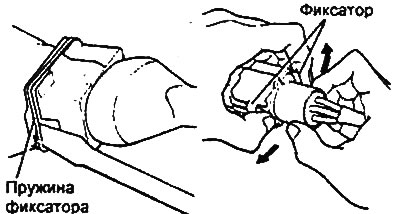
2. Checking the quality of the connection in the connector.
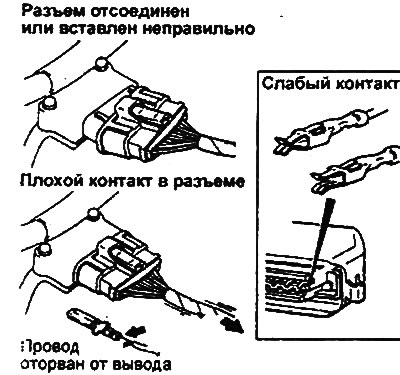
Warning: Malfunctions in the electronic control system may be caused by incorrect connection of the electrical wiring connectors. However, when checking the system, the malfunction symptom may disappear after repeated disconnection and connection of the connectors. Possible causes of such malfunctions are:
- The connector is disconnected or the connector is not connected correctly.
- Loss of connector pins.
- Poor contact in the connector due to excessive tension on the wiring in the connector
- Poor contact due to corrosion of connector terminals or foreign particles getting inside.
[Original version of the article on the website: hyundaibook.ru]
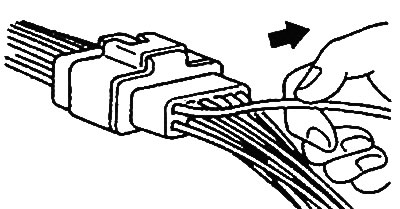
- a) If the pin stopper on the connector 8 is damaged, the pins may fall out from the back of the connector, even if the connector is connected. Therefore, it is necessary to carefully pull each wire from the back of the connector and make sure that the pins do not fall out.
- b) To check the reliability of the contact between the terminals, use a special tool. The force of disconnecting the terminal should be at least 1 N.
3. Checking the connector terminals.
Attention:
- Never force the probe into the connector, as this may damage the pin or cause poor contact in the connector. If the probe cannot be inserted into a connector that is too small (control unit, etc.), use an ultra-thin probe.
- Be very careful when checking to avoid short-circuiting the terminals. Short-circuiting the terminals can damage the circuits inside the electronic control unit.
4. Features of testing on the terminals of sealed connectors.
Caution: When testing circuits with sealed (waterproof) connectors, it is recommended to use a test lead harness.
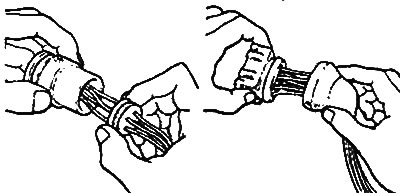
- a) If the test wire harness is missing, then it is necessary to carefully remove the protective cover.
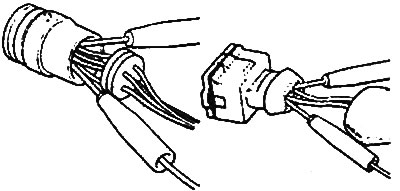
- b) When checking resistance, current or voltage, always insert the tester probe from the wire side.
Caution: Never insert the probe directly into the connector from the wire side through the protective cover, as this will result in a breach of the connector seal and corrosion.
- d) After checking, firmly install the protective cover on the connector.
Checking the electrical wiring
1. When checking the wiring harness for an open circuit when the ends of the wire being checked are significantly separated from each other, use a wire with an alligator clip to connect one end of the wire to ground, and then check for a closed circuit between the other end of the wire and ground. If the circuit is open, repair the wiring.
Note: However, when checking the power line wire for an open circuit, check for a complete circuit directly between both ends of the wire, without using an alligator clip to connect one end of the wire to ground.
2. When checking a circuit for a short circuit (to ground), disconnect one end of the wire and check for an open circuit between ground and the other end of the wire. If the circuit is closed (short circuit), repair the wiring.
Note: When checking the circuit condition, use an analog ohmmeter or multimeter.
3. If the wiring is normal, but the voltage (power) supplied to the sensor differs from normal, then replace the electronic engine control unit with a known good unit and repeat the check.
Note: When checking voltage, use a digital voltmeter (or multimeter). However, when checking voltage in the power transistor circuit, use an analog voltmeter.
Checking the circuit when the fuse blows
1. Remove the fuse and measure the resistance between the ground and the load contact of the fuse.
- a) Set the switches of all circuits related to this fuse to the closed position.
- b) If the resistance is almost zero, then a short circuit occurs in the circuit between the switches and the load.
- c) If the resistance is greater than zero, then there is currently no short circuit. However, the instantaneous short circuit caused the fuse to blow.
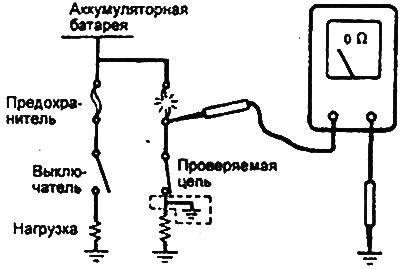
2. The main causes of short circuits are:
- a) Pinching of the wire by a body part.
- b) Damage to insulation due to wear or overheating.
- c) Water entering the connector or circuit.
- d) Human factor (erroneous short-circuiting of the circuit, etc.).
Troubleshooting intermittent problems
1. Intermittent faults (where the fault symptom may not reappear) often occur under certain conditions and if these conditions can be established, the cause of the fault can be easily determined. To determine the conditions under which the fault occurs, information about the driving conditions, weather conditions, frequency of occurrence and fault symptoms are first needed.
2. Perform a simulation test to reproduce the conditions for the malfunction to occur.
- a) When the root cause of the fault is probably vibration then:
- Gently shake the connector up and down, right and left.
- Gently shake the wire up, down, right and left.
- Gently shake each sensor, relay, etc. by hand.
- Gently shake the wire harnesses running on the suspension and other moving parts.
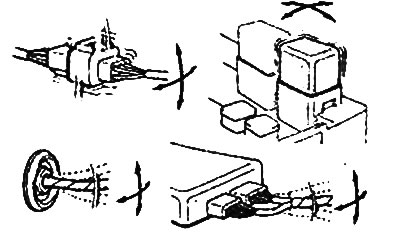
Note: if any wire shows signs of mechanical damage (severe bending, breakage, insulation cut, etc.), then a new wire must be connected in its place.
- b) When the root cause of the fault is likely to be overheating, use a hair dryer to heat the component where the fault is suspected to occur.
Caution: Do not heat system components above 80°C.
- c) When the main cause of the malfunction is probably increased resistance in the electrical circuits, set all electrical switches (including the headlight switches and rear window defogger switch) to the "ON" position.
- d) If the malfunction symptom does not reoccur even after performing the above checks, troubleshooting should be temporarily discontinued.