2. Disconnect the throttle position sensor connector.
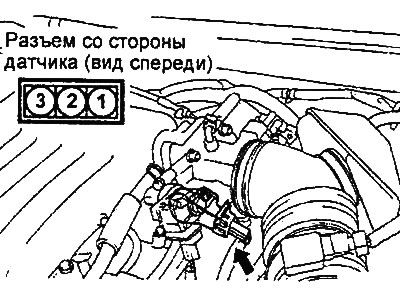
3. Using the alligator clip wires, connect the ohmmeter to terminal "2" (ground) and terminal "3" (signal) of the throttle position sensor.
4. Insert a 0.65 mm thick feeler gauge between the factory idle speed adjustment (SAS) screw and the throttle lever.
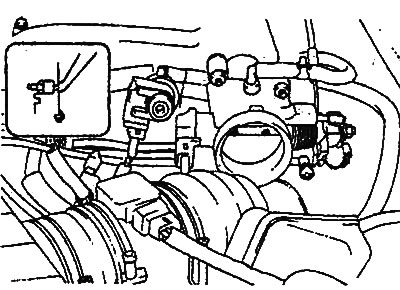
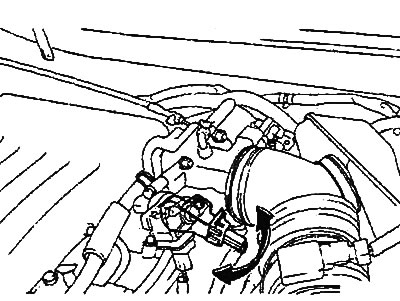
5. Loosen the throttle position sensor mounting screws and turn the sensor housing counterclockwise until it stops.
6. Under these conditions, check that the circuit is closed between terminals "2" and "3" of the sensor.
7. Slowly turn the sensor body clockwise to find the position where the circuit between the indicated terminals is broken. Then securely tighten the sensor mounting screws in this position.
8. Connect the throttle position sensor connector.
9. Connect the tester to the diagnostic connector.
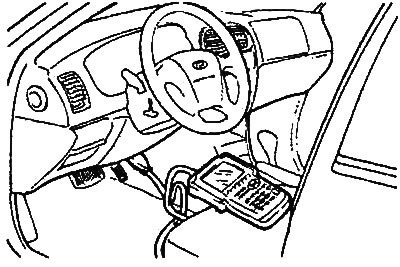
10. If a tester is not used for testing, connect a digital voltmeter between terminals "1" (ground) and "3" (signal) of the sensor connector via the test wire harness.
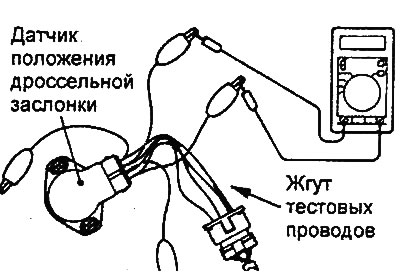
11. Turn the ignition switch to the "ON" position, do not start the engine. Make sure that the throttle position sensor signal voltage is within the nominal value range. If the test is performed using a tester, read the sensor signal voltage (select item No.14 of the Hi-Scan tester).
- Nominal value: 250-800 mV
12. If the measured voltage does not correspond to the nominal value, make sure that the resistance between the ground and the sensor signal terminal corresponds to the nominal value.
- Nominal value: 1.6-2.4 kOhm
13. If the measured resistance does not correspond to the nominal value, replace the throttle position sensor.
14. Remove the dipstick.
15. Turn the ignition switch to the "OFF" position.
16. Disconnect the tester or digital voltmeter.
Checking the vacuum hose nipple for purging the adsorber
Caution: Perform the check only when the coolant temperature is 80-95°C.
1. Disconnect the vacuum hose from the purge port of the canister (on the throttle body) and connect a hand vacuum pump.
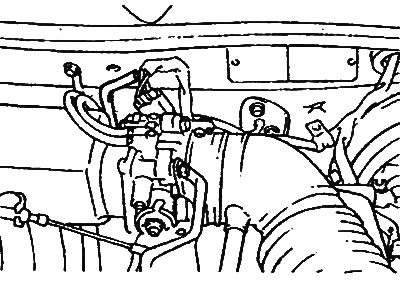
Engine 2.7 l. |
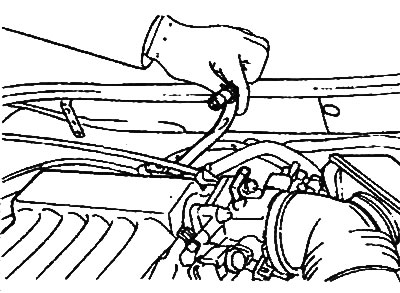
Engines 2.0 l / 2.4 l. |
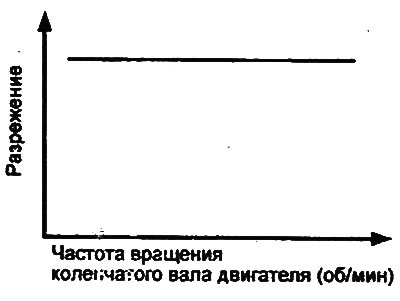
2. Start the engine and make sure that as the engine crankshaft speed increases, the vacuum remains almost constant.
(Information is copied from the website: HYUNDAIBOOK.ru)
Note: If vacuum is not created, there is likely deposits in the vacuum hose fitting channel (in the throttle body) and it needs to be cleaned.