Contents: General information ⇓ Search for basic faults by their…⇓ Features of fuel injection system…⇓ Standard troubleshooting scheme…⇓ Checking the "CHECK ENGINE" light ⇓ Reading fault codes ⇓ Clearing fault codes without a tester ⇓ Recommendations for troubleshooting…⇓ Explanations on the operation of the…⇓ Table. Troubleshooting by diagnostic…⇓
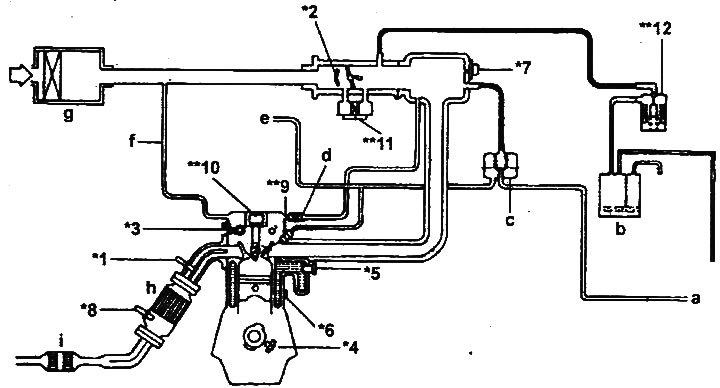
General diagram of the fuel injection system (MFI) of the 2.4L engine (EOBD type).
1 - front oxygen sensor, 2 - throttle position sensor, 3 - camshaft position sensor, 4 - crankshaft position sensor, 5 - coolant temperature sensor, 6 - knock sensor, 7 - manifold absolute pressure sensor, 8 - rear oxygen sensor, 9 - fuel injector, 10 - ignition coil, 11 - idle speed control servo, 12 - canister purge solenoid valve, a - to fuel tank, b - canister, c - fuel pressure regulator, d - positive crankcase ventilation valve, e - from fuel pump, f - positive crankcase ventilation hose, g - air filter, h - pre-catalytic converter (on the exhaust manifold), i - main catalytic converter (under the floor of the car body).
Note: signals from the components marked are used by the electronic control unit (signals from the ignition switch, starter interlock switch (models with automatic transmission), vehicle speed sensor, power steering fluid pressure switch, ignition system, air conditioning switch signal are also used, battery voltage is taken into account); components marked with "**" are actuators (together with the main relay of the injection system, the relay of the electromagnetic clutch of the air conditioning compressor; in addition, the electronic engine control unit (models with automatic transmission) or the electronic engine and automatic transmission control unit (models with automatic transmission) provide output signals to control the fuel pump, ignition timing and self-diagnostic system).
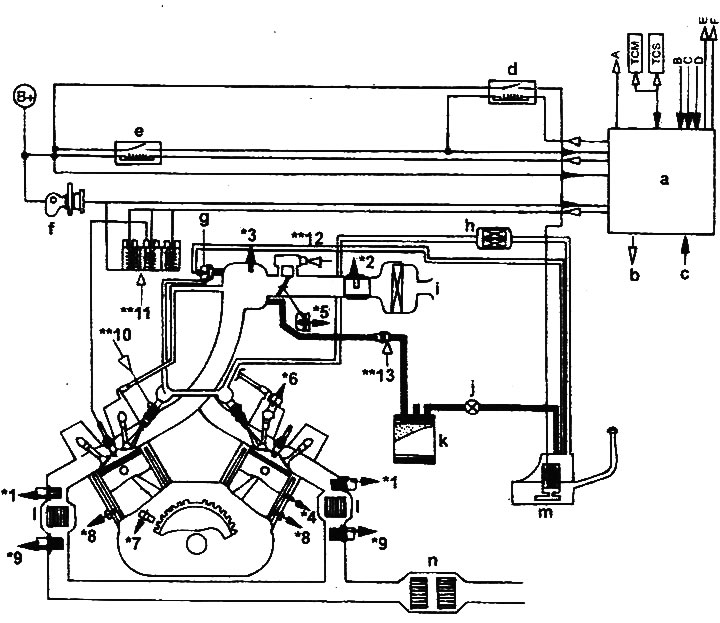
General diagram of the fuel injection system (MFI) of the 2.7L engine (EOBD type).
1 - front oxygen sensor, 2 - mass air flow sensor, 3 - intake manifold air temperature sensor, 4 - coolant temperature sensor, 5 - throttle position sensor, 6 - camshaft position sensor, 7 - crankshaft position sensor, 8 - knock sensor, 9 - rear oxygen sensor, 10 - fuel injector, 11 - ignition coil, 12 - idle speed control servo, 13 - canister purge solenoid valve, a - engine control unit, b - output signal, c - input signal, d - fuel pump relay, e - engine control relay, f - ignition switch, g - fuel pressure regulator, h - fuel filter, i • air filter, j - two-way valve, k - adsorber, I - preliminary catalytic converter (on the exhaust manifold), m - fuel tank, n - main catalytic converter (under the floor of the car body); A - tachometer signal, B - vehicle speed sensor signal, C - air conditioner switch signal, D - air conditioner compressor electromagnetic clutch relay signal, E - air conditioner condenser fan motor "HI" mode relay signal, F - air conditioner condenser fan motor "LO" mode relay signal, TCM - automatic transmission electronic control unit, TCS - traction control system electronic control unit.
Note: signals from the marked components are used by the electronic control unit (signals from the ignition switch, starter interlock switch (models with automatic transmission), fuel pump relay, vehicle speed sensor are also used, the signal from the air conditioner switch is used, the battery voltage is taken into account); components marked with "**" are actuators (together with the main relay of the injection system, the relay of the electromagnetic clutch of the air conditioning compressor; in addition, the electronic engine control unit provides output signals to control the fuel pump, ignition timing and self-diagnostic system).
General information
1. Type of electronic engine control unit.
- a) Models with 2.0 l and 2.4 l engines were equipped with an electronic engine control unit developed by MELCO (Mitsubishi Electric Co).
- b) Models with a 2.7 liter engine were equipped with electronic engine control units developed by Siemens.
- c) Depending on the export region, units with a standard control system based on signals from two oxygen sensors (with EOBD) and with a simplified control system based on signals from one oxygen sensor (without EOBD) could be installed. A catalytic converter was installed on all such models.
2. Diagnostic connectors.
The vehicle was equipped with one standard 16-pin main diagnostic connector.
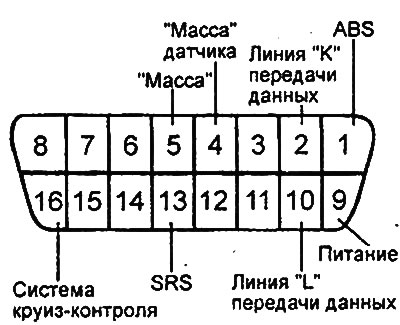
3. Type of self-diagnostic system.
- a) The EOBD or OBD-II standard self-diagnostic system is used. The standard diagnostic code consists of one letter and 4 digits (for example: "P0000"). The numbering of such codes is continuous, i.e. the fault codes for different systems are not repeated.
- b) When a fault is detected by the self-diagnosis system, the corresponding diagnostic code will be recorded and the current parameters of the main engine units and systems at that moment will be recorded ("data freeze frame"). This data, read by the tester, can simplify the analysis of the conditions of the fault occurrence.
4. Features of diagnostics using a tester.
- a) The algorithm of the Hyundai diagnostic system may differ from the standard algorithm (OBD-II protocol), therefore, to perform correct diagnostics, it is recommended to use the Hi-Scan(Pro) tester.
- b) It is recommended to connect the tester with the ignition off, since with the ignition on, a failure in the electronic engine control unit may occur.
- c) Before connecting the tester to the diagnostic connector, make sure that the condition and shape of the connector terminals are normal.
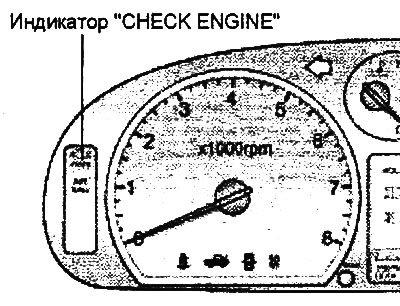
5. Explanations on the operation of the "CHECK ENGINE" indicator:
- a) The indicator lights up for a few seconds immediately after the ignition is turned on to indicate that the indicator itself is functioning normally.
- b) Next (after starting or with the engine running), the indicator lights up to warn the driver that the self-diagnostic system has detected a malfunction.
Note: If the indicator lights up due to a malfunction of the electronic control unit, it is impossible to establish communication between the tester and the electronic control unit, and it is not possible to read diagnostic codes.
- c) Intermittent flashing of the indicator indicates the presence of a temporary fault. It may continue as long as a major fault affects the emission control system or other systems (e.g., damage to the catalytic converter due to misfiring).
- d) In case of a critical malfunction (the presence of a serious defect in the fuel injection system or the exhaust toxicity reduction system), the indicator will light continuously while the vehicle is moving until the malfunction code is cleared after the malfunction has been corrected (i.e. after repair).
Note: Clearing the fault code does not correct the fault.
- d) The indicator will go out when the ignition is switched off (ignition key in the "OFF" position).
6. Conditions under which the illuminated "CHECK ENGINE" indicator may go out due to a signal from the electronic control unit when the ignition is on (the fault code remains):
- a) For a transmission fault: If the engine control unit has not detected a fault during three consecutive vehicle driving cycles under the appropriate modes and conditions (see conditions for setting the code).
- b) For a fault in the exhaust emission system (misfiring): if the engine control unit has not detected a fault during the cycle under similar engine operating conditions (crankshaft speed, coolant temperature, etc.) under which the fault was first detected.
7. The fault code (for the fuel injection system) can be automatically cleared from the engine control unit memory when the ignition is on if the corresponding fault has not been detected within 40 subsequent vehicle driving cycles.
8. Explanations on the operation of the self-diagnostic system.
- a) The engine control unit monitors input/output signals (some constantly, others only under certain conditions). If a constant or specified period of time malfunction of the system is detected, or if after the first incorrect signal several more similar signals are received by the engine control unit, the engine control unit will perceive this as a malfunction, record the corresponding malfunction code in memory and send a signal to the output of the self-diagnostic system.
Note:
- Typically, if the ECU detects a fault, the "CHECK ENGINE" indicator will illuminate and a fault code will only be stored after the engine is restarted and the same fault is detected again (i.e. if the fault persists for two consecutive driving cycles).
- For some faults (e.g. codes P0300, P0301, P0302, P0303, P0304, P0305 and P0306) the "CHECK ENGINE" indicator will light and the fault code will be recorded the first time they are detected if the fault is critical (damage to the catalytic converter occurs). If the misfiring in the cylinders only leads to increased exhaust toxicity (over 150% of the norm), then a fault code of the P030x type is recorded immediately, and the indicator lamp lights up when the fault is detected again.
- When some faults occur (for example, codes: P0230, P0325, P0506 and P0507), the "CHECK ENGINE" indicator does not light.
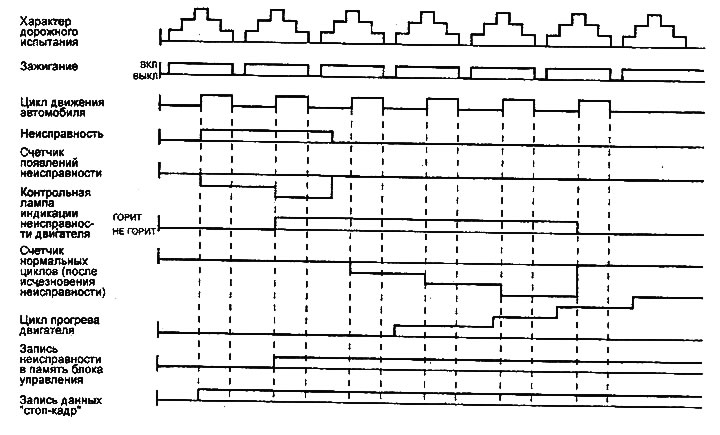
Relationship between fault codes and road test pattern for EOBD type system.
Note:
- "Engine warm-up cycle " means adequate operation of the vehicle engine, which increases the coolant temperature from a minimum of 4.4°C at engine start to a minimum of 70°C.
- "The vehicle driving cycle" consists of starting the engine and running the engine after the start of feedback control on the air-fuel mixture composition ("closed-loop").
- b) Since the memory device (RAM of the ECU) is powered directly by the battery, the diagnostic results are saved even when the ignition switch is turned to the "OFF" position. The trouble codes will be erased when the battery terminal or the ECU connector is disconnected. In addition, the trouble codes are erased if a signal to erase the trouble codes is sent from the tester to the ECU with the ignition switch turned on (the key is in the "ON" position).
Note: If you disconnect the connector of any sensor with the ignition on (key in the "ON" position), the electronic control unit will perceive this as a malfunction and a corresponding code will be written into the electronic control unit's memory. In this case, delete the malfunction codes.
Search for basic faults by their signs
1. Identifying the causes of engine malfunctions should always begin with checking the functionality of the main systems. If one of the following malfunctions is present: the engine does not start, unstable idle speed, poor throttle response (poor acceleration), then start checking the following main systems:
- a) Power supply system (battery, fuse, fuse).
- b) Ground connection wires.
- c) Fuel supply system (fuel lines, fuel filter, fuel pump).
- d) Ignition system (spark plugs, high-tension spark plug wires, ignition coil).
- d) Toxicity reduction system (forced crankcase ventilation system, vacuum line tightness).
- e) Other faults (ignition timing, idle speed).
2. Very often the cause of the malfunction of the distributed fuel injection (MR) system is poor contact in the connectors. Be sure to check all connectors and make sure that they are securely connected.
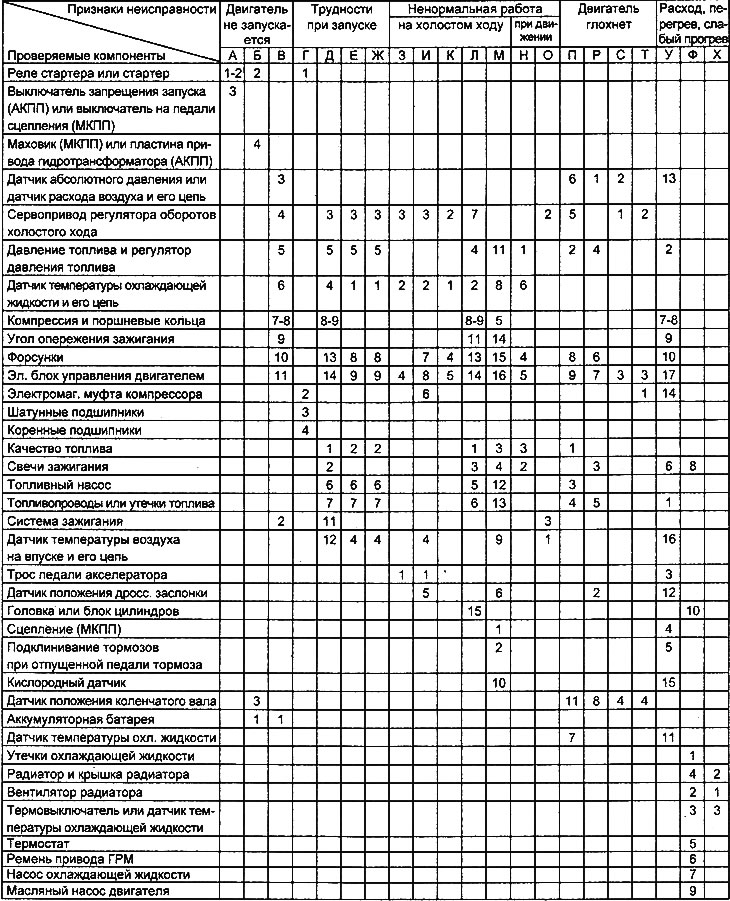
3. For troubleshooting, see the corresponding table.
The engine does not start:
- A. The engine crankshaft does not turn over with the starter.
- B. The starter turns the crankshaft, but the engine does not start.
- B. Incomplete combustion of fuel.
Difficulties when starting:
- G. Long-term cranking of the Honanaioiu engine shaft by the starter.
- D. Always.
- E. When the engine is cold.
- G. When the engine is warm.
Abnormal idling:
- 3. Inappropriate idle speed during warm-up.
- I. Idle speed too high.
- K. Low idle speed in verse.
- L. Uneven engine operation.
- M. Inadequate engine response to control action or poor throttle response.
Abnormal engine operation while the vehicle is moving:
- H. Jerks and twitching of the car.
- O. Detonation.
The engine stalls:
- P. Soon after launch.
- P. After pressing the accelerator pedal.
- C. After releasing the accelerator pedal.
- T. When turning on the air conditioner
Other malfunctions:
- U. Increased fuel consumption.
- F. The engine is overheating.
- X. The engine does not warm up.
4. If you experience any difficulties with refueling (overflow, fuel splashing out of the tank), check the fuel shut-off valve, the fuel tank ventilation valve hose and the fuel vapor adsorber filter.
Features of fuel injection system testing
1. If the components of the fuel injection system (sensors, electronic engine control unit, injectors, etc.) are faulty, the result will be a stop in fuel supply or a failure in the precise fuel supply under various engine operating conditions.
The following situations may arise:
- a) The engine does not start or starts with difficulty.
- b) Unstable engine operation at idle.
- c) Poor engine control.
2. If any of the above situations occur, first perform the normal diagnostic procedure, which includes basic engine checks (no ignition system malfunction, incorrect engine settings, etc.). Then check the fuel injection (MFI) system components with a tester in accordance with the subsection "Standard troubleshooting scheme using a tester".
Note:
- Before removing or installing any component, first read the diagnostic trouble codes and then disconnect the negative battery cable.
- Before disconnecting the battery cables, turn the ignition switch to the "OFF" position. Disconnecting or connecting the battery cables with the ignition on or the engine running may damage the engine control unit.
- The control system wires that connect the ECM to the oxygen sensor are shielded with a ground wire that is connected to the body to eliminate interference from the ignition system and radio. If the shield wire is faulty, replace the ECM wiring assembly.
- When testing the alternator, do not disconnect the positive battery cable, otherwise damage to the ECM may occur.
- When charging the battery from an external source, disconnect the battery terminal cables on the vehicle to prevent damage to the ECM.
Standard troubleshooting scheme using a tester
1. Simulate signs of a malfunction to check for their presence and determine the nature and conditions of occurrence (engine operating mode, operating conditions, etc.).
2. Read the fault codes and determine the causes of the fault, the components to be checked and the order in which they are checked.
3. Check the input signals of the electronic engine control unit using a tester or motor tester. If the signals are normal, then the corresponding sensor (element) is in good condition. Proceed to check the next component.
4. Check the output signals of the engine control unit using a motor tester and check the operation of the actuators (drives) using the ACTUATOR TEST item of the tester. If the signals of the engine control unit and the drive are normal, then the drive control is normal. Proceed to checking the next component.
5. If the ECU signals are normal, check and repair the wiring of the system components if necessary. After repair, check the ECU signals again. If the signals are normal this time, check the input and output signals for the next component to be checked.
6. If the wiring is OK, but the input and output signals of the engine control unit are not normal, check the individual components of the system and, if necessary, repair or replace them. After repair, check the signals of the engine control unit again. If the signals are not normal this time, check the signals for the next component to be checked.
7. Recheck for signs of malfunction and repair.
If the suspected wiring circuit and specific components are checked and no faults are found, but the ECU input and output signals are abnormal, then evaluate the symptoms more closely (the initial diagnosis may have been incorrect or incomplete). When checking further, try to expand the troubleshooting area to other groups of components (repair if necessary).
8. Try to simulate the symptoms of the malfunction to be sure that the malfunction has been eliminated. Eliminate the cause of the malfunction to prevent the defect from reoccurring.
Table. Troubleshooting by their signs (the number shows the sequence of checks).
Checking the "CHECK ENGINE" light
1. Turn the ignition switch to the "ON" position and check that the "CHECK ENGINE" indicator comes on for approximately 5 seconds and then goes out.
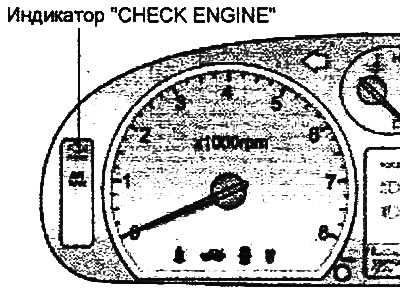
2. If the indicator does not light, check the wiring, fuse and indicator lamp.
Reading fault codes
1. Prepare the vehicle for inspection as follows.
- a) Make sure that the battery is in good condition, as fault detection is impossible if the battery voltage is low.
- b) Turn off all additional equipment.
- c) Set the manual transmission gear shift lever to neutral or the automatic transmission selector lever to the "N" position.
Caution: Do not disconnect the battery until the diagnostic results have been fully read, as the fault code will be cleared from the ECU memory when the battery or ECU connector is disconnected.
2. When checking with a tester, connect the tester to the diagnostic connector located under the lower cover of the instrument panel.
Caution: Before connecting or disconnecting the tester, turn off the ignition.
3. Turn on the ignition and read the diagnostic codes.
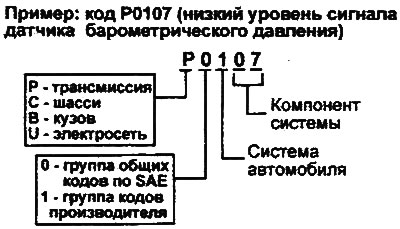
4. Description of the structure of the standard diagnostic trouble code for the OBD-II type system.
- a) The letter indicates the purpose (area of application) of the faulty device: P - transmission (engine and gearbox), C - chassis, B - body, U - on-board electrical system.
- b) The first digit of the code after the letter denotes either the group of general SAE codes (0) or the group of manufacturer-specific codes (1).
- c) The second digit of the code after the letter indicates the specific vehicle system in which the fault is present. For example, if the application area is the transmission (P), then the following 8 systems are defined for it: 1 - fuel and air supply system, 2 - fuel and air supply system (only types of faults in the injector circuit), 3 - ignition system or misfiring in cylinders, 4 - additional emission control system, 5 - vehicle speed control system and idle speed control system, 6 - circuits of various electronic control systems, 7 and 8 - transmission (gearbox).
- d) The remaining 2 digits indicate a specific component of the system.
Clearing fault codes without a tester
Note: After performing repairs, clear the fault codes from the memory of the electronic control unit.
1. Turn off the ignition (key in the "OFF" position).
2. After disconnecting the cable from the negative battery terminal for 15 seconds or more, reconnect the cable to the terminal.
3. Start the engine and after warming up, let it idle for 15 minutes or more.
4. With the ignition on, read the fault codes and make sure that a normal condition code is displayed.
Recommendations for troubleshooting by codes
1. Before searching for the cause of the malfunction, check that the battery voltage is 10 V or more, then check the ground circuit of the engine control unit.
2. If the DTC continues to appear even though the test showed that the systems/circuits being tested are normal (no faults were found), then replace the ECM with a known good one, perform a road test and retest.
3. Replace the engine control unit with a new one only after checking the voltage at its terminals to confirm that there is no open or short circuit in the circuits.
4. If the diagnostic code is not issued (with a functioning diagnostic circuit) and the engine stalls or the engine does not start, replace the engine control unit with a new one.
5. For most items diagnosed with codes, the main causes of failure are:
- a) Defect of the corresponding element (indicated in the code detail, see code table);
- b) Poor contact in the element connector, broken wiring or short circuit in the element circuit (power supply circuit, ground, signal);
- c) Defective electronic engine control unit.
Explanations on the operation of the system in emergency mode
When the self-diagnostic system detects a critical failure of one of the main sensors, the engine management system switches to emergency control mode (LIMP HOME FUNCTION), replacing the incorrect signal with a signal previously recorded in the control unit memory so that the vehicle can continue moving (to the service station).
1. If the air flow sensor is faulty:
- a) For control, signals from the throttle position sensor (if serviceable), crankshaft position sensor (engine crankshaft speed), and intake manifold air temperature sensor are used in accordance with a specified program.
- b) The idle speed control servo is fixed in the programmed position, as a result of which the idle speed is not regulated.
2. If the intake manifold air temperature sensor is faulty, the intake manifold air temperature is calculated using the signals from the coolant temperature sensor.
3. If the throttle position sensor is faulty, there is no increase in fuel supply when the accelerator pedal is pressed (according to the signal from the throttle position sensor). Signals from the absolute pressure sensor, the air temperature sensor in the intake manifold and the position of the idle speed control servo are used for control.
4. If the coolant temperature sensor is faulty, the temperature is calculated based on the signals from the intake manifold air temperature sensor.
5. If a misfire is detected in any cylinder, the fuel supply to that cylinder is stopped.
6. If the oxygen sensor (models with one sensor) or the front oxygen sensor (models with two or four sensors) is faulty, the air-fuel ratio will not be regulated (no feedback control).
7. (EOBD models) If the rear oxygen sensor is faulty, the air-fuel ratio control (closed-loop control) is performed taking into account signals from the front oxygen sensor only.
8. If the camshaft position sensor is faulty, a later ignition timing angle is set and sequential fuel injection begins based on signals from the crankshaft position sensor.
9. If the fuel balance is incorrect (codes P0170 - P0173), the adsorber is not purged.
10. If the knock sensor is faulty, the ignition timing angle is adjusted only based on signals from the crankshaft position sensor and the air flow sensor.
11. If the idle speed control servo drive is faulty (codes P1505 - P1508 for the 2.7 L engine), then the idle speed is regulated according to a specified program without a servo drive, depending on the signals from the crankshaft position sensor and the throttle position sensor.
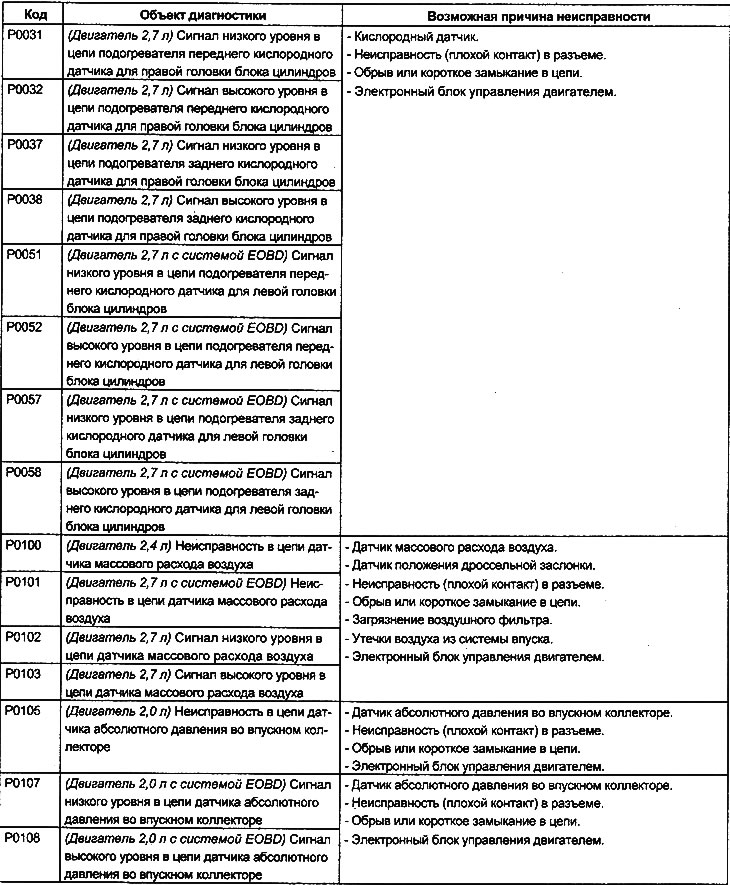
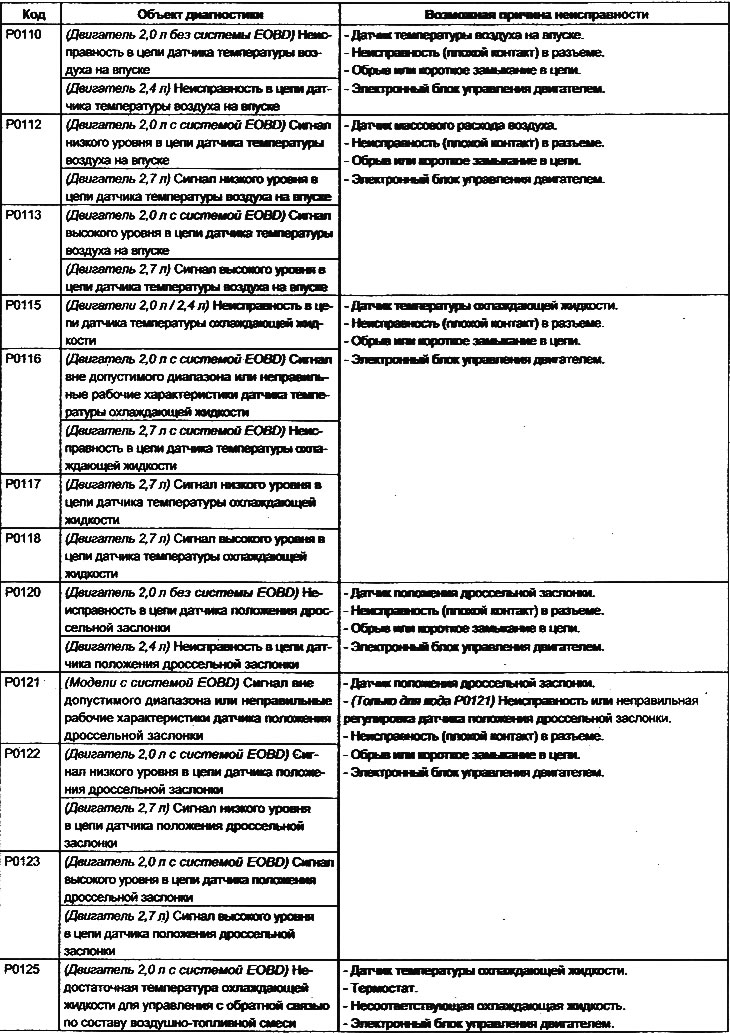
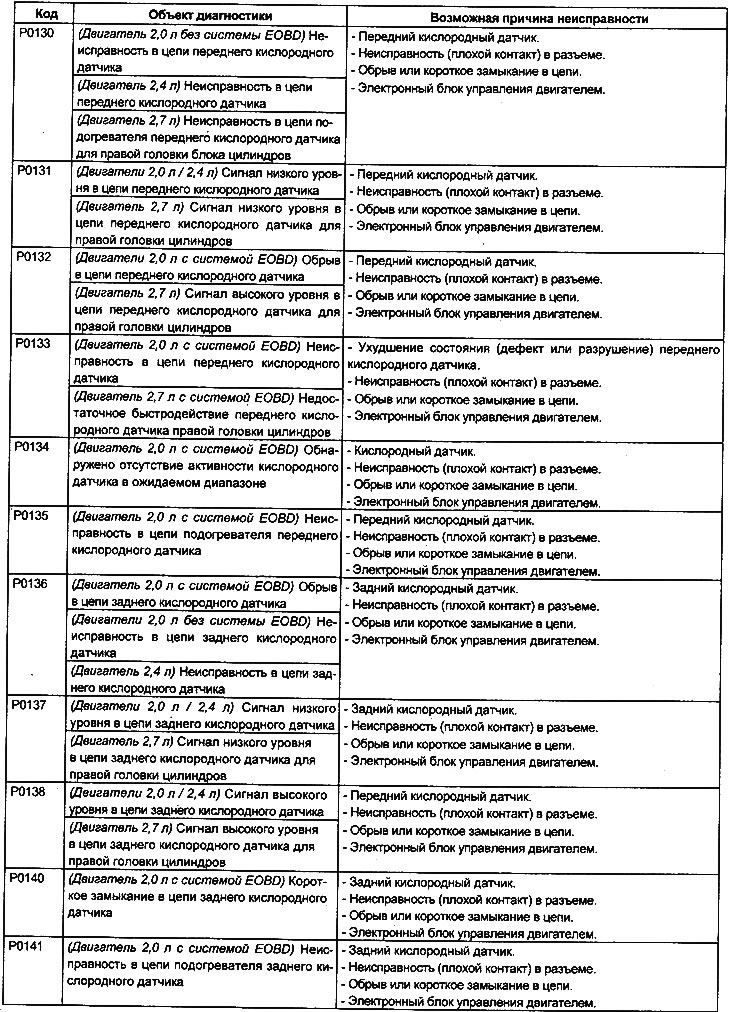
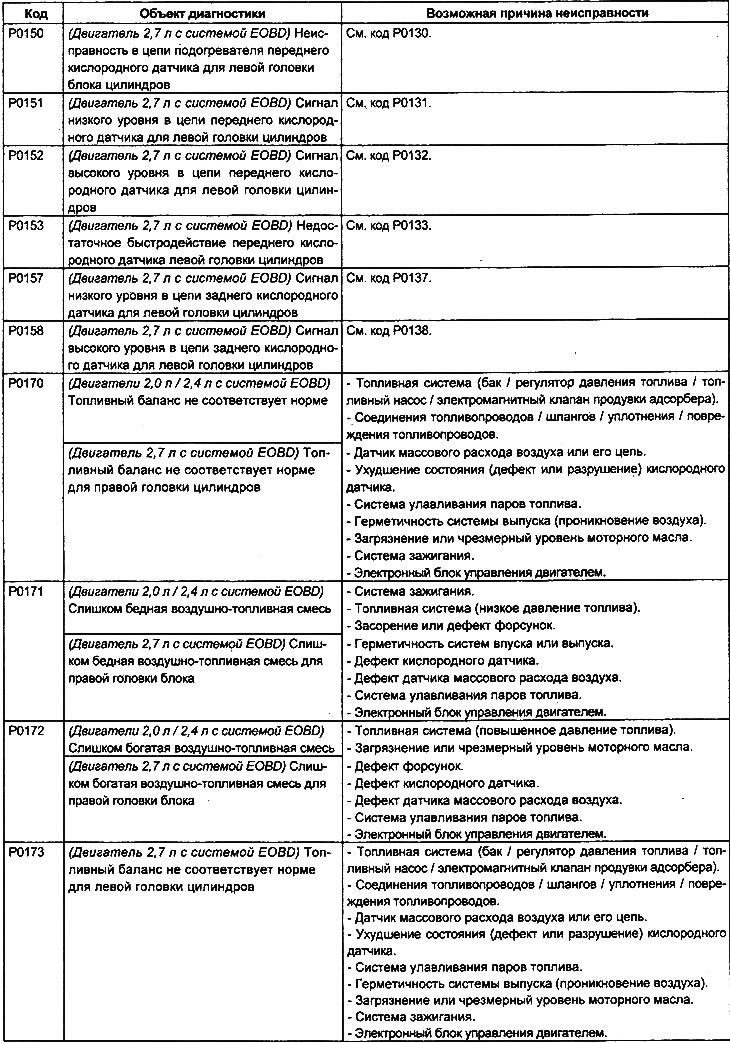
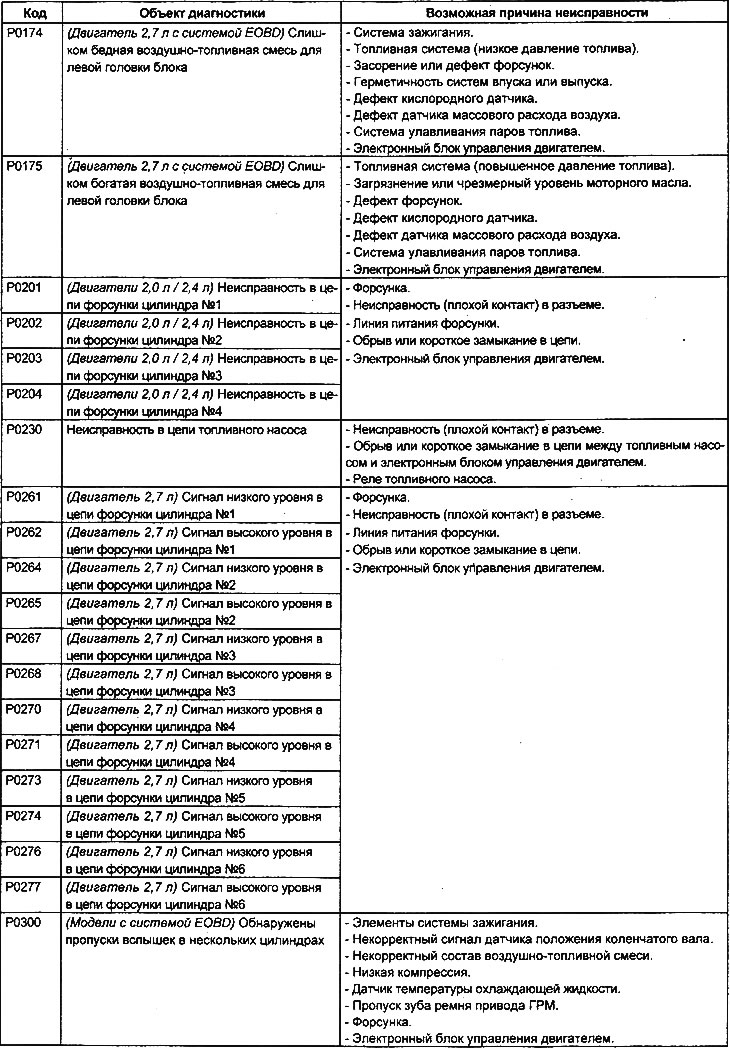
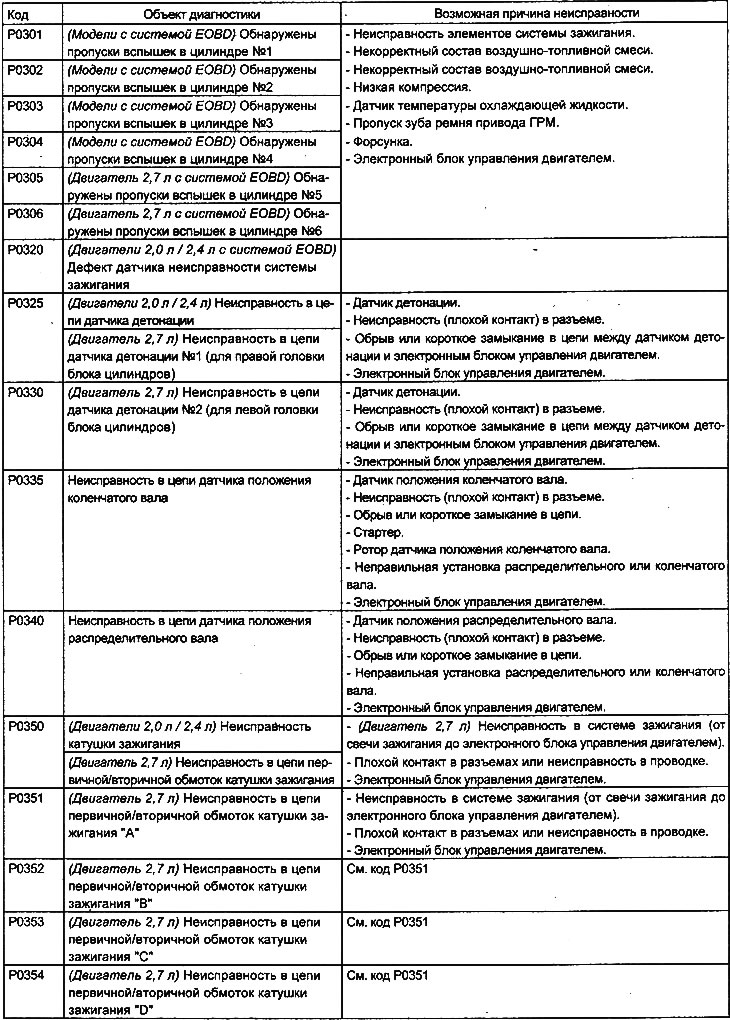
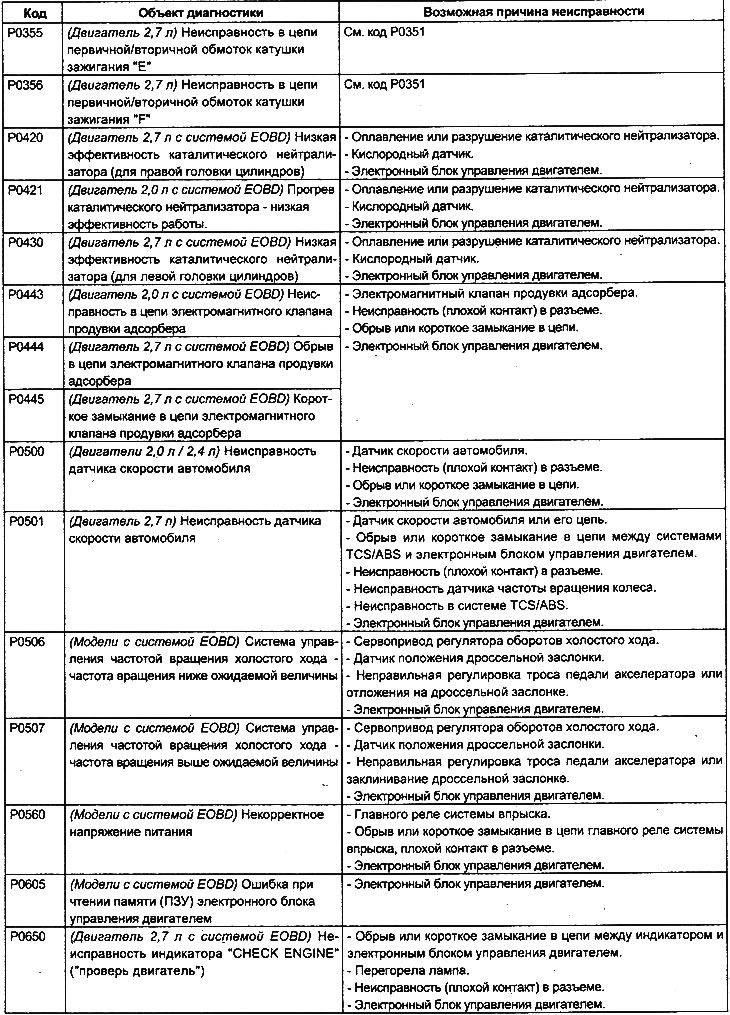
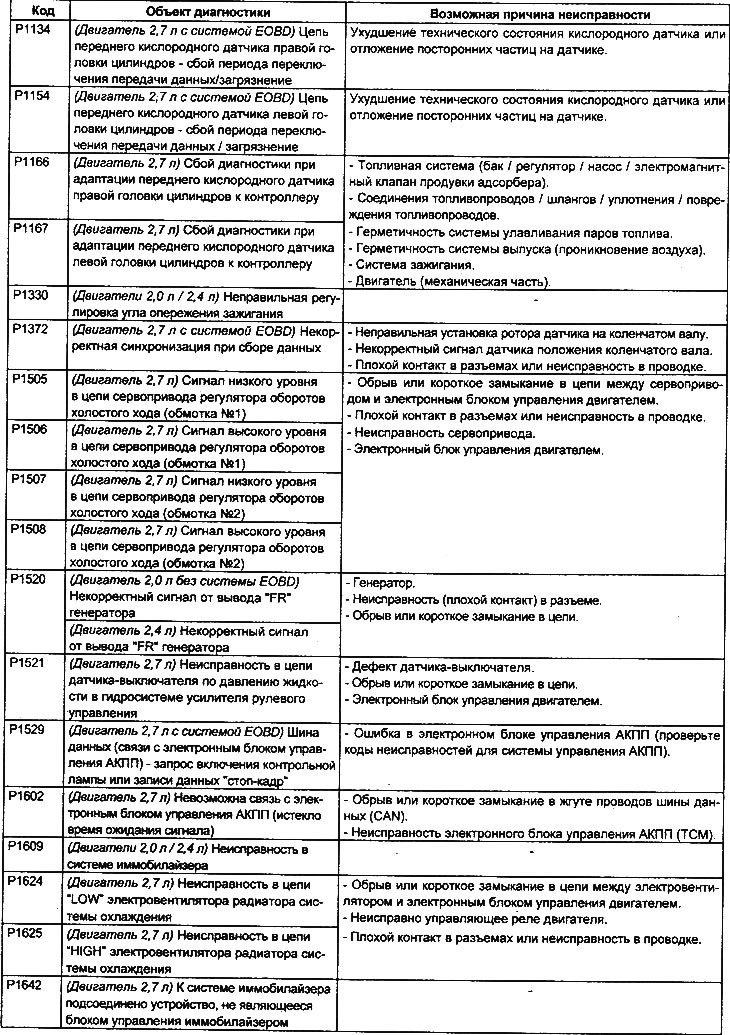
Table. Troubleshooting by diagnostic codes.
Note:
- Models with EOBD:
- 2.0L/2.4L engines: models with two (front and rear) oxygen sensors.
- 2.7L engine: models with four (two front and two rear - for the right and left cylinder heads) oxygen sensors.
- Non-EOBD models:
- 2.0L/2.4L engines: Models with one (front) oxygen sensor.
- 2.7L Engine: Models with two (front) oxygen sensors.