
HyundaiBook.ru
Repair Chevrolet Repair Honda Repair Toyota Repair Land Rover Repair VAZ Repair Renault Repair Nissan
English Русский
Български
Беларускі
Український
Српски
Hrvatski
Română
Polski
Slovenský
Magyar
ArticlesSitemapContacts  


  Accent   Elantra   Getz   Grandeur   Sonata   Santa Fe   Tucson   Others
Elantra 1 (1990-1995, petrol) Elantra 2 (1995-2000, petrol) Elantra 3 (2000-2006)
  • Main
  • Elantra
  • XD (2000-2006)
  • Transmission
  • Drive shafts and axles
  • Drive shaft with ball type and Birfield type CV joints

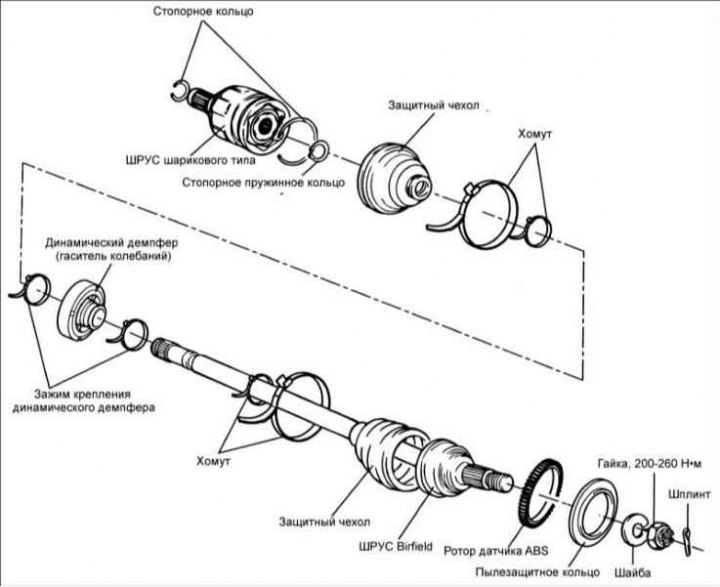
Drive shaft with ball type and Birfield type CV joints (Hyundai Elantra XD)

0
Contents: Disassembly ⇓ Examination ⇓ Assembly ⇓
Disassembly


Disassembly


  • Do not disassemble the Birfield type CV joint.
  • To lubricate CV joints, use only special grease.
  • When assembling the CV joint, it is necessary to install new clamps.


1. Remove the clamps and pull off the protective cover from the ball joint of the drive shaft.

Caution: Be careful not to damage the protective cover.
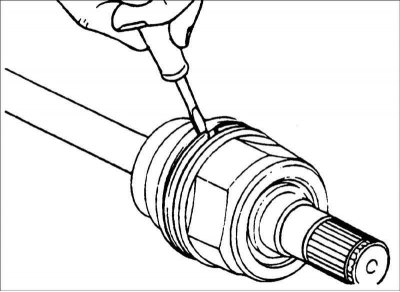

2. Using a flat-blade screwdriver,…


2. Using a flat-blade screwdriver, remove the retaining ring.
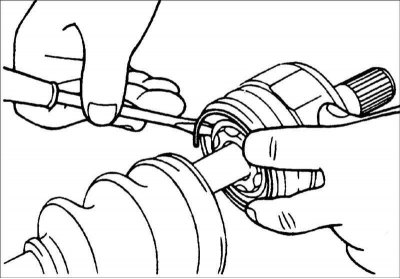
3. Remove the ball joint from the drive…


3. Remove the ball joint from the drive shaft.
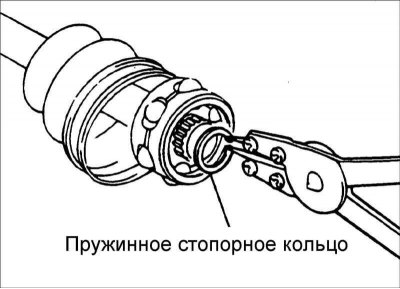


4. Remove the snap ring, take out the…


4. Remove the snap ring, take out the inner ring, housing and balls as an assembly.

5. Without disassembling, clean the inner ring, housing and balls.

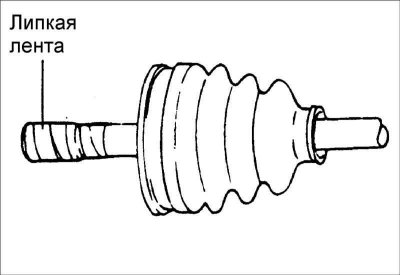
6. Remove the clamps and pull off the protective boots of the ball CV joint and Birfield CV joint.
Warning!


Warning!


If the boot is to be reused, wrap the drive shaft splines with tape before removing the boot to protect it.

Examination


1. Check the ball CV joint for signs of rust, damage to the outer ring, inner ring and balls.

2. Check the condition of the drive shaft splines.

3. Check the Birfield CV joint protective boot for any traces of rust, water or foreign objects.
Warning: If the Birfield CV joint is to…


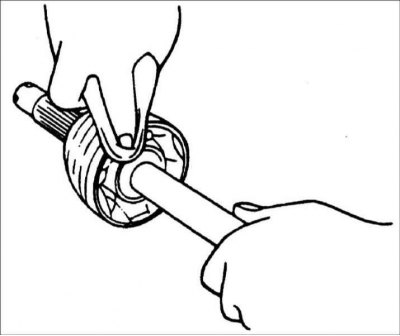
Warning: If the Birfield CV joint is to be used repeatedly, do not remove the grease from it. Make sure the lubricant is free of any impurities.


If necessary, clean the Birfield CV joint and replace the grease in it.

Assembly


1. Before installing the boot, wrap the splines of the drive shaft on the ball joint side with adhesive tape to protect it.

2. Apply grease to the drive shaft and install the boot.
3. To install the dynamic damper,…


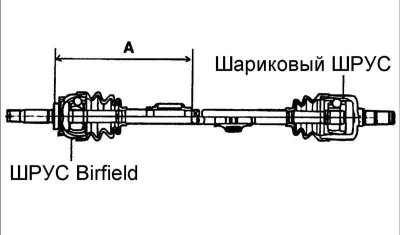
3. To install the dynamic damper, position the Birfield CV joint straight in relation to the shaft, position the damper at a certain distance and secure it with a clamp.

Damper installation distance (A)
  • cars with 1.6 and 1.8 l engines with manual transmission: 467.5 (2/0) mm
  • cars with 2.0 engines with manual transmission: 469 (2/0) mm
4. Apply grease to the inner ring and…


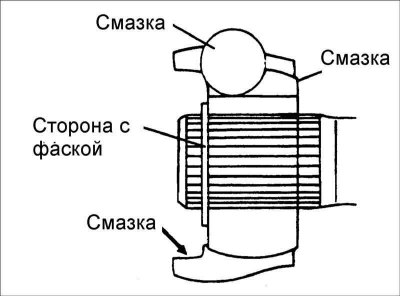
4. Apply grease to the inner ring and housing. Install the housing so that the offset on the rolling surface is located as shown in the figure.


Caution: Use the lubricant supplied with the repair kit.


5. Apply grease to the housing and balls located in the housing.

6. Install the hinge as shown in the figure and secure it with the snap ring.

7. Apply the required amount of grease to the outer ring and install it on the drive shaft.

8. Place the required amount of grease into the protective boot and install the boot onto the hinge.

9. Secure the ball-type protective cover with clamps.

10. Add as much Birfield grease to the CV joint as was wiped off during the joint inspection.

11. Install the covers.

12. Secure the Birfield CV joint protective cover with clamps.
13. To control the air pressure in the…


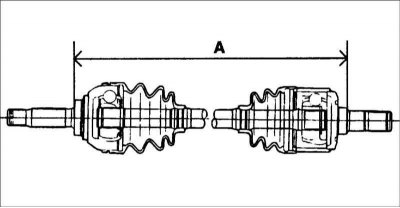
13. To control the air pressure in the T.J. joint boot, maintain the required distance between the protective boot mounting clamps or the length of the drive shaft when tightening the clamps. The nominal length of the drive shafts is given in the table.

Nominal length of drive shafts with ball-type and Birfield CV joints


Name
Left side
Right side
Cars with 1.6 l engines with manual transmission
512.7 (22.8/ –15.1) mm
795.7 (22.8/ –15.1) mm
Cars with 1.8 l engines with manual transmission
795.2 (22.7/ –14.4) mm
513.2 (22.7/ –14.4) mm
Cars with 2.0L engines with manual transmission
513.2 (20.7/ –15.5) mm
796.2 (20.7/ –15.5) mm


[The original material is located on the website: www.HyundaiBook.ru]
This article is available at russian, bulgarian, belarusian, ukrainian, serbian, croatian, romanian, polish, slovak, hungarian
This article has been reviewed by: Konstantin Smirnov
Add to social network:

Previous
Elantra 3: Drive shafts and axles
Next

Drive shaft — removal and installation
Technical data of drive shafts and axles
Drive shaft with Birfield (BJ) and tripod type (TJ) CV joints
Front wheel steering knuckle and hub
Rear axle / rear wheel hub
Troubleshooting issues
We recommend other articles on the topic of Hyundai manuals:

Drive shaft with ball and Birfield type CV joints Hyundai Accent 2 (1999-2005)
Drive shaft with TJ and BJ type CV joints. Hyundai Getz (2002-2011)
Ball joint and steering seals. Steering and drive shaft boots Hyundai Sonata 3 (1993-1998)
Front wheel drive shaft (CV joint with length compensator (DOJ)… Hyundai Santa Fe 2 (2007-2012, petrol)
Adjusting the drive belt tension Hyundai Tucson 1 (2005-2010)
Front wheel drive shaft (CV joint with length compensator (DOJ)… Hyundai Matrix (2001-2010, petrol)

Link in different formats to this article

Visitor comments
No comments yet


How much will 16 + 13 ?


Elantra 3 (2000-2006) 
  • User manual
  • Control devices
  • Audio system
  • Starting the engine and driving
  • Faults en route
  • Maintenance and care
  • Technical information
  • Power unit
  • Gasoline engines
  • Diesel engines
  • Lubrication system
  • Cooling system
  • Fuel system (gasoline)
  • Fuel system (diesel)
  • Decreased toxicity
  • Ignition system
  • Transmission
  • Clutch
  • Mechanical gearbox
  • Automatic gearbox
  • Drive shafts and axles
  • Chassis
  • Car suspension
  • Steering
  • Brake system
  • Body
  • Exterior (external elements)
  • Interior (internal elements)
  • Air conditioning system
  • Electrical equipment
  • Equipment and devices
  • Headlights and lighting
  • Power devices
  • Electrical circuits
Elantra 2 (1995-2000, petrol) 
  • General information
  • Maintenance
  • Power unit
  • Engine repair
  • Cooling system
  • Intake and exhaust system
  • Fuel system
  • Transmission
  • Clutch
  • Manual gearbox
  • Automatic gearbox
  • Drive shafts and axles
  • Chassis
  • Front suspension
  • Rear suspension
  • Steering
  • Brake system
  • Body
  • Body elements
  • Electrical equipment
  • Equipment and devices
  • Electrical diagrams
Elantra 1 (1990-1995, petrol) 
  • General information
  • Introduction to the guide
  • Maintenance
  • Power unit
  • Minor engine repair
  • Engine overhaul
  • Lubrication system
  • Cooling system
  • Fuel injection system
  • Ignition system
  • Exhaust system
  • Transmission
  • Clutch
  • Manual gearbox
  • Automatic gearbox
  • Drive shafts
  • Chassis
  • Front suspension
  • Rear suspension
  • Steering
  • Wheels and tires
  • Troubleshooting
  • Brake system
  • Body
  • Body elements
  • Electrical equipment
  • Equipment and devices
  • Power devices
  • Heating and air conditioning
  • Electrical circuits
HyundaiBook.ru © 2018-2026 · Mobile version · Sitemap: EN BG BY UA RS HR RO PL SK HU · Administration · Site search · Hyundai owners Accent 1 · Accent 2 · Accent 3 · Elantra 1 · Elantra 2 · Elantra 3 · Getz · Sonata 3 · Sonata 4 · Santa Fe 2 · Tucson 1 · Tucson 2 · Matrix ·
This site uses cookies to optimize its functionality. By continuing, you agree to our terms.