
HyundaiBook.ru
Repair Chevrolet Repair Honda Repair Toyota Repair Land Rover Repair VAZ Repair Renault Repair Nissan
English Русский
Български
Беларускі
Український
Српски
Hrvatski
Română
Polski
Slovenský
Magyar
ArticlesSitemapContacts  


  Accent   Elantra   Getz   Grandeur   Sonata   Santa Fe   Tucson   Others
Elantra 1 (1990-1995, petrol) Elantra 2 (1995-2000, petrol) Elantra 3 (2000-2006)
  • Main
  • Elantra
  • XD (2000-2006)
  • Chassis
  • Brake system
  • Anti-lock braking system (ABS)
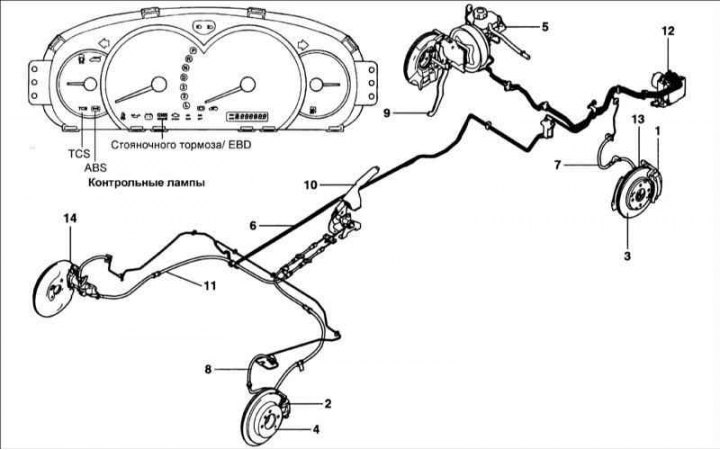
Anti-lock braking system (ABS) (Hyundai Elantra XD)

0

Anti-lock braking system


1 – front brake; 2 – rear brake; 3 – front brake disc; 4 – rear brake disc; 5 –…

1 – front brake; 2 – rear brake; 3 – front brake disc; 4 – rear brake disc; 5 – brake booster and master cylinder; 6 – brake pipe; 7 – front brake pipe; 8 – rear brake pipe; 9 – brake pedal; 10 – parking brake lever; 11 – Parking brake cable; 12 – ABS control unit (HECU); 13 – Front wheel speed sensor; 14 – rear wheel speed sensor


The anti-lock braking system (ABS) controls the pressure in the hydraulic brake drive of each wheel individually and reduces the fluid pressure in the wheel brake mechanism whose wheel begins to lock.

ABS performs the following functions:
  • Improved vehicle control stability when avoiding obstacles even during braking.
  • Reducing the braking distance during heavy braking while maintaining vehicle stability and control even when cornering.

The anti-lock braking system operates based on information from four sensors transmitted to the ABS unit. The system controls each wheel separately and reduces the fluid pressure in the wheel brake mechanism whose wheel begins to lock.

The material is reprinted from another resource [HyundaiBook.ru]

Under normal conditions, the standard brake system applies the brakes until the wheel locks up, which is detected by the ABS control unit. When the ABS control unit detects a wheel lock up, it controls each valve to increase or decrease the pressure.


The ABS control unit determines the rotation speed and deceleration rate of each wheel based on information from the wheel speed sensors. When braking, the wheel speed decreases and the ABS unit detects the difference between the vehicle speed and the wheel speed. If the deceleration of some wheels exceeds the expected value, the ABS unit detects the onset of locking and opens the corresponding solenoid valves to reduce the brake fluid pressure. At the same time, the wheel rotation speed increases and the electromagnetic pressure relief valve closes, increasing the brake fluid pressure in the working brake cylinder of the corresponding wheel.

EBD (Electronic brake force distribution)


EBD is additionally used instead of the pressure regulator to ideally distribute pressure to the front and rear brakes to prevent the rear wheels from locking under heavy braking.
This article is available at russian, bulgarian, belarusian, ukrainian, serbian, croatian, romanian, polish, slovak, hungarian
This article has been reviewed by: Konstantin Smirnov
Add to social network:

Previous
Elantra 3: Brake system
Next

Parking brake — removal and installation
Brake pipes and hoses
Pressure regulator
Replacing the working brake cylinder
Rear drum brakes
Hydraulic unit HECU
Wheel speed sensor
Bleeding the hydraulic brake system using a scanner
Troubleshooting the brake system
We recommend other articles on the topic of Hyundai manuals:

Anti-lock braking system (ABS) Hyundai Accent 1 (1994-1999)
Anti-lock braking system (ABS) controls Hyundai Getz (2002-2011)
Anti-lock braking system — general information Hyundai Sonata 3 (1993-1998)
Anti-lock braking system Hyundai Santa Fe 2 (2007-2012, petrol)
Anti-lock braking system (ABS) — device Hyundai Tucson 1 (2005-2010)
Anti-lock braking system Hyundai Matrix (2001-2010, petrol)

Link in different formats to this article

Visitor comments
No comments yet


How much will 25 + 50 ?


Elantra 3 (2000-2006) 
  • User manual
  • Control devices
  • Audio system
  • Starting the engine and driving
  • Faults en route
  • Maintenance and care
  • Technical information
  • Power unit
  • Gasoline engines
  • Diesel engines
  • Lubrication system
  • Cooling system
  • Fuel system (gasoline)
  • Fuel system (diesel)
  • Decreased toxicity
  • Ignition system
  • Transmission
  • Clutch
  • Mechanical gearbox
  • Automatic gearbox
  • Drive shafts and axles
  • Chassis
  • Car suspension
  • Steering
  • Brake system
  • Body
  • Exterior (external elements)
  • Interior (internal elements)
  • Air conditioning system
  • Electrical equipment
  • Equipment and devices
  • Headlights and lighting
  • Power devices
  • Electrical circuits
Elantra 2 (1995-2000, petrol) 
  • General information
  • Maintenance
  • Power unit
  • Engine repair
  • Cooling system
  • Intake and exhaust system
  • Fuel system
  • Transmission
  • Clutch
  • Manual gearbox
  • Automatic gearbox
  • Drive shafts and axles
  • Chassis
  • Front suspension
  • Rear suspension
  • Steering
  • Brake system
  • Body
  • Body elements
  • Electrical equipment
  • Equipment and devices
  • Electrical diagrams
Elantra 1 (1990-1995, petrol) 
  • General information
  • Introduction to the guide
  • Maintenance
  • Power unit
  • Minor engine repair
  • Engine overhaul
  • Lubrication system
  • Cooling system
  • Fuel injection system
  • Ignition system
  • Exhaust system
  • Transmission
  • Clutch
  • Manual gearbox
  • Automatic gearbox
  • Drive shafts
  • Chassis
  • Front suspension
  • Rear suspension
  • Steering
  • Wheels and tires
  • Troubleshooting
  • Brake system
  • Body
  • Body elements
  • Electrical equipment
  • Equipment and devices
  • Power devices
  • Heating and air conditioning
  • Electrical circuits
HyundaiBook.ru © 2018-2026 · Mobile version · Sitemap: EN BG BY UA RS HR RO PL SK HU · Administration · Site search · Hyundai owners Accent 1 · Accent 2 · Accent 3 · Elantra 1 · Elantra 2 · Elantra 3 · Getz · Sonata 3 · Sonata 4 · Santa Fe 2 · Tucson 1 · Tucson 2 · Matrix ·
This site uses cookies to optimize its functionality. By continuing, you agree to our terms.