
HyundaiBook.ru
Repair Chevrolet Repair Honda Repair Toyota Repair Land Rover Repair VAZ Repair Renault Repair Nissan
English Русский
Български
Беларускі
Український
Српски
Hrvatski
Română
Polski
Slovenský
Magyar
ArticlesSitemapContacts  


  Accent   Elantra   Getz   Grandeur   Sonata   Santa Fe   Tucson   Others
Elantra 1 (1990-1995, petrol) Elantra 2 (1995-2000, petrol) Elantra 3 (2000-2006)
  • Main
  • Elantra
  • J2 (1995-2000)
  • Chassis
  • Steering
  • Power steering system

Power steering system (Hyundai Elantra J2)

0
Contents: Removal ⇓ Checking and adjusting ⇓
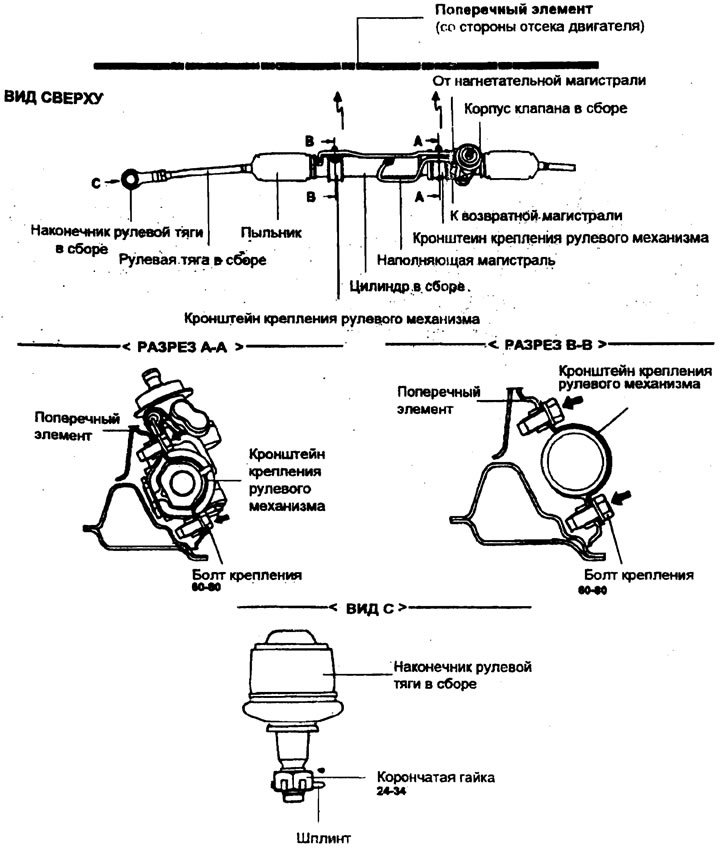
Tightening torque, Nm

Tightening torque, Nm


Removal


1. Remove the intake manifold assembly.

2. Disconnect the clamps securing the power steering pressure and drain hoses.
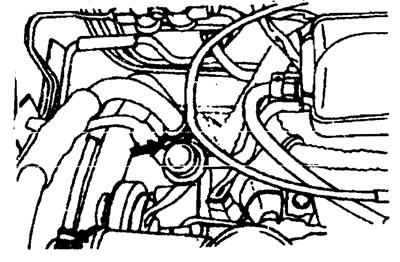
2. Disconnect the clamps securing the…


3. Drain the power steering fluid.

4. Disconnect the power steering pressure and drain line fittings from the steering gear.

5. Disconnect the steering shaft assembly from the steering gear on the passenger side.

6. Remove the clamp, pull out the boot and remove the boot mounting plate.

7. Raise the car on the lift.

8. Remove the front wheels.

9. After removing the cotter pin, disconnect the steering rod from the steering knuckle using a special tool.

10. Remove the stabilizer mounting bracket on the right side.


11. Remove the front muffler assembly.

12. Remove the steering gear mounting brackets and the bracket that supports both (pressure and drain) pipeline.

13. Remove the steering gear assembly towards the right side of the vehicle.

Checking and adjusting


Place the crankcase in a vice with soft jaws.
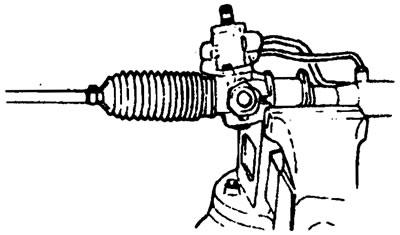
Place the crankcase in a vice with soft…


Gear preload


1. To measure the preload, rotate the drive gear at a speed of 1 revolution per 4-6 seconds. Compare the obtained value with the standard value.
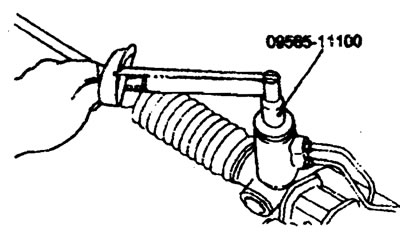
1. To measure the preload, rotate the…


Total gear preload (standard value) — 0.6-1.3 Nm

Note: Preload is measured over the entire stroke length of the rack.


2. If the measured value is not within the standard value, first adjust the bearing plug, then recheck the overall gear preload.

3. If the adjustment fails to achieve the required overall gear preload, check or replace the bearing plug components.


Steering tie rod resistance


1. Rock the steering rod hard 10 times.

2. Using a spring scale, measure the steering rod swing resistance.
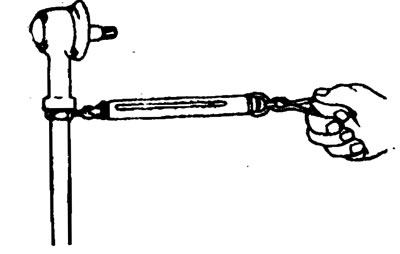
2. Using a spring scale, measure the…


Steering tie rod resistance (standard value) — 8-22 N (2-5 Nm)

3. If the measured value exceeds the upper standard value, replace the steering rod assembly.

Note: If the steering rod swings smoothly and without excessive play, it can be used even if the measured value is below the lower standard value. If the obtained value is less than 4.3 N, replace the steering rod.


[This publication is based on information from the portal HYUNDAIBOOK.RU]
This article is available at russian, bulgarian, belarusian, ukrainian, serbian, croatian, romanian, polish, slovak, hungarian
This article has been reviewed by: Konstantin Smirnov
Add to social network:

Previous
Elantra 2: Steering
Next

Folding type (with airbag)
Folding type (without airbag)
Steering column and shaft (non-folding type)
Checking the Power Steering Belt Tension
Air bleeding
Steering gear housing
Power steering oil pump
Power steering hoses and lines
Inflatable airbag
We recommend other articles on the topic of Hyundai manuals:

Bleeding the hydraulic power steering system Hyundai Accent 2 (1999-2005)
Bleeding the hydraulic power steering system Hyundai Getz (2002-2011)
Bleeding the power steering system Hyundai Sonata 4 (2001-2012, petrol)
Power Steering Hydraulic Hoses Hyundai Santa Fe 2 (2007-2012, petrol)
Bleeding the power steering system Hyundai Tucson 1 (2005-2010)
Power steering system Hyundai Matrix (2001-2010, petrol)

Link in different formats to this article

Visitor comments
No comments yet


How much will 20 + 30 ?


Elantra 3 (2000-2006) 
  • User manual
  • Control devices
  • Audio system
  • Starting the engine and driving
  • Faults en route
  • Maintenance and care
  • Technical information
  • Power unit
  • Gasoline engines
  • Diesel engines
  • Lubrication system
  • Cooling system
  • Fuel system (gasoline)
  • Fuel system (diesel)
  • Decreased toxicity
  • Ignition system
  • Transmission
  • Clutch
  • Mechanical gearbox
  • Automatic gearbox
  • Drive shafts and axles
  • Chassis
  • Car suspension
  • Steering
  • Brake system
  • Body
  • Exterior (external elements)
  • Interior (internal elements)
  • Air conditioning system
  • Electrical equipment
  • Equipment and devices
  • Headlights and lighting
  • Power devices
  • Electrical circuits
Elantra 2 (1995-2000, petrol) 
  • General information
  • Maintenance
  • Power unit
  • Engine repair
  • Cooling system
  • Intake and exhaust system
  • Fuel system
  • Transmission
  • Clutch
  • Manual gearbox
  • Automatic gearbox
  • Drive shafts and axles
  • Chassis
  • Front suspension
  • Rear suspension
  • Steering
  • Brake system
  • Body
  • Body elements
  • Electrical equipment
  • Equipment and devices
  • Electrical diagrams
Elantra 1 (1990-1995, petrol) 
  • General information
  • Introduction to the guide
  • Maintenance
  • Power unit
  • Minor engine repair
  • Engine overhaul
  • Lubrication system
  • Cooling system
  • Fuel injection system
  • Ignition system
  • Exhaust system
  • Transmission
  • Clutch
  • Manual gearbox
  • Automatic gearbox
  • Drive shafts
  • Chassis
  • Front suspension
  • Rear suspension
  • Steering
  • Wheels and tires
  • Troubleshooting
  • Brake system
  • Body
  • Body elements
  • Electrical equipment
  • Equipment and devices
  • Power devices
  • Heating and air conditioning
  • Electrical circuits
HyundaiBook.ru © 2018-2026 · Mobile version · Sitemap: EN BG BY UA RS HR RO PL SK HU · Administration · Site search · Hyundai owners Accent 1 · Accent 2 · Accent 3 · Elantra 1 · Elantra 2 · Elantra 3 · Getz · Sonata 3 · Sonata 4 · Santa Fe 2 · Tucson 1 · Tucson 2 · Matrix ·
This site uses cookies to optimize its functionality. By continuing, you agree to our terms.