


Contents: Replacement of working fluid ⇓ Bleeding the Power Steering…⇓ Checking the power steering pump…⇓
Replacement of working fluid
Raise the front wheels of the vehicle and place safety stands under the vehicle.
Disconnect the return hose from the power steering reservoir and close the reservoir nipple with a plug.
Connect an additional hose to the return hose and drain the working fluid into a suitable container.
Disconnect the high tension wires from the ignition coils.
To completely drain the working fluid, crank the engine crankshaft by briefly turning the starter several times while constantly turning the steering wheel left and right until it stops.
Connect the return hose to the tank and secure it with a clamp.
Fill the power steering reservoir with the recommended fluid.
Recommended working fluid: PSF-3.
Filling capacity: 0.75–0.8 l.
Start the engine.
Check for leaks of working fluid from the hose connections, then turn off the engine.
Fill the tank with the recommended fluid to the bottom position of the tank filter.
Bleed the power steering hydraulic system.
Bleeding the Power Steering Hydraulic System
Fill the power steering reservoir with the recommended fluid up to the "MAX" mark.
Raise the front wheels of the car.
Disconnect the high-tension wires from the ignition coils. Crank the engine crankshaft by briefly turning the starter several times while constantly turning the steering wheel left and right until it stops five or six times for 15–20 seconds.
Note: During air removal, it is necessary to constantly add fluid and ensure that its level does not fall below the lower position of the filter.
If air is removed while the engine is running, air will be sucked in and will enter the working fluid. Therefore, remove air from the hydraulic system only when the engine crankshaft is turned by the starter.
Connect the high tension wires to the ignition coils, then start the engine and let it idle.
Turn the steering wheel from lock to lock until the air bubbles in the power steering fluid reservoir disappear.
Note: Do not hold the steering wheel in the extreme position (turned to the stop) for more than 10 seconds.
Make sure that the working fluid is transparent, without cloudiness, and its level in the tank is between the "MAX" and "MIN" marks on the tank wall.
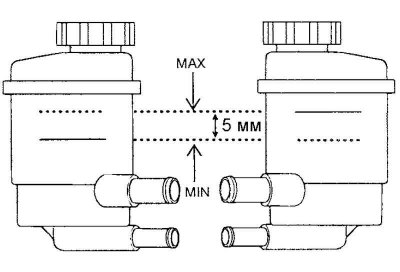
Fig. 5.10. Scheme for checking the change in the fluid level in the power steering reservoir
Make sure that the fluid level in the reservoir changes slightly when turning the steering wheel left and right (Fig. 5.10).
Note. If the fluid level changes by more than 5 mm, it is necessary to bleed the air from the hydraulic system of the power steering again. If the fluid level rises sharply after the engine is stopped, it means that the air from the hydraulic system has not been completely removed. If the air from the hydraulic system of the power steering is not completely removed, extraneous rattling noises occur from the power steering pump and the fluid flow control valve, which leads to a reduction in the service life of the pump and other elements of the hydraulic system.
Checking the power steering pump pressure
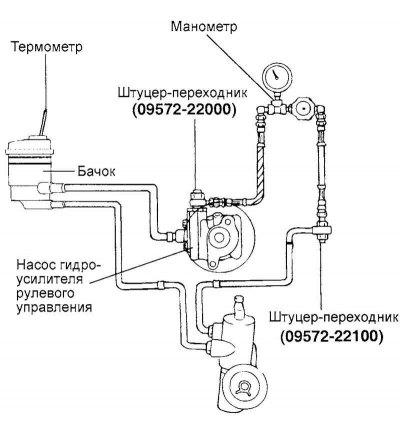
Fig. 5.11. Connection diagram of the pressure gauge for checking the power steering pump pressure
Disconnect the pressure hose from the power steering pump. Connect special tools between the pressure hose and the power steering pump, as shown in Figure 5.11.
Bleed the air from the power steering hydraulic system. Then start the engine and, with the vehicle stationary, turn the steering wheel several times until the fluid temperature rises to approximately 50°C.
Set the engine operating mode to 1000 min⁻¹.
Completely close the shut-off valve on the pressure gauge, measure the power steering pump supply pressure and check whether it corresponds to the nominal value.
Pump feed pressure (nominal value): 7500–8200 kPa.
Caution! The shut-off valve on the measuring pressure gauge should not be left closed for more than 10 s.
Disconnect the special tools, connect the delivery hose and tighten the hose fasteners to the specified tightening torque of 55–65 N·m.
Bleed the power steering hydraulic system.