


Contents: Removal ⇓ Examination ⇓
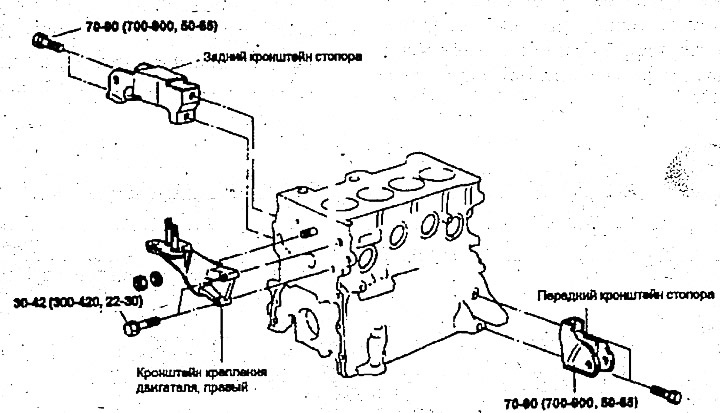
Removal
1. Remove the cylinder head, timing belt, front cover, flywheel, piston and crankshaft.
2. Using a special tool (09260-32000), remove the oil pressure sensor.
Examination
Cylinder block
1. Visually inspect the cylinder block for scratches and rust. Also check for cracks and other defects. Repair or replace the defective block.
2. Using a ruler, check the top surface of the cylinder block for deformation. Make sure the surface is not contaminated with gasket pieces or other foreign materials.
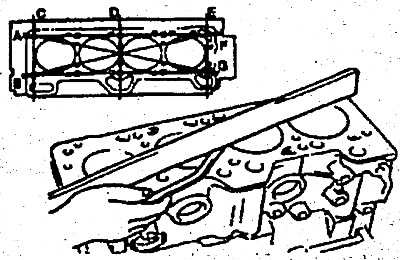
Non-flatness:
- Standard value is 0.05mm or less
- Limit value - 0.1 mm
3. Using a dial indicator, measure the cylinder diameter at three levels in directions A and B. If the cylinders are excessively out of round or taper, and the cylinder walls are severely worn or scored, the cylinder block should be bored and honed, and oversized pistons and piston rings should be installed. The measuring points are shown.
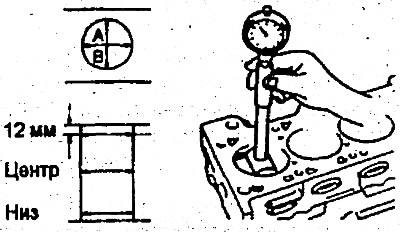
- Inner cylinder diameter - 75.5 mm
- Inner diameter of the cylinder - taper 0.02 mm
4. If the top of the cylinder is worn and has steps, cut them off with a reamer.
5. Oversized pistons are available in four sizes.
Piston size and marking, mm:
- 0.25 O.S. — 0.25
- 0.50 O.S. — 0.50
- 0.75 O.S. — 0.75
- 1.00 O.S. — 1.00
OS - Increased size.
6. When reboring cylinders to a larger size, adopt a certain clearance between the oversized piston and the cylinder, and ensure that all pistons used are the same size. The standard measurement of the piston outside diameter is taken at a distance of 9 mm from the edge of the piston skirt on the pressure-bearing surfaces.
The gap between the piston and the cylinder wall is 0.02-0.04 mm.