
HyundaiBook.ru
Repair Chevrolet Repair Honda Repair Toyota Repair Land Rover Repair VAZ Repair Renault Repair Nissan
English Русский
Български
Беларускі
Український
Српски
Hrvatski
Română
Polski
Slovenský
Magyar
ArticlesSitemapContacts  


  Accent   Elantra   Getz   Grandeur   Sonata   Santa Fe   Tucson   Others
Accent 1 (1994-1999) Accent 2 (1999-2005) Accent 3 (2005-2010)
  • Main
  • Accent
  • MC (2005-2010)
  • Chassis
  • Wheels and tires
  • Checking and adjusting wheel alignment angles

Checking and adjusting wheel alignment angles (Hyundai Accent MC)

0
Contents: Preliminary work ⇓ Checking the longitudinal tilt of…⇓ Checking and adjusting the camber ⇓ Checking and adjusting the alignment ⇓

Preliminary work


1. Balance the wheels and check the air pressure in the tires.

2. Check the wheel bearing runout.

3. Check the tightness of the ball joint and steering knuckle fasteners.

4. Completely unload the trunk and disembark all passengers.

5. Rock the front of the car several times to check the operation of the shock absorbers.

Note: Checking and adjustment must be performed strictly in the following sequence: longitudinal tilt of the steering axis → camber → toe-in.


Checking the longitudinal tilt of the pivot axis


6. Measure the longitudinal tilt of the steering axis using special equipment. Nominal value: 4°00' ±30' (to the road surface); 4°30' (to the body). If the measured value is different from the specified range, check the front suspension parts and replace the damaged element if necessary.
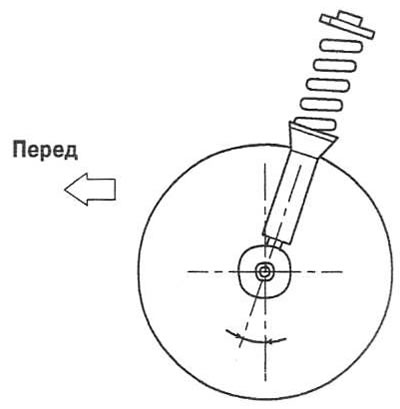
6. Measure the longitudinal tilt of the…


Note: the value of the longitudinal tilt of the steering axis is determined by the design of the car and is not subject to adjustment. Violation of this angle indicates a malfunction of the suspension or body elements.


Checking and adjusting the camber


Please note: The front suspension is designed in such a way that no camber adjustment is required.


7. Measure the wheel camber angle (A) using special equipment. Standard value: 0° ±30' (front wheel); -1±30' (rear wheel).
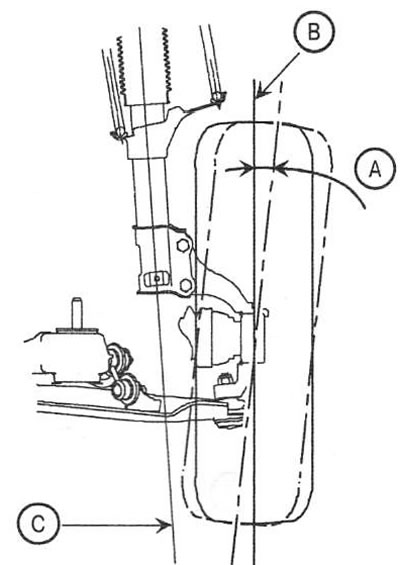
A. Positive camber
A. Positive camber
B. Vertical line
C. Center line of the rack


Checking and adjusting the alignment


8. Using a ruler, measure the full toe-in of the front wheels (B-A). Nominal value: -2-2 mm (front axle); 2-6 mm (rear axle). If the measured value is outside the specified value range, adjust the wheel alignment.
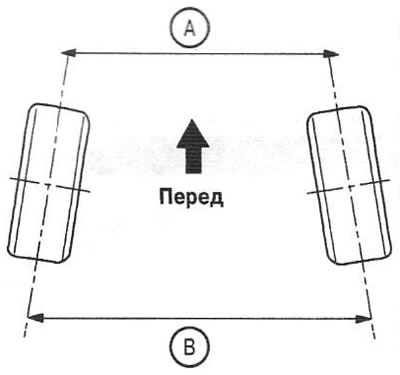
8. Using a ruler, measure the full…


9. Set the front wheels straight ahead and lock the steering wheel.

10. Loosen the lock nut (A) of the end and the clamp of the steering rod boot. Turn the steering rod to adjust the wheel toe-in.
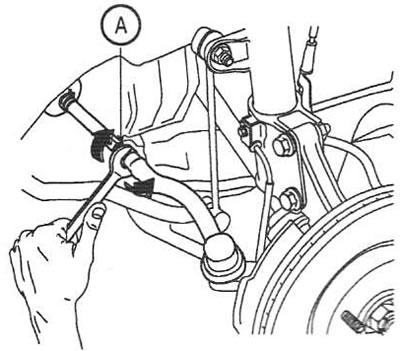


10. Loosen the lock nut (A) of the end…


11. After completing the adjustment, tighten the boot clamp and tighten the lock nut. Tightening torque: 50-55 Nm.
This article is available at russian, bulgarian, belarusian, ukrainian, serbian, croatian, romanian, polish, slovak, hungarian
This article has been reviewed by: Konstantin Smirnov
Add to social network:

Previous
Accent 3: Wheels and tires
Next

Checking the axial and radial runout of wheels
Removal and installation a wheel
Main faults and their causes
We recommend other articles on the topic of Hyundai manuals:

Rear Wheel Alignment — Checking and Adjusting Hyundai Elantra 1 (1990-1995, petrol)
Front wheel alignment angles Hyundai Getz (2002-2011)
Checking and adjusting the front wheel alignment angles Hyundai Sonata 4 (2001-2012, petrol)
Checking the steering wheel play Hyundai Santa Fe 2 (2007-2012, petrol)
Checking the wheel turning angles Hyundai Tucson 1 (2005-2010)
Checking and adjusting the valve drive clearance Hyundai Matrix (2001-2010, petrol)

Link in different formats to this article

Visitor comments
No comments yet


How much will 20 + 20 ?


Accent 3 (2005-2010) 
  • General information
  • User manual
  • Maintenance
  • Power unit
  • Engine repair
  • Cooling and lubrication system
  • Power and exhaust system
  • Engine electrical equipment
  • Engine management
  • Transmission
  • Clutch
  • Mechanical gearbox
  • Automatic gearbox
  • Chassis
  • Front suspension
  • Rear suspension
  • Wheels and tires
  • Steering
  • Brake system
  • Body
  • Exterior (external elements)
  • Interior (internal elements)
  • Heating and ventilation
  • Electrical equipment
  • Equipment and devices
  • Electrical circuits
Accent 2 (1999-2005) 
  • User manual
  • Control devices
  • Starting engine and driving
  • Troubleshooting
  • Power unit
  • SOHC engines
  • DOHC engines
  • Lubrication system
  • Cooling system
  • Decreased toxicity
  • Fuel system
  • Ignition system
  • Transmission
  • Clutch
  • Mechanical gearbox
  • Automatic gearbox
  • Axles and drive shafts
  • Chassis
  • Car suspension
  • Steering
  • Brake system
  • Body
  • Exterior (external elements)
  • Interior (internal elements)
  • Air conditioning system
  • Electrical equipment
  • Equipment and devices
  • Power devices
Accent 1 (1994-1999) 
  • General information
  • Maintenance
  • Power unit
  • SOHC engines
  • DOHC engines
  • Cooling system
  • Intake and exhaust systems
  • Fuel supply (1.3 l, injection)
  • Fuel supply (1.5 l, injection)
  • Fuel supply (carburetor)
  • Transmission
  • Clutch
  • Manual gearbox
  • Automatic gearbox
  • Drive shafts
  • Chassis
  • Car suspension
  • Steering
  • Brake system
  • Body
  • Body elements
  • Electrical equipment
  • Equipment and devices
  • Electrical circuits
HyundaiBook.ru © 2018-2026 · Mobile version · Sitemap: EN BG BY UA RS HR RO PL SK HU · Administration · Site search · Hyundai owners Accent 1 · Accent 2 · Accent 3 · Elantra 1 · Elantra 2 · Elantra 3 · Getz · Sonata 3 · Sonata 4 · Santa Fe 2 · Tucson 1 · Tucson 2 · Matrix ·
This site uses cookies to optimize its functionality. By continuing, you agree to our terms.