


Convergence:
- models before 2001:
- α+β: 0°0'0"±17'11"
- B-A: 0±3 mm
- models since 2001:
- α+β: 0°0'0"±10'48"
- B-A: 0±2 mm
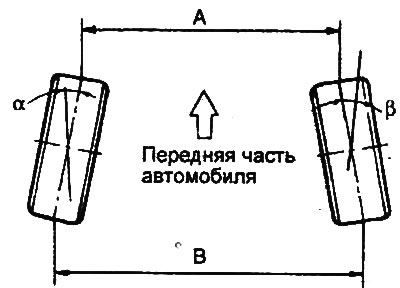
If the toe-in is not within specifications, adjust the toe-in.
2. Adjust the front wheel alignment.
- a) Loosen the clamps of the steering rod boots.
- b) Loosen the tie rod end locknuts.
- c) Adjust the toe-in by turning the left and right rods the same amount.
Note: when the steering rods are turned by 1 revolution, the toe-in changes by 9.6 mm.
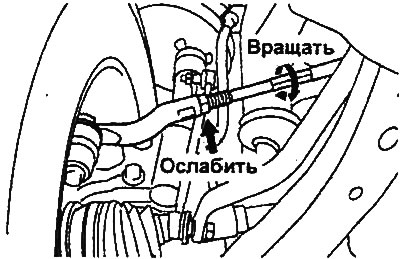
- d) Tighten the tie rod end locknuts.
- Tightening torque: 50-55 Nm
- d) Tighten the clamps of the steering rod boots.
Note: Make sure the covers are not twisted.
3. Place the vehicle on a rig and check the camber, longitudinal and lateral tilt angles of the front wheel steering axis.
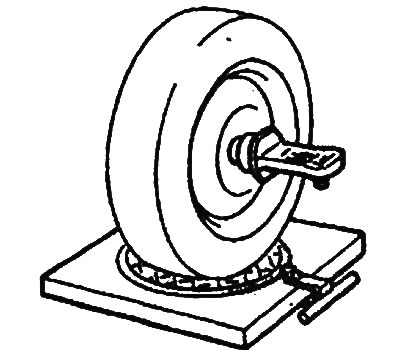
The material is reprinted from another resource HyundaiBook.ru
- Camber angle:
- on models with standard suspension: 0°0'±30'
- on models with off-road suspension: 0°8'±30'
- difference in values for left and right wheels: no more than 30'
- Angle of longitudinal tilt of the pivot axis: 3°15'±1°
- difference in values for left and right wheels: no more than 30'
- Angle of transverse tilt of the pivot axis: 8°29'
The camber, caster and lateral tilt angles of the front wheel pivot axis cannot be adjusted. If the obtained values do not correspond to the technical data, replace the deformed and damaged suspension parts.
Checking and adjusting wheel angles
Turn the steering wheel fully and measure the turning angles.
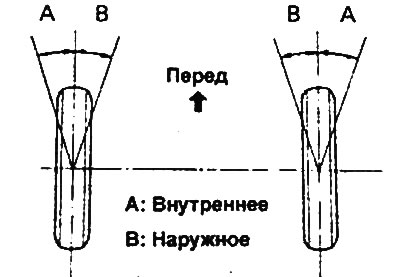
Rotation angles:
- inner wheel: 40.7°±2°
- outer wheel: 32.4°
If the wheel turning angles differ from the standard ones, then adjust it by changing the length of the steering rods.