


Convergence
Toe-in is defined as the difference in distances (B-A) between the front and rear sides of the wheel rims and is adjusted by rotating the steering rods. Positive toe-in means that the wheels are closer together at the front than at the rear, measured at the height of the midpoint of the wheel. The toe-in angle of the left front wheel can be reduced by rotating the steering rod towards the front of the car. Toe-in of both front wheels is adjusted by rotating both steering rods by an equal amount.
Toe-in (B-A): 0±2 mm
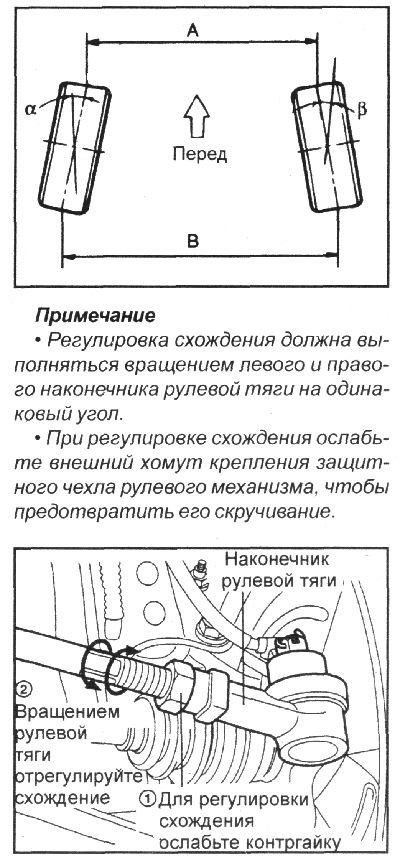
After adjustment, tighten the tie rod end locknuts and steering gear boot clamps.
Adjust the toe-in of each wheel within ±1.5 mm.
Tightening torque of the tie rod end lock nut: 50–55 N·m
Collapse
Camber is the angle of the wheel in relation to the road surface in the vertical plane. Camber is set at the factory by installing the steering knuckle at a certain angle and is not subject to adjustment during operation.
Camber: 0° ±30'
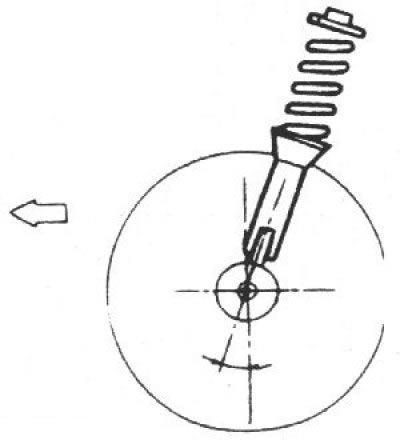
Angle of longitudinal inclination of kingpin
The caster angle of the kingpin is set during the manufacturing of the vehicle and cannot be adjusted. If the caster angle of the kingpin does not correspond to the required values, replace bent or damaged parts.
Angle of longitudinal inclination of kingpin:
- vehicles with power steering: 1°54' ±30'
- vehicles without power steering: 2°24' ±30'
Note.
- 1.Before checking and adjusting wheel alignment angles, the front suspension must be free of worn, loose or damaged parts.
- 2. Wheel alignment must be performed using special computer equipment.
- 3. The camber and caster angles are set during vehicle manufacture and cannot be adjusted.
- 4. If the camber and caster angle of the kingpin do not correspond to the required values, replace the bent or damaged parts.
- 5. The difference in camber angle and kingpin caster between the left and right wheels should be within 0° ±30'.