
HyundaiBook.ru
Repair Chevrolet Repair Honda Repair Toyota Repair Land Rover Repair VAZ Repair Renault Repair Nissan
English Русский
Български
Беларускі
Український
Српски
Hrvatski
Română
Polski
Slovenský
Magyar
ArticlesSitemapContacts  


  Accent   Elantra   Getz   Grandeur   Sonata   Santa Fe   Tucson   Others
Tucson 1 (2005-2010) Tucson 2 (2009-2015)
  • Main
  • Tucson
  • JM (2005-2010)
  • Power unit
  • Engine cooling system
  • Replacing the coolant

Replacing the coolant (Hyundai Tucson JM)

0
Replacing the coolant

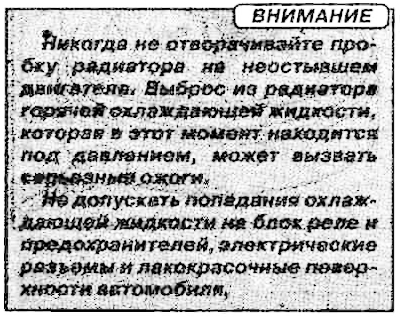
1. Set the heater temperature control lever to the highest temperature. Touch it to make sure the engine and radiator are cool.

2. Remove the radiator cap.

3. Unscrew the drain plug (A) and drain the coolant from the system.
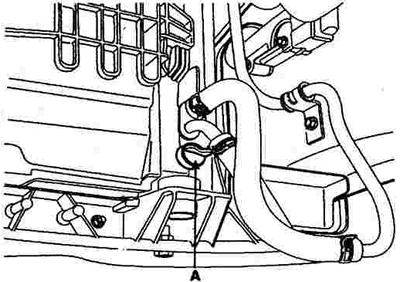
3. Unscrew the drain plug (A) and drain the coolant from the system.


4. Securely tighten the cooling system drain plug (A).

5. Remove the expansion tank of the cooling system. Drain the coolant from it and reinstall the tank.

6. Fill the tank halfway with water, then add antifreeze. The ratio of antifreeze to water is approximately 4:6.

7. Carefully pour coolant through the radiator cap. Wiggle the upper and lower radiator hoses to help remove air pockets.

Note:
  • Use only ethylene glycol based coolants.
  • For optimum protection against corrosion processes, the concentration of antifreeze in the coolant should be at least 50% throughout the year. A lower concentration of antifreeze is not able to provide protection against corrosion and freezing of the coolant in the winter.
  • Antifreeze concentrations above 60% are also not recommended due to reduced cooling efficiency.
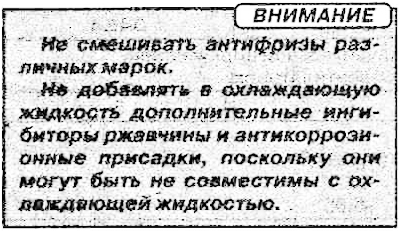

Antifreeze concentrations above 60% are also not recommended due to reduced…

8. Start the engine and let it run for a while to allow the coolant to circulate within the system. When the electric fan of the cooling system starts working, add coolant through the radiator cap.


9. Repeat step 8 3-5 times to completely remove air from the cooling system.

10. Stop the engine and let it cool down. Screw in the radiator cap and fill the expansion tank with coolant up to the "MAX" mark.

11. Start the engine at idle speed. After the electric fan has been turned on two or three times, stop the engine and let it cool down.

12. Repeat steps 6 - 11 until the level in the expansion tank stops decreasing to completely remove air from the cooling system.

Note: Since the engine must be completely cool to completely remove air from the cooling system, recheck the fluid level in the expansion tank after 2-3 days.
This article is available at russian, bulgarian, belarusian, ukrainian, serbian, croatian, romanian, polish, slovak, hungarian
This article has been reviewed by: Konstantin Smirnov
Add to social network:

Previous
Tucson 1: Engine cooling system
Next

Technical characteristics of the cooling system
Checking the radiator cap
Checking the tightness of the cooling system
Checking the technical condition
Engine cooling system G5BA — device
G5BA Engine Cooling System — Removal
We recommend other articles on the topic of Hyundai manuals:

Replacing the coolant Hyundai Accent 1 (1994-1999)
Checking the level and replacing the engine coolant Hyundai Elantra 3 (2000-2006)
Checking and replacing engine coolant Hyundai Getz (2002-2011)
Replacing the coolant Hyundai Sonata 4 (2001-2012, petrol)
Checking and replacing engine coolant Hyundai Santa Fe 2 (2007-2012, petrol)
Checking and replacing fuses Hyundai Matrix (2001-2010, petrol)

Link in different formats to this article

Visitor comments
No comments yet


How much will 22 + 49 ?


Tucson 2 (2009-2015) 
  • General information
  • Faults en route
  • User manual
  • Maintenance
  • Power unit
  • Gasoline engines
  • Diesel engines
  • Engine cooling system
  • Engine lubrication system
  • Engine power system
  • Control system
  • Intake and exhaust systems
  • Engine electrical equipment
  • Transmission
  • Clutch
  • Mechanical gearbox
  • Automatic gearbox
  • Drive shafts
  • Chassis
  • Suspension and wheels
  • Brake system
  • Steering
  • Body
  • Exterior (external elements)
  • Interior (internal elements)
  • Security systems
  • Air conditioning and heater
  • Electrical equipment
  • Electrical circuits
Tucson 1 (2005-2010) 
  • General information
  • User manual
  • Maintenance
  • Power unit
  • Gasoline engine G6BA
  • Gasoline engine G4GC
  • Diesel engine D4EA
  • Fuel system (gasoline)
  • Fuel system (diesel)
  • Engine lubrication system
  • Engine cooling system
  • Engine electrical equipment
  • Transmission
  • Clutch
  • Car gearbox
  • Drive shafts and cardan
  • Chassis
  • Car suspension
  • Steering
  • Brake system
  • Body
  • Exterior (external elements)
  • Interior (internal elements)
  • Air conditioning and heater
  • Airbags
  • Electrical equipment
  • Equipment and devices
  • Electrical circuits
HyundaiBook.ru © 2018-2026 · Mobile version · Sitemap: EN BG BY UA RS HR RO PL SK HU · Administration · Site search · Hyundai owners Accent 1 · Accent 2 · Accent 3 · Elantra 1 · Elantra 2 · Elantra 3 · Getz · Sonata 3 · Sonata 4 · Santa Fe 2 · Tucson 1 · Tucson 2 · Matrix ·
This site uses cookies to optimize its functionality. By continuing, you agree to our terms.