


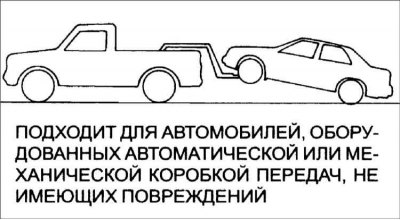
Towing a vehicle with the drive wheels raised off the ground
As a general rule, vehicles should be towed with the drive wheels off the ground. If, due to significant damage to the vehicle or other circumstances, the vehicle cannot be towed with the drive wheels off the ground, use a dolly.
Towing a car with a manual transmission
If you are towing your vehicle with the front wheels raised, make sure the parking brake is released.
If you are towing a vehicle with the rear wheels raised, make sure that the gearbox is in neutral. Also, make sure that the ignition key is in the "ACC" ("Accessories") position. This is necessary to prevent damage to the steering wheel lock mechanism, which is not designed to hold the front wheels in a straight-ahead position while the vehicle is being towed.
In case of damage to any of the loaded wheel or suspension parts, a towing dolly must be used.
Towing a car with an automatic transmission
[The original version is stored on the website: hyundaibook]
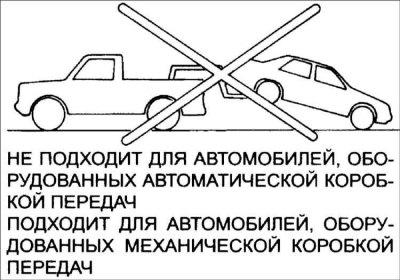
It is prohibited to tow a vehicle with an automatic transmission, rear of the vehicle forward with the rear wheels raised
Warning! Do not tow a vehicle equipped with an automatic transmission backwards with the rear wheels raised. This can seriously damage the transmission. If it is necessary to tow the vehicle backwards, the front wheels must be on a towing dolly.
If you are towing your vehicle with the rear wheels raised, make sure the parking brake is released.
When towing a vehicle with all wheels on the road, it can only be towed forward with the front of the vehicle. Make sure the gearbox is in neutral. The towing speed should not exceed 50 km/h and the towing distance should not exceed 25 km.
Make sure the steering wheel is unlocked, turn the ignition key to the "ACC" position (Accessories). When towing, the driver must be in the vehicle to control it.