
HyundaiBook.ru
Repair Chevrolet Repair Honda Repair Toyota Repair Land Rover Repair VAZ Repair Renault Repair Nissan
English Русский
Български
Беларускі
Український
Српски
Hrvatski
Română
Polski
Slovenský
Magyar
ArticlesSitemapContacts  


  Accent   Elantra   Getz   Grandeur   Sonata   Santa Fe   Tucson   Others
Accent 1 (1994-1999) Accent 2 (1999-2005) Accent 3 (2005-2010)
  • Main
  • Accent
  • LC (1999-2005)
  • User manual
  • Starting engine and driving
  • Jump starting from another car's battery

Jump starting from another car's battery (Hyundai Accent LC)

0
Jump starting can be dangerous if done incorrectly. Therefore, follow the procedure below to avoid personal injury or damage to the vehicle or battery.

Keep all sources of flame or sparks well away from the battery. The battery produces hydrogen gas, which can explode if exposed to flame or spark. Do not attempt to start the engine if the discharged battery is frozen or if the electrolyte level is low, the battery may rupture or explode.

Sequence of starting the engine from the battery of another car:


1. Make sure the booster battery has 12V and that its negative terminal is grounded.

2. Check the electrolyte level in each cell of the battery.

3. If the booster battery is in another vehicle, do not allow the vehicles to touch.

This article is based on information from the website [hyundaibook.ru]

4. Turn off all unnecessary electrical consumers.

5. Connect all cables in the exact sequence shown in Fig. 120. First connect one end of a cable to the positive (+) terminal of the discharged battery, then the other end of the same cable to the positive (+) terminal of the booster battery. Next connect one end of the second cable to the negative (–) terminal of the booster battery, and then the other end to a solid, stationary metal point (such as an engine mount) other than the battery. Do not connect the cable to or near moving parts, as they may be damaged during starting. Do not connect the cable from the negative (–) terminal of the booster battery to the negative (–) terminal of the discharged battery. Do not allow the cables to touch anything except the corresponding battery terminals or a proper ground. Do not lean over the battery when connecting the cables.
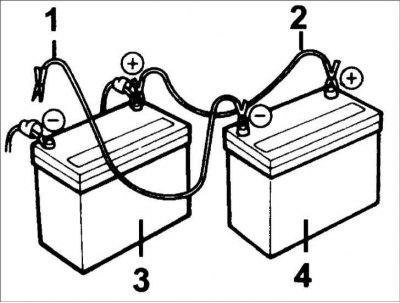


The sequence of connecting cables when starting the engine from the battery of…

The sequence of connecting cables when starting the engine from the battery of another car.


6. Start the car engine with the booster battery and let it run at 2000 rpm⁻¹. Then start the car engine with the discharged battery.

If the cause of your battery discharge is not obvious, such as the headlights being left on accidentally, you should have your vehicle inspected by an authorized Hyundai dealer.
This article is available at russian, bulgarian, belarusian, ukrainian, serbian, croatian, romanian, polish, slovak, hungarian
This article has been reviewed by: Konstantin Smirnov
Add to social network:

Previous
Accent 2: Starting engine and driving
Next

If the engine stalls while driving
If the engine turns normally with the starter, but does not start
The engine does not start
Towing a trailer or car
Driving in winter conditions
If the engine overheats
Towing a car
Emergency towing
Corrosion prevention and periodic maintenance
We recommend other articles on the topic of Hyundai manuals:

Algorithm for troubleshooting the engine starting system… Hyundai Elantra 1 (1990-1995, petrol)
Before starting the engine Hyundai Getz (2002-2011)
Charging the battery Hyundai Sonata 3 (1993-1998)
Before starting the engine Hyundai Santa Fe 2 (2007-2012, petrol)
Battery charging system — general information Hyundai Tucson 1 (2005-2010)
Before starting the engine Hyundai Matrix (2001-2010, petrol)

Link in different formats to this article

Visitor comments
No comments yet


How much will 43 + 26 ?


Accent 3 (2005-2010) 
  • General information
  • User manual
  • Maintenance
  • Power unit
  • Engine repair
  • Cooling and lubrication system
  • Power and exhaust system
  • Engine electrical equipment
  • Engine management
  • Transmission
  • Clutch
  • Mechanical gearbox
  • Automatic gearbox
  • Chassis
  • Front suspension
  • Rear suspension
  • Wheels and tires
  • Steering
  • Brake system
  • Body
  • Exterior (external elements)
  • Interior (internal elements)
  • Heating and ventilation
  • Electrical equipment
  • Equipment and devices
  • Electrical circuits
Accent 2 (1999-2005) 
  • User manual
  • Control devices
  • Starting engine and driving
  • Troubleshooting
  • Power unit
  • SOHC engines
  • DOHC engines
  • Lubrication system
  • Cooling system
  • Decreased toxicity
  • Fuel system
  • Ignition system
  • Transmission
  • Clutch
  • Mechanical gearbox
  • Automatic gearbox
  • Axles and drive shafts
  • Chassis
  • Car suspension
  • Steering
  • Brake system
  • Body
  • Exterior (external elements)
  • Interior (internal elements)
  • Air conditioning system
  • Electrical equipment
  • Equipment and devices
  • Power devices
Accent 1 (1994-1999) 
  • General information
  • Maintenance
  • Power unit
  • SOHC engines
  • DOHC engines
  • Cooling system
  • Intake and exhaust systems
  • Fuel supply (1.3 l, injection)
  • Fuel supply (1.5 l, injection)
  • Fuel supply (carburetor)
  • Transmission
  • Clutch
  • Manual gearbox
  • Automatic gearbox
  • Drive shafts
  • Chassis
  • Car suspension
  • Steering
  • Brake system
  • Body
  • Body elements
  • Electrical equipment
  • Equipment and devices
  • Electrical circuits
HyundaiBook.ru © 2018-2026 · Mobile version · Sitemap: EN BG BY UA RS HR RO PL SK HU · Administration · Site search · Hyundai owners Accent 1 · Accent 2 · Accent 3 · Elantra 1 · Elantra 2 · Elantra 3 · Getz · Sonata 3 · Sonata 4 · Santa Fe 2 · Tucson 1 · Tucson 2 · Matrix ·
This site uses cookies to optimize its functionality. By continuing, you agree to our terms.